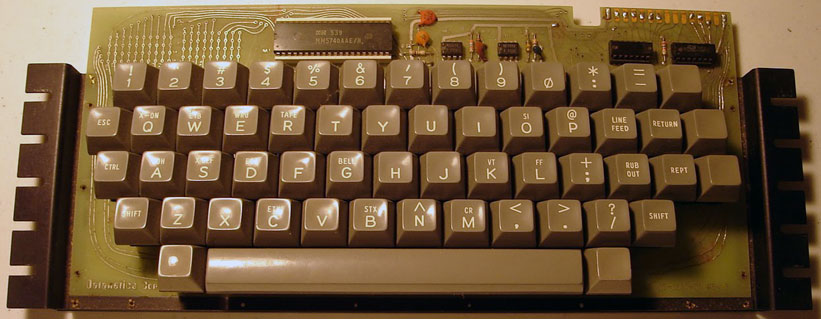
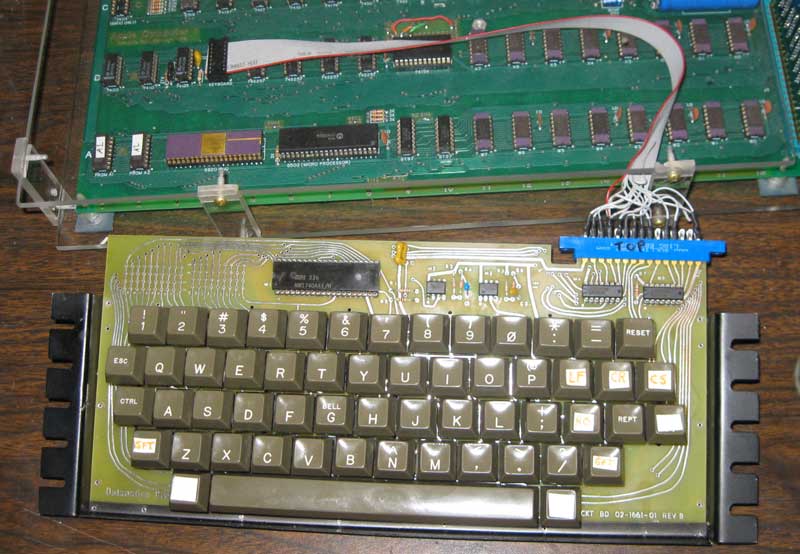
This
is one of the most common keyboards that can be found with an
Apple 1. Here is a link to an original set of directions
about
how to connect this keyboard to an Apple 1.
When I
get a chance I'll clarify and provide more understandable
instructions (check out my blog).
http://www.applefritter.com/node/2809?res=original
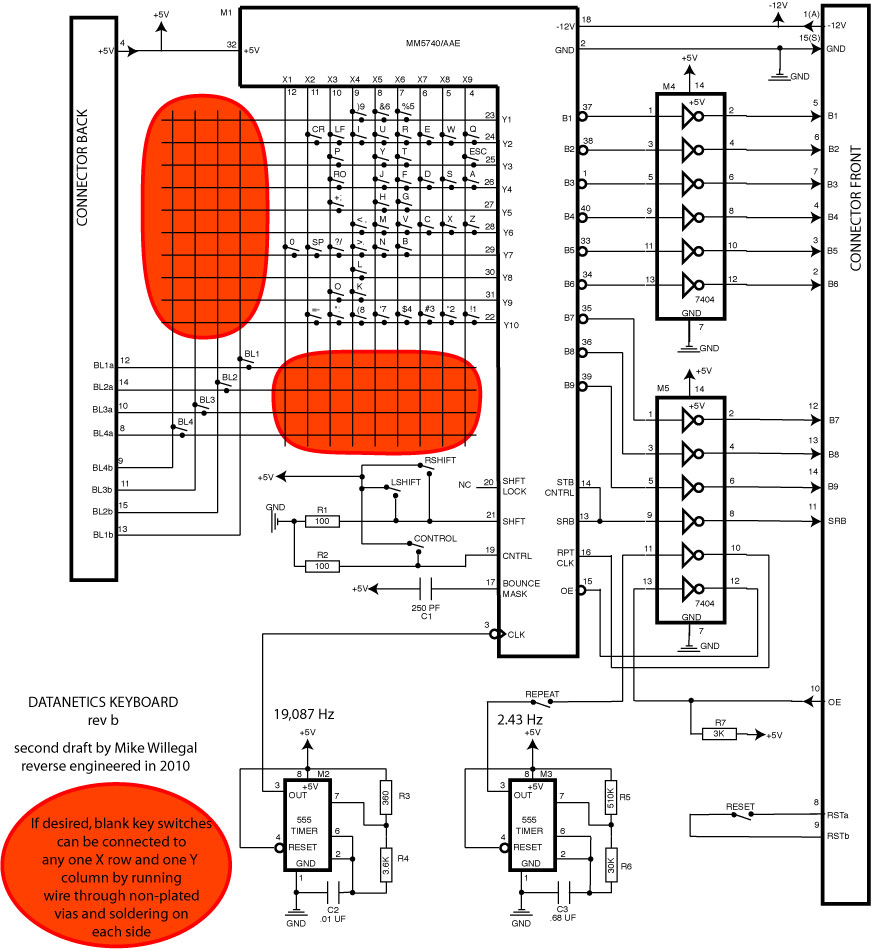
I have built a reproduction. As part of
the reproduction process, I reverse engineered the board and created
a
set of
schematics.
Parts
Datanetics
Inc. made
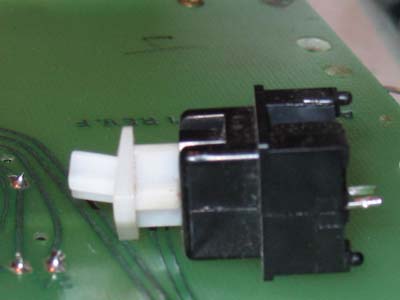
their own patented keyswitches. I've run across two types of
these keyswitches, those with straight stems and those with slanted
stems, as shown below. The Datanetics rev B used switches
with
slanted stems.
As
far as I can tell, sources for original new keyswitches and caps are
non-existant. However, very early Apple II and Apple II plus
computers used keyboards made by Datanetics. Most of the keycap set
used by Apple is close enough to the Datanetics keyboards to be
useful.
Early Apple II plus computers may be considered the only
likely
source for these Datanetics keyswitches and key caps.
The
other difficulty is the keyboard encoder. This part is a
National Semiconductor MM5740/AAE. This part is difficult,
and
sometimes impossible to find. When you do find them, they
frequently come with a mysterious defect that causes randomly
repeating
key strokes. They are also sensitive to static electricity,
so
handle them with care, if you do find one. If you can't find
a
working one, a micro-controller could be programmed to perform the
same
function. It would have to be mounted on a daughter card,
because
the power connections on the MM5740 are in non-standard locations.
The data book and app. notes for this part can be downloaded
from here.
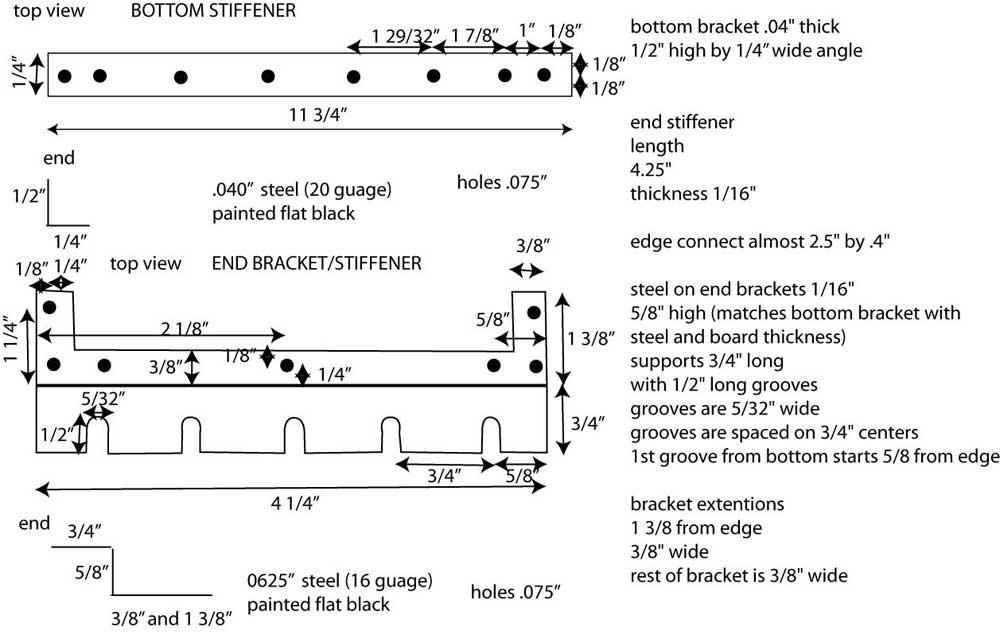
Stiffener Dimentions
Here
is a not to scale rough drawing of the stiffeners used by the
Datanetics keyboard.
Datanetics Rev b
Reproduction
Here
is my reproduction Datanetics rev B connected to the Mimeo.
1 MM5740/AAE (hard to find, but occassionally available from
littlediode.com)
2 555 timers
2 7404 inverters
56 datanetics keyswitches with key caps (most practical
source is to pull from an "early" apple II plus) - be aware
you'll need
a few extra keys beyond what you can pull from a single Apple II
plus
1 datanetics spacebar assembly - spacebar, supports on each
end and support wire (most practical source is to pull from an
"early" apple II plus)
brackets - dimensional drawings above
A couple of things to be aware of before taking on this project.
The matrix vias are plated through and must be drilled out to
eliminate connectivity between top and bottom copper layers
this must be done carefully or you risk delaminating the
copper pads
the holes are drilled undersize, to .026 mils dimension, you
should drill them out to about .036 mils (an 1/32" drill
bit will
do)
use a sharp drill bit, in order to reduce risk of
delaminating pad
I recommend drilling partway through from each side, to
reduce the possibility of delamininating pad
check connectivity after drilling out with an ohm-meter to
ensure that the connectivity is removed.
This reproduction faithfully reproduces a mistake that existed
on
the original Datanetics rev B. Fixing this requires
cutting a
trace in two places and jumpering. My blog has details of
this
issue.
The fit of the plastic studs on the keyswitches to the PCB
holes
may be tight. If you can't get a keyswitch to mount flat
to the
keyboard, you can ream the mounting holes slightly. There
is no
electrical connection in these holes, so removing plating is not
important.
There is no stiffener across the top of the board because
unless
it is insulated, it would short out the traces running across
this area.
Corey Cohen wrote this build manual based on his experience
building a reproduction Datanetics.
Datanetics PCBs are all sold - As they were very slow sellers, I'm not
sure when or if I will make another run.
In case you want to make your own PCBs, design and gerber
files are available for download. The zip file contains Osmond PCB
design file and gerbers. Note that the Datanetics board do not
have a solder mask or silkscreen. The matrix in the upper left
corner must be manually drilled out after you receive your boards.
Be aware that any problems in use of these files are entirely
your problem! Repeat... I am not responsible for any outcome,
problem or issues that you may have.