Archive for the ‘Datanetics PCB’ Category

Say Hi At VCFse in the Atlanta Area

Monday, March 18th, 2013

This year, for the third year in a row, I’ll be leaving the family in the care of our dog, Toby, and be spending a weekend with fellow retro-computer hobbyists. Since this years VCFeast, had to be cancelled, I’ll be treking down to VCF southeast in Atlanta for the weekend of April 20 and 21st. These weekends are always fun, so I highly encourage everyone that might be interested in these things to make the effort to join us.

Here is the link with informaiton for that event.
http://vintage.org/2013/southeast/

Stop by my exhibit. I’ll be operating a Mimeo 1 and a reproduction SCELBI 8H (one of a very few working SCELBIs in the world). I’ll even give you a chance to “drive”. Tell me you read my blog and get a free SCELBI/8008 reference card.

See you there…

Beginning of Year Retro Update

Tuesday, January 1st, 2013

Mimeo’s

Last weekend, I sold the last of the Mimeo PCBs (Glossy and Matte) that I had in stock. I will make some more matte after I’ve sold some of the first batch of the SCELBIs. I’m down to 4 ACI cards, so I’ll have to do a batch in matte to go with the next batch of Mimeos.

The new movie, “jOBS” will premiere at the Sundance Film festival this month. I’m hoping that the Mimeo PCBs that I sold to the prop house supporting the film, get some screen time and the film is good enough to get some decent reviews.

I still have plans to do a full built up system, but that project will have to wait until I have the SCELBI going. I am sorry that this has been teaser for some folks who have been waiting for it. However, I’m hoping that when I finally get to it, that folks will be impressed with the results, and say that the wait was worth it.

The new run of Datanetics PCBs have been trickling out, maybe a little faster than I expected, given the difficulty of finding components. They have mostly been combined with Mimeo PCB sales. I really wonder how many will get built up. This datanetics PCB batch has been done more of a service to the retro community, as it will be a while before this project breaks even financially.

SCELBI

Quotes from Advanced Circuits on SCELBI boards are about half of what I expected, which is awesome. Nashua Circuits came in as expected, so I guess Advanced will get this business, unless Nashua can do much better (I’ll give them a chance to improve their quotes). Since there is no solder mask, it really shouldn’t make much of a difference who makes them.

Design checks on the base 5 board set is done, and I’m about ready to declare victory on the layout tweaking/matching. The 8H backplane is just about ready, so I’ll probably get a batch of those made to go with the base 5 board 8H set, making it a 6 board set. The backplane has been challenging, as there is no schematic, only a wire list intended for wiring your own chassis. Good images of the top of backplane are non-existant. My orders for the PCBs may go in, as early as this week.

I do have one thing to check on the CPU board. There were at least two versions of the CPU board made, I am replicating a later version. There is a report of an issue with the step function reported SCELBI digest, issue II. Though describing a problem in a later version of the CPU board, this report shows a slightly different design than the one in the version of the schematics/layout that I am replicating. I just need to make sure the schematics that I’ve followed are accurate.

At this writing, estimates for the set of 6 PCBs, with an 8008D thrown in, but no other components, is in the range of 300 dollars. Final price might vary a bit, but I doubt that I could make it go any lower, without making this a one off effort, not to be repeated.

A friend of mine, is looking into doing a reproduction bezel for the front panel of the chassis. He tells me that there are some challenges, as the original was anodized, and most panel manufacturers, these days, do powder coating.

Today, I am going to see if I can generate a BOM (bill of materials) in an excell spreadsheet. Except for the 8008 and memory, I think most of the rest of the electronics components are readily available. I plan on sending the BOM to Unicorn, who have indicated, a while back, that they would do parts kits for this project, like they have for the Mimeo/Apple 1. The relay sockets used for I/O ports in the chassis, are available, but expensive – I’m going to see if I can find a way to get bulk price on those from someone.

The 8B will follow on the heals of the 8H, It uses the same front panel, CPU, DBB, and input boards as the 8H, but requires 4 new boards…

  • new backplane with an extra slot for the memory addressing board. I haven’t investigated in detail, but I hope I can leverage most of the 8H backplane design, making this pretty straightforward
  • new 4K memory module. I already have done the base chip placement for this one
  • PROM board. Cameron Cooper has a draft design, that he says he will let me leverage
  • memory address expansion card – haven’t started
  • All in all, you can see that based on the head start that I have on the 8B boards, this shouldn’t take nearly as long as the 8H has taken, to complete.

    After these are done, there is more SCELBI hardware to be done, a TTY interface, a scope interface and a cassette interface. Power supplies are another potential future project. For now you will need to find a 5 volt and -9 volt supplies. Amperage ratings depend upon the amount of memory and peripherals. According to SCELBI documentation, system with a keyboard, oscilloscope interface, and cassette interface requires the following.

  • 4K memory requires 5 volts at 6 AMPs and -9 volts at 3 AMPs
  • 1K memory requires 5 volts at 3 AMPs and -9 volts at 1 AMP
  • I’m also likely to do an automated front panel controller with a micro-controller, to make loading the memory on the 8H easier. I might be able to reuse my existing PS/2 adapter with a new program in order to accomplish this.

    Brain Board

    Brain Board stock is dwindling, but sales have been very slow, as of late. When the stock runs out, I’ll definitely hold off on making a new run, until demand builds up again.

    SUPERPROTO

    So far, interest has been a bit lighter than expected. However I’ve got wind of a couple of super cool SUPERPROTO based projects, that may just jumpstart sales when the projects are publicly announced. Feedback from folks using the card has been positive, with no unexpected problems or issues reported. I also know of one, well known, Apple II hardware designer that is leveraging parts of the design, which I have published in detail on the SUPERPROTO Wiki, for his next efforts. Even though, I get no financial reward from this leveraging, it is gratifying to know that my efforts are of use to others.

    Apple II rev 0

    A rerun of these PCBs is also in the cards, though I want to make a few tweaks, so it will also come after the SCELBI and probably the fully built Mimeo.

    That is all the retro stuff that I can think of, for now – Happy New Year

    New Run of Datanetics Rev B are in Stock and Ready to Ship

    Friday, November 9th, 2012

    Price is $75 for each PCB and includes shipping. No components or hardware is included.

    See my web page for details:

    http://www.willegal.net/appleii/apple1-datanetics.htm

    New Datanetics PCBs Due in 2-3 Weeks!

    Friday, October 26th, 2012

    Despite very limited demand for these keyboard reproductions, I decided to pull the trigger on another batch. I think I am having more than enough made for everyone that has expressed interest, but in any case, let me know, if you are seriously interested in getting one or more.

    This time, I will be only selling blank PCBs, no brackets or anything else, so these are for the advanced hobbyist, only. I may do a brief instruction sheet, if I have time, but most of the info needed to build one up, is already on this blog (check the Datanetics category) or my website. I have to think some more about price, but I expect they will be around $80, including shipping. Even to me, this seems high for a blank PCB. However, keep in mind that these are fairly big boards by modern standards, and I only make a few in a batch.

    Like all my PCBs, they are made to a very high quality standard, right here in the USA.

    Apple 1 and Datanetics Backspace Working

    Friday, September 28th, 2012

    While working on a micro-controller replacement for the MM5740/AAE keyboard decoder used on the Datanetics keyboard, I discovered a way to send the unique Apple 1 backspace keycode (0x5F). You need to connect line X4 of the matrix to one lead of a blank keyswitch and Y3 to the other lead of the same keyswitch. Then by holding down shift and pressing that blank key, you can generate the 0x5F needed to backspace the Apple 1 monitor.

    Note that you could also rewire the left arrow key of a MM5740 based Apple II keyboard to accomplish the same thing. Unfortunately there is no easy way to avoid the requirement of pressing the shift key to generate the correct code.

    MM5740 to AVR pinout mapping

    Wednesday, April 4th, 2012

    In the PDF at the end of this post, I have captured some notes associated with an abandoned project to use an ATMEL AVR – ATMEGA16 in place of a National MM5740 keyboard decoder. Both parts come in 40 pin DIP packages, which makes the AVR substitution idea work pretty well.

    avr encoder

    avr encoder


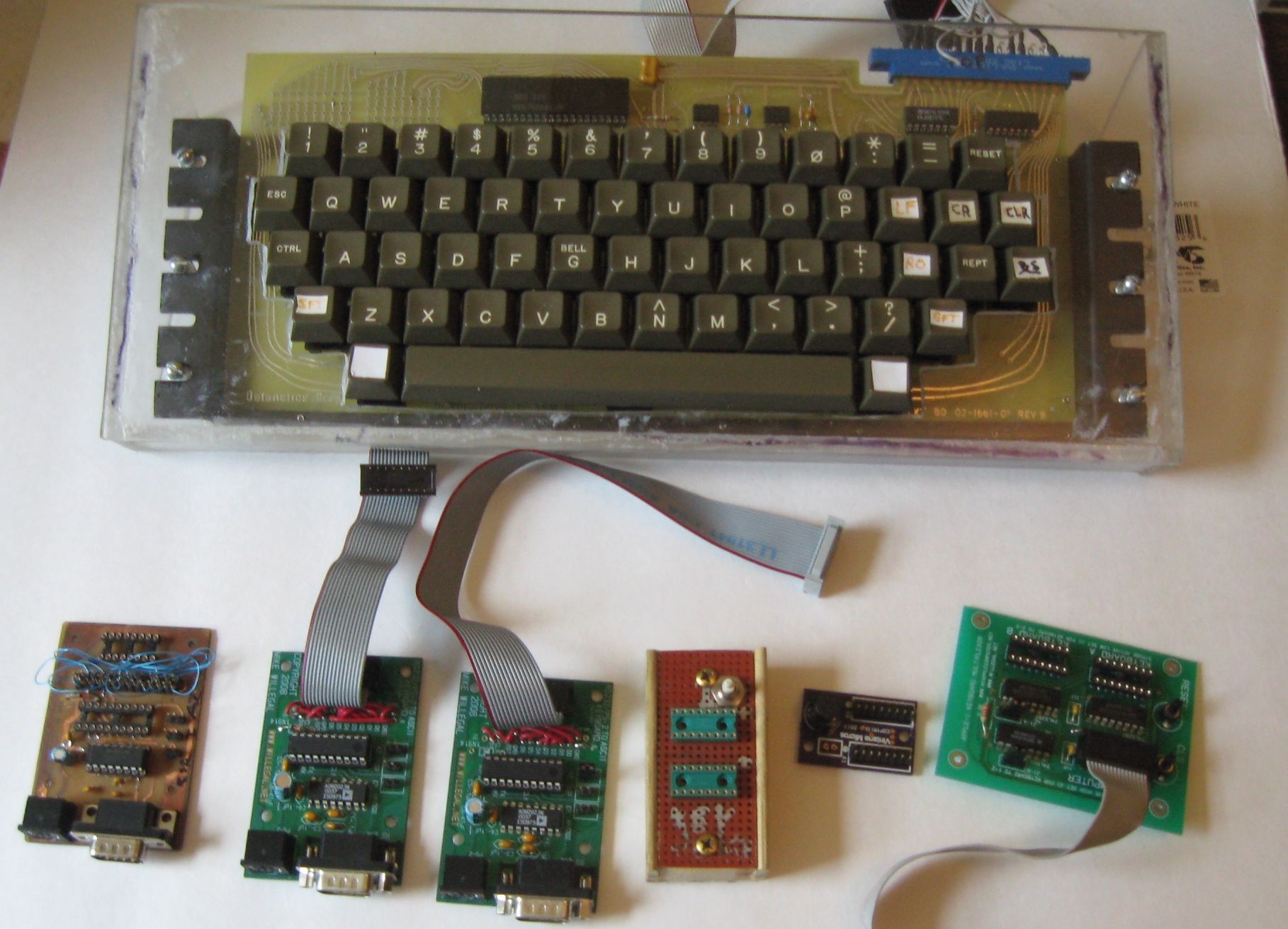
    The initial idea was to check to see if the AVR could be used as a plug in replacement, with some socket stacking and rewiring. I was also considering building a Datantetics Apple 1 and Apple 2 compatible keyboard using Cherry key switches and an AVR as the encoder. The reason why I stopped this project is that costs would probably have forced a selling price of close to $200. These notes are associated only with mapping the pinouts. I had assumed that if I could make a reasonable mapping that the software would be pretty straight forward.

    It turns out that there are just enough pins to do the job without any loss in functionality. The strobe control, Output enable (OE) and shift lock functions are not used on Apple II/IIplus or earlier Datantetics keyboards. The Bounce Mask function can be accomplished in the AVR’s software. The clock of the AVR can be generated by either the internal RC oscillator or an external crystal input.

    The PDF follows:
    MM5740-to-AVR-mapping

    Datanetics Keyboard PCB Rerun Possible

    Friday, March 9th, 2012

    If 6 people make firm commitments to buying a Datanetics keyboard PCB, I would be willing to make a rerun. Cost would the be the same as before – $79, but would not include brackets or anything other than the PCB. Drop me an email if you are interested.

    Reproduction Datanetics Keyboard

    Reproduction Datanetics Keyboard

    Complete Information on MM5740 Keyboard Decoder Found!

    Tuesday, February 14th, 2012

    I’ve done several online searches for a complete MM5740 data sheet over the last several years. There is a version that can be found on many of the data sheet archive search engines, but it is missing at least one page, containing crucial information. I knew it was part of National’s MOS/LSI data book from the mid ’70s, but I couldn’t locate an online version of that book, and I really didn’t want to buy a physical copy. One of the key questions that couldn’t be answered with the existing online data sheet, is what exactly is the difference between the AAC/AAD/AAE/AAF versions.

    Finally while exploring the possibility of using an AVR as a replacement decoder for the MM5740, I did another search and the data book turned up as a PDF at bitsavers.org. The last page of the data sheet show that the AAE version has N-key rollover and the AAF version has 2-key rollover. Otherwise they are the same. This means that the AAF version should be usable in the Apple/Datanetics keyboards, only with the loss of the n-key rollover feature. Also, in this data book are some app notes, that provide information on the AAC and AAD versions. Those versions decode the matrix differently, in order to make using an external PROM decoder simpler. They will not be compatible with Apple/Datanetics keyboards.

    Once I figure out the best way to cut it out of the complete data book, I’ll put a copy of the complete MM5740 data sheet and associated app notes up on one of my web pages. For now, you can try to download the complete National MOS/LSI data book from bitsavers.org. Recently, I’ve have trouble accessing that site, but if you are persistant, you should be able to get through.

    One project complete – Datanetics PCBs sold out

    Thursday, October 20th, 2011

    Finally, I sold the last of the 10 Datanetics PCBs that I had made last year. I don’t expect to make another run of these since the market for them is so tiny. I guess about the only way that that another run would happen, is if someone is willing to buy an entire batch and finances the whole thing.

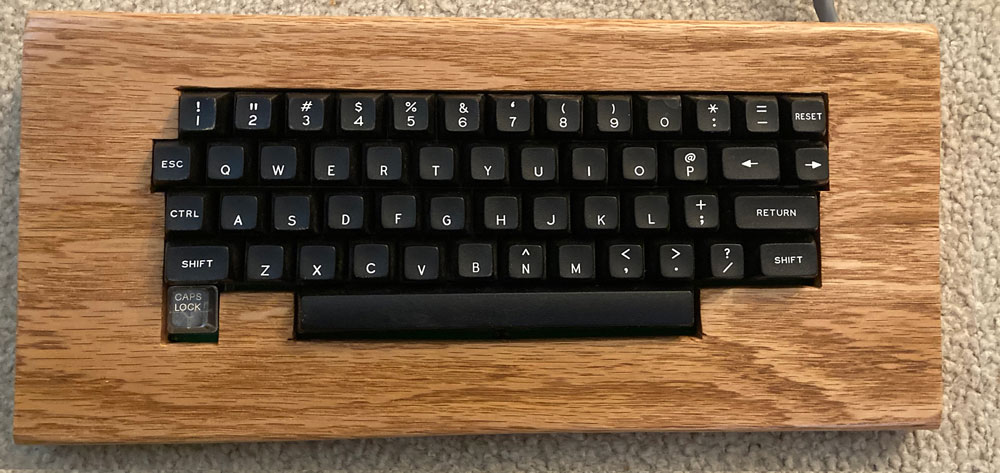
    I am glad I did this project, as now I have a nice matching keyboard for my personal Mimeo 1.

    The one thing that surprised me about this project, is that no owners of original Apple 1s that needed a matching keyboard bought a PCB to build up. Original keyboards appropriate for Apple 1′s are extremely rare and a number of the original Apple 1s don’t have the original keyboards. I’m learning that many people get enjoyment out of owning, admiring and preserving original artifacts, without the risk of operating them. Other people, like myself, get more satisfaction out of operating the old style gear. I think that there is an important place for both types of people in this hobby.

    Though the Datanetics keyboard project was a money loser, I am really glad that John Calande talked me into doing it. He also lent me the original Datanetics keyboard he owns, which greatly facilitated this project. Also thanks to Mike Gregory for fabricating the brackets and stiffeners.

    Only 2 Replica Datanetics PCBs left

    Saturday, July 9th, 2011

    It is highly unlikely that another run of these will be made. Checkout my Datanetics webpage and the Datanetics catagory of this blog for more information.

    Also, on a related note, it appears that littlediode.com has MM5740/AAE keyboard encoders in stock.