A reproduction white 6502 … and comments on reproductions and fakes…

The immediate reason for this post, is that an Apple 1 reproduction now sports a plastic 6502 that has been converted to look like a white ceramic 6502. Details of this conversion can be found on the retro-restore yahoo group. I plan on converting one of my own, as I’m not that excited about the price of real ones. Also be aware that many of the white ceramic 6502s that have recently come to market were pulled from interesting vintage gear, like Kim-1s or arcade games, a practice I have mixed feelings about.

I’ve heard from several people over the years about the risk of reproduction parts and systems being sold as the real thing. As the popularity of the vintage computer hobby and value of the rare vintage systems increases, it is inevitable that new kinds of reproductions will appear.

My position on reproduction components and systems is that they will allow people who couldn’t otherwise afford to operate the real thing to get a better understanding of this vintage technology and have some fun. The closer the reproductions are to the real thing, the more accurate the experience will be and the more we will learn about the original systems and the history of computing. Usage of reproductions instead of originals also saves wear and tear on original systems.

A number people get great enjoyment from making a reproduction that both operates and appears as authentic as possible. This is similar to the enjoyment that skilled craftsman in other hobbies get from their efforts to make life size and scale reproductions of everything from stone tools to railroad empires. We should enjoy our hobby and marvell at the skill some of our friends, who go the extra mile to make their creations as accurate as they can.

One of the favorite things that I have heard during a VCF event, was when one visitor commented that he never thought he would ever get to operate an Apple 1. Of course he was operating a Mimeo, but to that visitor, it didn’t matter that it was a reproduction. So reproductions can give enjoyment not only to hobbyist, but to visitors to our hobby.

The best thing that can be done to defend ourselves from fakes, is to be made aware of the possibilities and educate ourselves as much as possible. This is one reason why I created the Apple 1 Registry. In this respect, I think the registry has been a success, as, since the registy’s creation, I am unaware of anyone trying to pass off a fake Apple 1 as real. However, be aware that some time ago, there was an attempt on eBay to pass off an Obtronix Apple 1 clone as the real thing, so I will not be surprised when it happens again.

A beautiful Apple 1 (and more) up for Auction

This Apple 1 motherboard is in fantastic condition for a 37 year old computer and includes most of the original add ons that you would want, including an original box and documentation. It is listed in my registry as “Framed #4”.

http://www.breker.com/ReadMore/

There are also a few other gems for sale, including a twiggy Macintosh, a Lisa 1, a SOL 20 and an Altair. I have a catalog of the auction scheduled for November 16th and it is filled with many other interesting vintage toys, scientific instraments and more.

I had the pleasure of meeting with the Brecker’s for a couple of hours back in August while they were on a business trip to the United States. It was very interesting to talk to them and I really wish them further success with their technology auctions.

By the way, I need to update the registry. People have continued to fix up their Apple 1s, so I’ve got a more up to date image of one unit that received some serious love over the last few months. I also need to add couple of new Apple 1s. I forgot to add the one in the history San Jose museum during last update and another one came to my attention immediately after the last update. Finally, I figured that units that are discussed in either Tom Owad’s book “Back to the Garage”, or Bob Luther’s “The First Apple”, should have that called out in the registry listing.

SCELBI 8H is now capable of running BASIC!

Thanks to Mark Arnold, who stripped down SCELBAL to the barest fundamental elements, I now have BASIC running on a 4K SCELBI 8H for the first time, ever. Mark, who created SCELBAL back in the mid 70’s calls his new stripped down version of BASIC, “tiny SCELBAL”. He removed all non-essential features, including support for floating point math in order to make it fit into 4K. There are only about 350 bytes for program space left in a 4K SCELBI 8H, but that is enough for some very simple games. I have ported a version of HILO from Ahl’s “BASIC COMPUTER GAMES” book, and made it fit. I’ll be making a video, posting source and object files very soon. I’ll also post the source of HILO and describe some space saving tricks.

Mark says SCELBI considered doing this back in the 70’s, but determined the result would be too limited to be useful for most practical purposes.

Apple 2 Rev 0 and Mimeo PCB update

I’ll be ordering my next batch of Mimeo’s sometime in October and be able to start shipping PCBs sometime in November. Keep an eye on this blog for an announcement in November. This version will fix a couple of minor issues in the silk screen layer, but the copper and mask layers will be identical with the last version.

I’m completely going over the Apple II rev 0 reproduction PCB layout. This was the first reproduction PCB that I did and either my skills or my standards have gone up. I’m tweaking a lot of minor issues, mostly on the front of the board, particularly on the silk screen layer. The average person will not notice any difference, but some Mimeo builders have turned out to not be average people. The first time around, I didn’t have a really good bare board image of the front side, only the poor photocopy of a bare board that can be seen in the “Red Book”. Since that time, a couple of bare board, rev 0 PCBs have turned up, and I have a really good scan of the front of one of them. Anyway, I’m mostly done with the tweaking, and only need to fix a few minor things and do a good bit of design checking. I hope to have boards made and ready to ship by the end of the year. With all the tweaking I’m doing, I’ll have to build one, before shipping, just to make sure I didn’t mess something up.

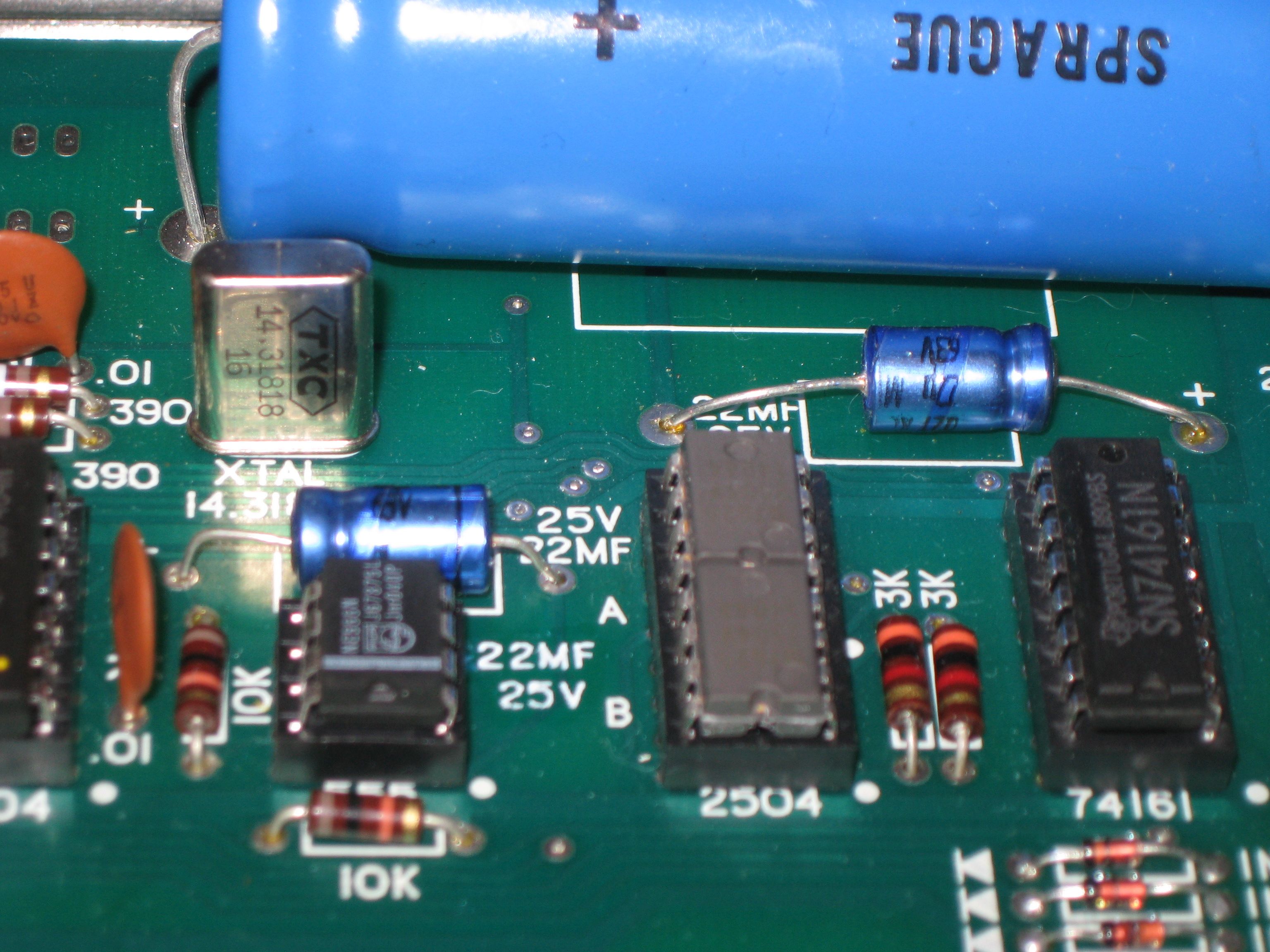
Mimeo Silk Screen Error and Fix

Fixed - extra 22MF 25V legend

Fixed – extra 22MF 25V legend

The lower 25V 22MF legend in this picture was a feature of the non-NTI Apple 1s. The legend is a duplicate of the one slightly higher up in the image and was removed for NTI series production.

The Mimeo is a NON-NTI clone and is missing this duplicate legend. Note that I had been shipping Mimeos several years before anyone brought this to my attention. Future production Mimeos will have this error rectified.

As can be seen in the image above, I have found a fix for the missing legend for existing Mimeo owners. This is water slide decal that I have printed. If you are a Mimeo owner, I’ll ship you several decals (extras in case you make a mistake) for a shipping and handling charge of $10.00. If you are a Mimeo owner and happen to be ordering kits, PCBs or any other stuff, let me know you want them and I’ll add a few copies of the decal into your shipment for free.

To apply the decal follow the this procedure.

  • Make sure this area of your PCB is clean
  • Cut out the decal as close to the printing as you can
  • Apply a drop of decal setting solution (I use testers brand) to the area where you are going apply the decal
  • Put the decal in clean water for about a minute. After that time you should be able to begin to slide the decal off the backing paper
  • Carefully slide the decal off the backing paper into position on the PCB.
  • Add a bit of decal setting solution to top of the decal
  • Let dry for 24 hours
  • If you have a glossy Mimeo, carefully apply a bit to Gloss Cote to protect and seal the decal to the PCB
  • If you have a matte Mimeo, carefully apply a bit of Dull Cote to protect and seal the decal to the PCB
  • Note that the decal can removed with Isopropyl Alcohol
  • SCELBI front panels now available

    I’m now taking orders for custom made reproduction SCELBI 8H front panels.

    Price is $65 plus $10 shipping continental USA or $20 international. I am pricing these more as service to SCELBI PCB kit builders than for profit. When I eventually sell most of the 20 that I have made, there may be a small profit in it for me, but it will not be much. Based on my experience, unless you were already set up for making custom front panels, making a single one for yourself would cost at least two to three hundred dollars.

    A couple of things to be aware of.

  • In my opinion, they look very good, but on close inspection you can tell that they are not perfect examples of what many people expect from modern machine made goods.
  • I will try to ship the best looking examples to first buyers, but even the ones with the most defects look very good.
  • The screen printed legends are rather fragile and can easily be damaged or rubbed off. I recommend you overcoat with some kind of clear satin spray. I have put 3 light coats of Minwax satin spray lacquer on my personal unit and it looks better than without the overcoat. I would do this myself for all units sold, but this sort of process takes a lot of time and care to get it right and it would make any tweaking or customization by the end user more difficult.
  • Send an email to:mike@willegal.net if you need more details on ordering.

    Progress on SCELBI Front Panels

    We are almost there.

    SCELBI Front Panels

    SCELBI Front Panels

    I need to reprint the bottom portion of a few that I printed last week. This weeks session went much better. There are a few minor defects in the printing, so I’m not guaranteeing perfection.

    The printing is pretty fragile. IPA takes it right off, with almost no effort. I’m going to experiment this weekend with spraying a light coat of clear as a protective overcoat before taking orders.

    Regards,
    Mike W.