Apple 1 update #13

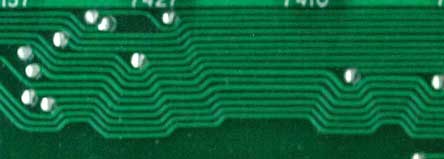
I’m still working on the design reviews – I hopefully will be done by Monday or so. Found an interesting less than obvious feature a couple of days ago. Take a close look at this image.

bigtraces

Do you see something unusual?

If you don’t see it, look again. Two of the traces are just slightly thicker than the others. At first when I was working on this project, I thought the variation was just some random variation. The reality is that those extra wide traces are carrying +12 volts and -!2 volts power around the board and are made intentionally wider than signal traces.

Apple 1 Update

Still gathering parts – and emptying my bank account. Hopefully, by the end of next week I’ll have everything but a few commonly available parts in hand. I’ve also borrowed a cassette interface PCB, which I will need to build up in order to test the expansion port. I have a parts list for the cassette interface and will order those parts along with the last parts for the motherboard.

I keep finding little discrepancies between my PCB layout and the original. One recent example is on the silk screen under the power and video connectors. Based on the Apple II, I assumed that there was a silk screened box around the holes for those connectors. However I found an image of an original board that does not have those connectors installed. Sure enough, there is no silk screened box around those connectors. These sorts of changes are easy to make once the difference is discovered, but determining how the hidden portions of the original board looks, can be difficult, if not impossible. I’d part with a bit of money to get a hold of a good X-ray of an original Apple1.

Close to Declaring Victory on Apple 1 PCB layout

I’m running out of things to fix or improve on the PCB layout. I’m about to round off corners of small traces. I’m doing that last since once I do the rounding off, tweaking trace placement becomes a whole lot more difficult. Also in the plans is complete netlist check to make sure I haven’t botched some connection and run another pass of the CAD programs design checks.

Apple 1 Replica Project Restarted #10

As I have been moving forward on the PCB layout, changes are getting smaller and I need to be more precise in making them. This slows down progress, as I really want to work on the PCB, only when my personal energy and patience are at high levels.

Had good energy early this morning and made progress on some touchy areas in and around the power supply. I finally feel that the back copper layer is starting to look close to where I want it. Changes to the back copper from here on out, are going to be very minor. In fact, on the back copper, I’m thinking of taking a shot at rounding off corners on the small traces, which is one of the last tasks for this layer.

On the front copper, before declaring victory, I want to do some trace spacing tweaks, especially in the busy areas between chip rows A & B and also B & C.

Front silk screen is pretty good, but I will improve character to character spacing in a couple of text strings and also improve the shape of the decoupling capacitor symbol.

My first pass through a PCB vendors DFM check returned a number of issues, I’m working through.

Besides circuit design reviews, I need to do a review of hole sizes – nothing worse than a hole too small to fit the designated component.

Regards,
Mike Willegal

Apple 1 Replica Project Restarted #9

A general update.

By now, I have already acquired or have sources for almost all of the components, though I am still working out the exact source for some supposedly common parts like capacitors. Even the easy stuff hasn’t been easy on this project. For example, the A1 used a lead spacing of 300 mills for decoupling caps, which is not common today.

Unfortunately costs have risen to the point where my cost per unit has exceeded the current selling price for an A2 motherboard replica kit. I don’t know how Steve Gabney sold his kits at the price he did. I suspect he isn’t responding to emails because his costs equaled or exceeded his selling price making his efforts a losing proposition in business terms. I hope that my final selling price doesn’t scare off too many hobbyists. At this point, I’m toying with either a 555.55 or 666.66 number. I may use the second number for assembled units and the first for kits.

Once I set the price on these units I will not budge. Lowering the price on the A2 rev 0 replica, like I did, really hasn’t greatly affected sales. Regarding the cost of the A2 rev 0 replica, I am planing on raising prices, a bit, once this batch of kits is sold. I still am in the red on that project. It’s not worth repeating the effort of gathering components for these complex kits unless there is some kind of return on investment. The only good thing concerning costs, is the recent sale of an original A1 for $50,000. That should put things in better perspective for buyers. Also I’ve only seen a single original A2 rev 0 on eBay all year. I would expect that some demand is building after a couple A2 rev 0’s went for what I consider bargain prices in 2008.

As far as the PCB layout goes, I have the first pass completely done. I’m in the first fine tuning pass. I’ve had one of the online PCB vendors run their free DFM check on it and it’s found a few issues, which I need to deal with. To give you an idea of the difficultly and the attention to detail I’m putting into this project, the CAD file on this project is currently 50% larger than the final A2 rev0 CAD file, even though there are only 2/3 the number of components. In real numbers the CAD file is 500K bytes long versus 336K on the A2 rev 0.

For those that wonder how they will be able to tell my replica from an original, I put a small logo in the copper layer on the back corner of the board. Here is what it looks like on a rev 0.
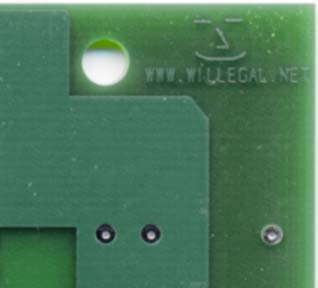
replica-logo

Finnally I started a webpage to be used as a source of information on the A1 replica. It is at http://www.willegal.net/appleii/apple1.htm

Apple 1 Replica Project Restarted #8

Quick update on major areas.

PCB:

First pass of the following layers complete.
bottom copper
top copper
top silk

Up next:
Top solder mask which has some unusual features.

Pending:
Second and then third passes through each layer (these should go much more quickly than the initial pass did)
PCB vendor DFM (design for manufacturing) check
Net list check against schematics
Rounding off trace corners
Final Pass
Final DFM check
Final Net list check

Parts:

Some parts have been received
Others on order
Still determining best vendor for several key parts.

Example of what goes on when sourcing parts. I spent several hours yesterday reviewing the board edge connector and evaluating sources. If I was doing a new design I would just pick an appropriate part and layout the board to suit. In the case of a replica you need to determine the specifications of the part, find the part that fits the specs and finally find a source.

Overall Costs:

Note that some rough estimates on PCB cost indicate that the gold finger edge on the board will raise PCB cost more than I initially thought. Costs continue to look higher than the Apple II due to to PCB, more expensive obsolete parts than the A2, and the power supply. The two transformers alone cost over $40 for a single Apple 1.