
Rod Holt’s Apple II fix

There are stories floating around, about how early prototypes of the Apple II were not very reliable and Rod Holt made some fixes to make the design more reliable. A recent example is this Mike Scott interview.

Just what exactly was wrong and how it was fixed is not mentioned in any of these stories. I’ve always had my suspicions about what one of the problems was. However, without confirmation, I’ve been reluctant to speculate publicly in my blog or elsewhere. Last spring at VCF east, I had a chance to chat with Dan Kottke. Dan was very involved at the technical level with both the Apple 1 and Apple II. More importantly, he seems to have retained in his memory a great many details about those early days at Apple. Dan confirmed my suspicions about what one the of problems was.

Since I first heard the story of the flakey Apple II prototypes, I was very suspicious of the two SIP resistor modules shoehorned at the end of two of the three rows of ram. Here is an crop of an image of Geoff Harrision’s rev 0 board, #97 showing two blue SIP packages.
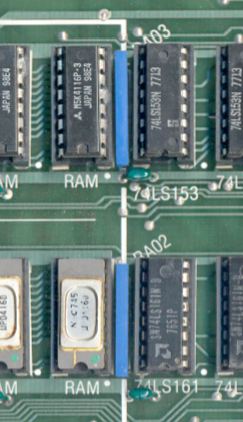
SIP Modules Shoehorned in between chips

SIP Modules Shoehorned in between chips


(thanks to Geoff for permission to use this image)

These resistors are used to terminate the DRAM address bus. Termination is often added to a bus to improve signal quality in cases where noise and ringing cause performance issues. That was the first clue, but there are others. Nowhere else on the board are parts jammed so close together with so little spacing between traces. Also note the silk screen set at an angle – no other parts on the Apple II are labelled that way.

This image of the copper layer on my rev 0 replica shows how tight this area of the layout is.
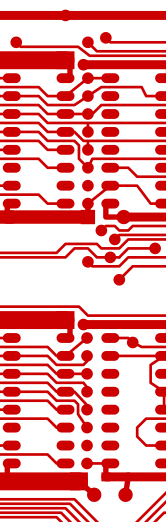
Copper layer around SIPs

Copper layer around SIPs

Dan confirmed for me that these SIP packages were added after prototypes exhibited problems with a DRAM address bus that was, in Dan’s words, “all over the place”.

Satisfied that I have found and had confirmed at least one of the problems with the preproduction Apple IIs, I still have two questions left to answer.

  • Just how bad is “all over the place? Just how well will a system without these resistors run?”
  • Are any preproduction Apple IIs without these SIP packages in existance?
  • Well, I think I have the means to get some idea of the answer to the first question. I will be doing some experiments in the future and reporting results in this blog.

    The answer to the second question will only be answered if someone comes forth with a pre-production Apple II, without the termination resistors. Knowing how engineers save prototype hardware, I’m thinking that some early Apple employee will come up with one, at some point in time. Who knows, maybe Rod still has the one in which he grafted the resistors onto, in order to test his fix.
    More SUPERPROTO ideas

    Prototypers looking to save money – check out the how I changed the 1101 SRAM tester into a permanent solution, without dedicating a SUPERPROTO board.

    http://willegal.net/superproto/index.php?title=Extending_to_Bread_Board_for_rapid_prototyping

    I also added jumper selection of SUPERPROTO superpages to my SUPERPROTO experimenters board. I’m able to change personalities of my SUPERPROTO now, simply by changing out the breadboard and by changing jumpers.

    New SUPERPROTO “Experiment” Added to Wiki

    This is really a practical application, not an experiment. Follow this link to see the details of the 1101 256×1 bit SRAM tester that I put together.

    I bought a bunch of these SRAMs for my SCELBI project, and since it is going to be a while before I can actually use them, I wanted to get some kind of read about how good or bad this lot of chips was. I have the SUPERPROTO available, so I went to work and put this tester together in three days. Probably 3/4 of the time was spent writing and debugging the test program.

    Oh – except for the one I ruined by connecting -9 volts to an address pin, all the SRAMs I’ve tried so far, test good.

    SUPERPROTO Now Available

    I’m going to open up general sales of SUPERPROTO kits and PCBs.

    Price will be $65 for a SUPERPROTO kit.

    Bare PCBs (no components) are going to be $35 each.
    I’m also offering a bundle deal of 4 bare PCBs (no components) for $125.

    Shipping will be a flat $10 to anywhere in the world. When I get busy, I often ship on Monday after packing during the weekend. Because of this, shipping may take up to a week after payment, though usually it’s less.

    For detailed ordering information, send an email to: mike@willegal.net.

    SCELBI progress

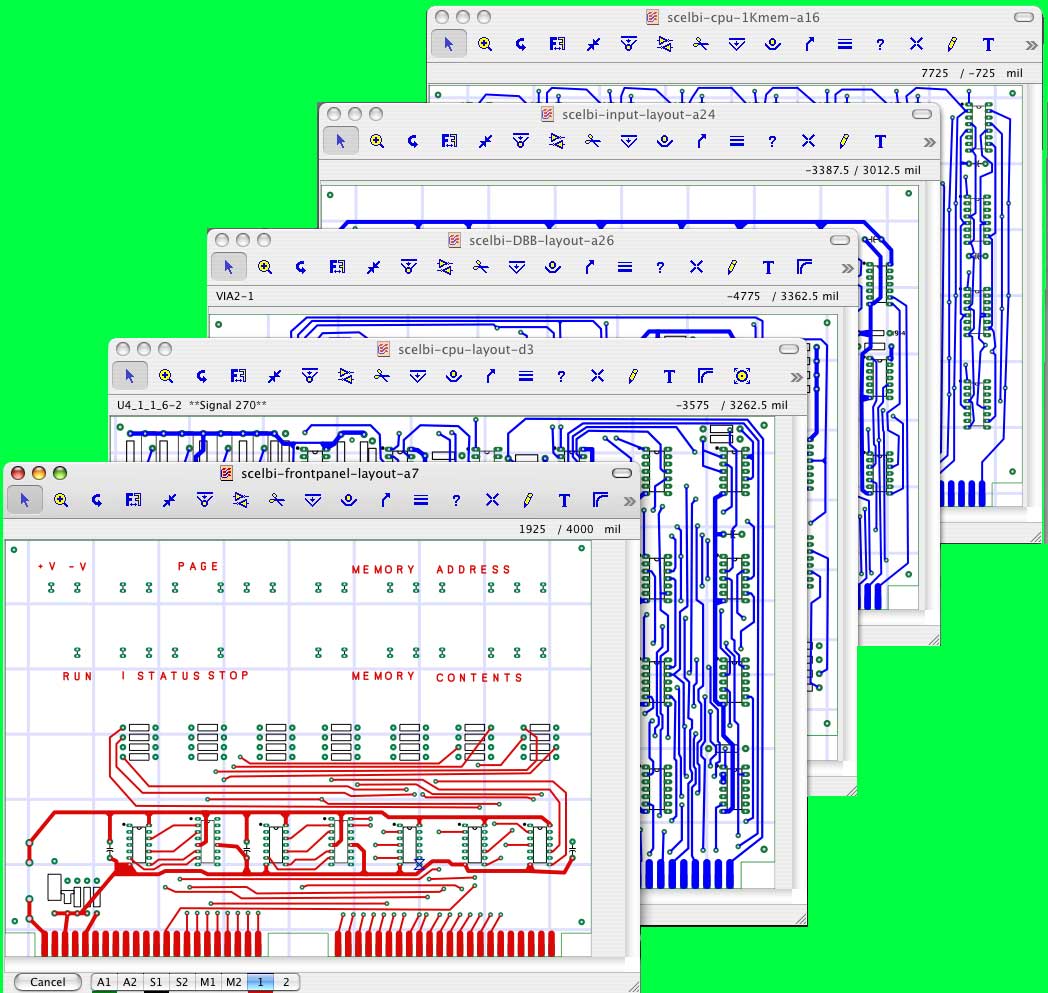
    Making progress on the SCELBI – I now have draft layouts of all 5 of the cards needed for a basic 8H system in CAD. Some are much closer to production ready than others, but they are all there. One interesting thing to note is that, so far, I haven’t found a single error in the SCELBI schematics that I’ve used as reference.

    SCELBI card stack

    SCELBI card stack

    I have also ordered enough 256×1 memories to populate 4 1K boards, so that I can build a full 4K 8H system. Turns out that American Microsemiconductor has 6000 MM1101A/A1 National parts with a date code 81 at 3.55 each. They are listed as 3-Input NAND-Function Logic Gate, but I’m convinced that that is a mistake. I hope I’m not wrong. 🙂 Older Intel 1101s will easily cost over $10 each and you’ll need 32 of them for just a single 1K board. Ignoring the price, you may have trouble finding that kind of quanity.

    American Microsemiconductor usually has high prices, but I’ve been able to find a couple of fairly good deals for RAM there. By the way, if you decide to order a bunch for yourself, be sure to talk to someone and ask for a quanity discount.

    http://store.americanmicrosemiconductor.com/mm1101a-a1n.html

    For the SCELBI, I’m going to be selling bare card sets, so you will need to find your own components, which is why I mentioning this opportunity. Since I haven’t built up a system with these parts, I can’t guarantee that they will work in the SCELBI.

    By the way, I just recently figured out what the H stood for, in 8H. H stands for hobby. We knew that B stood for business, in the 8B system, but somehow it never dawned on me that H stood for hobby. So it seems that from the beginning that SCELBI had plans to create a range of machines. One of the great questions is what would have happened if Nat Wadsworth hadn’t suffered the heart attacks. Could SCELBI, with their vision and engineering skills been able to evolve and remain competitive?

    Lastly, I hope to get together a SCELBI podcast in the next couple of weeks.

    Ask Permission, Credit Your Sources

    Long time visitors to my web site probably already know that when I post information and images on my website or blog, I always try to do two things.

  • Ask permission to post any proprietary/private information or images
  • Credit the source (as long as the source doesn’t desire anonymity)
  • There are many reasons for this approach and I’ll list them here in no particular order.

  • Asking permission is easy
  • I have never been turned down, though a museum once asked for a couple of hundred dollars for use of an image (I found an alternate source)
  • Adding credit is easy
  • People deserve credit for their efforts
  • Doing the “right” thing makes me feel good
  • Even a tiny piece of the historical record, needs source of facts documented
  • People are more likely to help you in the future, if you credit them in the present
  • Over the years, I have freely shared virtually all the information I have gleaned over the years about the many topics that I have investigated, from Tropical Fish to Vintage Computers. About the only time I withhold information, is if I think the data might reflect badly upon a living person, and would serve no other useful purpose.

    There have been several cases where I found weaknesses or bugs in the systems I have replicated. I have always published my findings, though in a couple of cases, it probably wasn’t necessary and I considered holding back. One example, is when I found a couple minor discrepancies between my rev 0 replica and the real thing. In the end, I decided to publish, even though it might reflect poorly upon my replication efforts.

    There have been a number of instances over the years where discoveries or information that I published on my web site has been used by others without giving proper credit. Most of the time, these cases are minor, and not worth bothering about. An recent example is when someone hijacked an image of Mimeo to use as an iPod cover. That “case” amused me more than anything, because there were plently of legit Apple 1 images that could have been hijacked, instead. A couple of recent cases involving a couple of different people have disturbed me a bit more than normal, which is prompting me to write this “editorial”.

    The bottom line is: ask permission and credit your sources. You’ll be amazed how a little bit of common courtesy will be paid back in a thousand ways.

    SCELBI memory

    The SCELBI 8H uses 256×1 bit MOS RAMs.

    Doing the math, it would take 134,217,728, 256×1 bit chips to equal the memory capacity of a modern 4 Gigabyte memory module. I don’t know production figures, but I strongly suspect that adding all the 256×1 bit memory chips ever made together into one system, would not equal the memory capacity of a single modern 4 Gigabyte module.

    SUPERPROTO Update

    Check out the new light detector experiment that I just posted on the SUPERPROTO wiki. http://willegal.net/superproto/index.php?title=Photo_Detector It actually took me about 3 times longer to write up this new wiki page, as it took me to try this experiment out. The SUPERPROTO is really going to make experimenting on the Apple II a snap.

    Thanks to Ken Gagne, I managed to sell a number of SUPERPROTOs at K’Fest. I also sold another to a person I know well. I expect to get some feedback with the next couple weeks, as well as get the few that did not sell at K’Fest returned to me. Assuming the feedback doesn’t reveal anything serious wrong with the design, I’ll be opening up general sales in about 2 weeks.

    Regular price is still to be set, but will not be lower than the special K’Fest introductory price of $60. I know that this is quite a bit for a “proto” board, but the PCB and chip costs dictate price, and there is little I can do about it. However I will offer bare boards at approximately half the kit price, for those that can supply their own 75LS245, GAL, VIA and EEPROM, or don’t need them for their application. I’ll also consider quantity deals for folks that want a batch of bare boards to use as the basis for a limited production project. Drop me an email at mike@willegal.net if you have interest in a quantity deal.

    Lucky Me

    I never thought my interest in the early Apple Computers would result in this, but I have been mentioned or quoted in Make magazine, Computerworld and even a local edition of the Wall Street Journel

    Now comes an awesome demonstration of a Mimeo by Evan Koblenz of MARCH at HOPE. This has just been published by the technology-related news website www.slashdot.org

    Enough of the links – far more important to me than the press, is that I’ve become good friends with a wide range of super people with a similar interest in vintage computers. The people are the reason why I continue to invest so much time and energy in this hobby. Take away the people and I’m doing something else.