
I have a small stack of packages almost ready to go out. I just sent an email to those with orders queued up. If you think you have an order queued up and don’t receive an email, contact me.
Category Archives: Apple 1
ACI bringup status
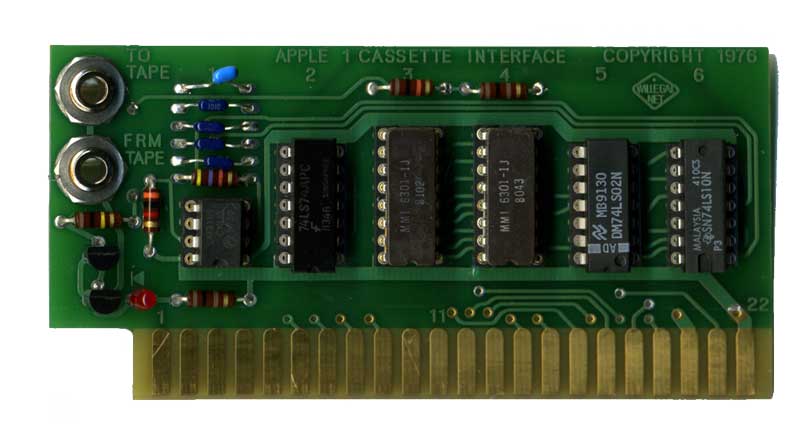
Replica Appe Cassette Interface Board
All parts have arrived. First board is built and successfully reading and writing. No problems found, though I’ve had to remind myself about the sensitivity to cassette volume control setting, before I could get reads to work well off of a cassette recorder. Reading off an iPod is much more forgiving. I need to do some further checkout, but at this point, things are looking good. I also need to print some bring-up guides and burn some PROMs before I’ll be able to ship these units to those who pre-ordered.
ACI PCBs arrive
So far, so good. I populated a board with ICs and I can run the software off of the onboard PROMS. I’ll be getting resistors and the rest of the parts over the next week. So by sometime next week, I’ll be able to complete the checkout. After that I’ll need to verify operation with a Replica 1 and then I’ll be in business.
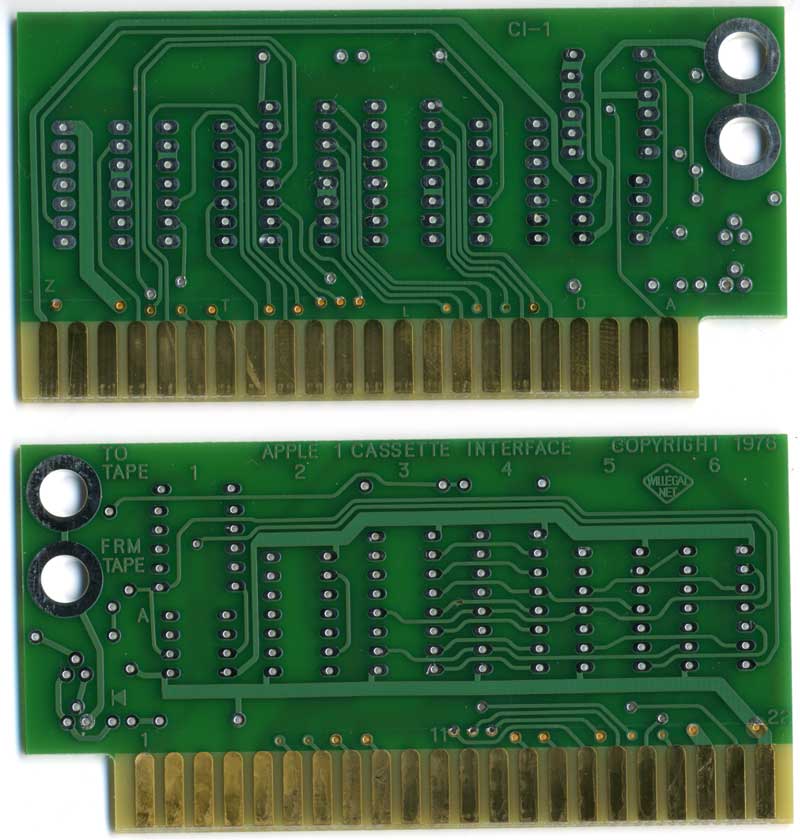
replica ACI
New Early Apple Keyboard Page Started
Just added the first version of an early Apple keyboard page. This details some of the changes that went into early Datanetics and Apple keyboards. There are more keyboards to be added, but I figured that I had enough interesting stuff written up to put up this link.
http://www.willegal.net/appleii/early-a2-keyboards.htm
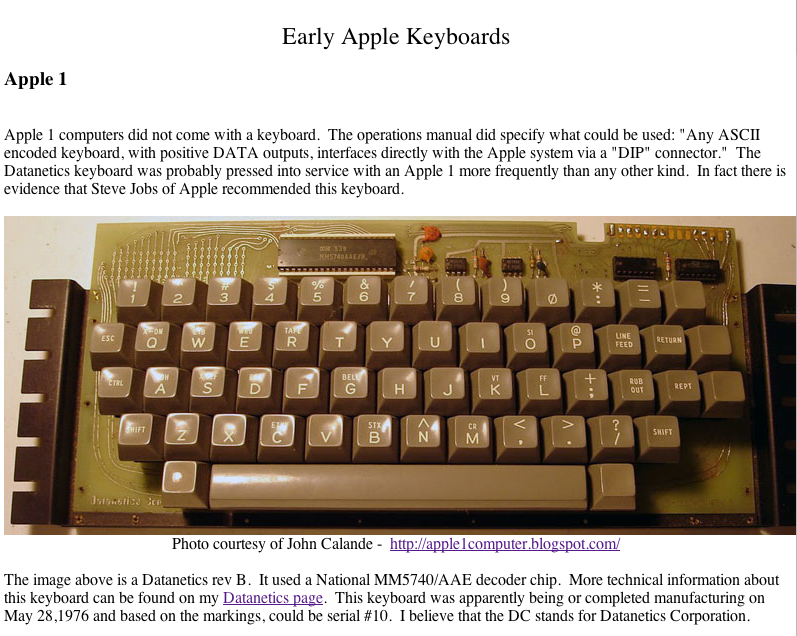
keyboard page
Apple II rev 0 closeout results
My ebay A2 rev 0 replica motherboard closeout on ebay is done. I successfully sold 4 kits for an average price of a bit under $300. Subtracting ebay fees, paypal charges, the net take was similar to the cost of putting these kits together.
However since my motivation was to bring in some cash, so I could move some other projects ahead, I consider the sale a success. The money is earmarked to make my Datanetics keyboard replica project a reality.
The ebay sales indicate that the current fair market price of the these kits is just under $300. Given that the cost of putting together kits is nearly as much, it is just not economically feasible to sell these kits. Maybe someday in the future things will change, but that is how it looks to me at the moment.
Here are some facts about the A2 rev 0 project.
Motherboard laid out 1st half of 2007
First board brought up summer, 2007
Last kit shipped fall, 2010
Production run:
2 batches total of 18 boards
1st batch 6 boards (glossy solder mask)
2nd batch 12 boards (matt solder mask)
Kits sold – 14
Bare boards sold -1
Build and tested motherboards sold – 1
Built and kept -2 (one from each batch)
I was hoping that the profit from this effort would be enough to pay for an original rev 0 or perhaps one of Grant’s Altair kits (no longer available). Though, financially, I did just a bit better than break even, the main profit came in other forms. I had a great time with this project. I made some great friends. I learned a ton about PCB layout and working with various suppliers. Also, I don’t think I could have done the more difficult Mimeo PCB as well as I did, without taking on this project, first.
Finally for those of you interested in the Mimeo kits, don’t worry, I will continue to produce and sell these kits as long as there is continuing interest and components available.
Apple Cassette Interface Update
Pre-order your ACI now – in case you forgot to order by end of September, the special price of $75 will be honored through Sunday 10/3/2010.
I have already ordered the PCBs and will get a first look at them next week. Still have to order a number of parts and will be doing that by early next week. By the way, I’m looking at buying carbon composition resistors which are more representative of the resistors used on the original units. Only downside is that they are 10 times the cost of carbon film resistors. If they work out, I’ll also switch Mimeo 1 kits to these resistors when I run out of the current carbon film resistor stock.
What O’scope Should You Buy?
I recently received this question from a fellow retro-computer hobbyist. Since it was such a good question, I figured I’d post my reply here on this blog. Though I can’t make a specific recommendation that is right for everyone, here is how I responded to this inquiry.
I use an old 100MHZ Tek 465 that I picked up off of ebay for about $80 (shipped). I was lucky, and it was almost completely functional, when it arrived. I spent another 50 bucks on probes and some minor repairs (replacing broken knobs). Total cost was less than $130.
Prior to landing this unit, I would occasionally borrow a more modern HP 20MHZ 4 channel digital storage scope from work. The user interface was nice and storage was great to have, but the bandwidth was a bit limited, considering early Apple computers have a base 14MHZ clock.
At times, it wouldn’t hurt to have more than 2 channels and occasionally a little more bandwidth would help. So I guess I think that 100 MHZ, 2 channels is minimum for my purposes. 100MHZ sounds fast, but remember that you want to see glitches and signal slope, not just digital highs and lows. The real neat thing about using this old scope is that this same tool was in use in the 70’s and 80’s by developers of the first personal computers. The price was right, too. At the time I bought it, I don’t think that you could touch the bandwidth at that price any other way.
A modern digital storage scope would be easier to use, especially on transient signals, as the scope stores the capture and you can view it at your leisure. On a traditional analog scope, a transient just flashes on the screen and is only present as long as the screen phosphor glows (one shot).
There are also digital storage scopes that plug into PC’s USB port and use the PC as the brains and display. Some of them have logic analyzer functions, which would be nice to have. Many of these units have limited bandwidth, compared to my old 100MHZ Tek.
I guess the bottom line is you need to decide much you want to spend and what kind of features are important to you.
ACI presale ends in less than 2 weeks
My presale of apple cassette interface cards is due to end on 9/30/2010. The presale price is $75. After 9/30 the price will go up to $100, unless you buy an ACI at the same time as an Apple 1. The bundle price will be $75.
I expect the ACIs will be shipping by early November.
I currently have a preliminary manual online at:
http://www.willegal.net/appleii/aci-v0.12.pdf
and some information about the ACI at
ACI build and operations manual online
I’ve put a preliminary copy of my ACI build and operations manual online at: http://www.willegal.net/appleii/aci-v0.12.pdf This contains an OCR’d copy (not just a scan) of the original Apple ACI manual, plus a complete assembled listing of the ACI PROM. Take a look and let me know if you see any problems.
Also – remember that this is the last month for discounted ACI presales – get the presale price of $75 through September ’10. Shipments begin late October or early November. Contact me via email at mike@willegal.net if you are interested in the ACI card.
Datanetics Keyboard Replica Progress
Still working on this one in my spare time. Just completed drawings (not to scale) for the brackets.
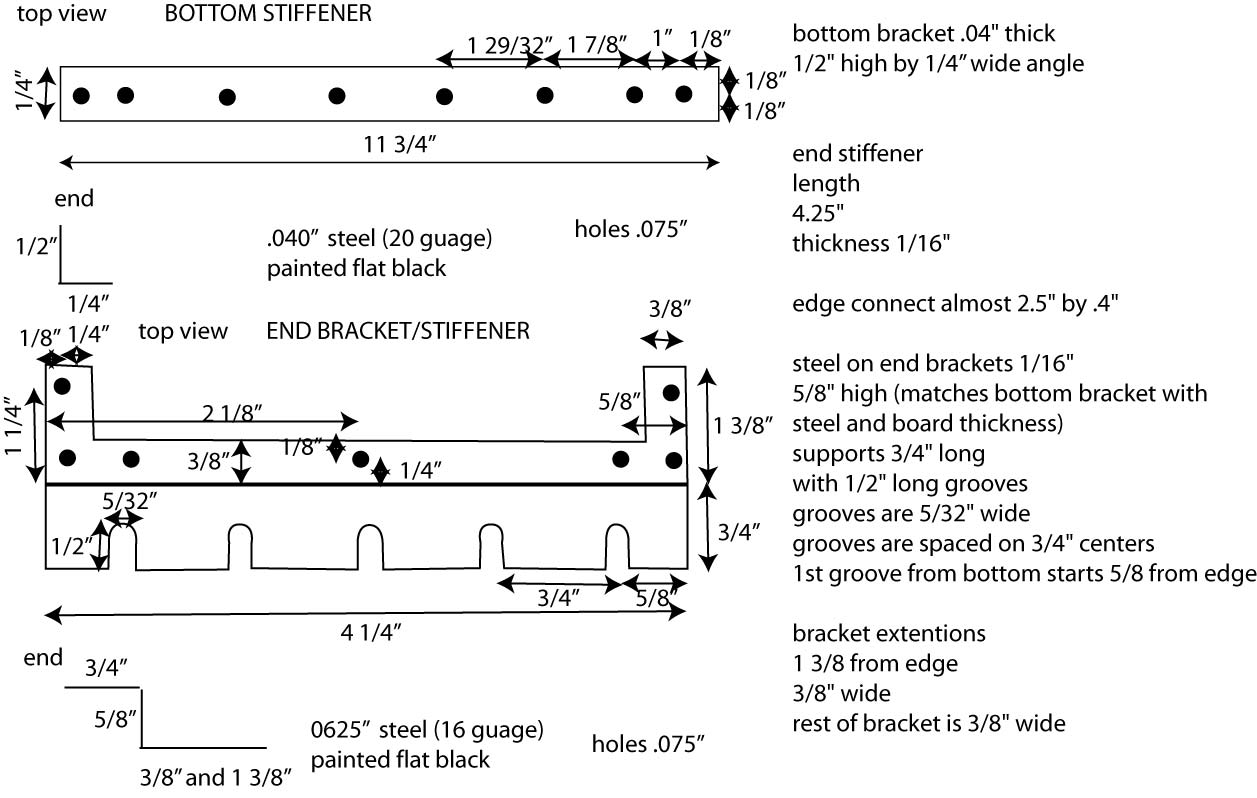
Datanetics Keyboard Stiffeners
Layout is coming along also. I have smoothed out the traces on the top and am working on the bottom. Also spent a lot of time working on hole sizes. It is surprising how important this is to a good replica and how long it takes to measure the various holes in a PCB.