Archive for the ‘Vintage Computing’ Category

MPS3704 status

Thursday, June 6th, 2013

Apple/Mimeo 1 people, be aware that normal production and stocking of MPS3704 seems to have stopped with major distributers. I just received this email from Mouser.

Hello Mike,

Thank you for choosing Mouser Electronics.

At the time of placing an order with our supplier, they required a minimum order quantity for the following part. If you are unable to increase your quantity to meet the minimum, we can attempt to locate a substitute for you. Please let us know how you would like to proceed with your order.

Purchase Order # XXXXXXXXXX
Part # 610-MPS3704
Minimum Order Quantity: 3,350

This part is not listed at Digikey, Allied, Unicorn or Jameco at all. Note that date code fanatics have been seeking out old Motorola MPS3704s from surplus suppliers for their Mimeo reproductions, anyway. It looks like future supplies of these transistors may have to come from those surplus suppliers.

Apple II Serial Card Initialization Details

Saturday, June 1st, 2013

While looking for a way to test the SCELBI current loop interface, I discovered that an early Apple II peripheral card, the Serial Interface Card, supported current loop. This card was designed to interface to printers and supported half duplex baud rates up to 19200 baud. Since I only need 2400 baud for SCELBI and the SCELBI only supports half duplex, I thought that I could use it for testing the SCELBI TTY interface card.

I found that I had a serial interface card in my stash and tried it out, using the RS232 mode to see if it would work. However I found that it would only output 1 byte and then hang. I had a friend who scanned the manual for me and sent a PDF to me. Looking over the manual at first, I couldn’t determine what was wrong. However dumping the firmware revealed that the firmware was different than that listed in the manual. After some web searches, I determined that there was a second version of the firmware that supported RTS/ACK software handshaking and that this second version did not work with some printers.

Since I couldn’t find a copy of the second version’s manual, this started me off on an reverse engineering investigation. This was a more difficult process than I first anticipated. Along the way I learned about some clever 6502 programming tricks, including a way to implement a primative 6502 skip instruction. I also have come up with a partly annotated listing that may be of interest to Apple II peripheral interface designers. This doc details some of the tricks involved in initializing Apple II interface cards. As the input and output functions are not of much interest, they are not well documented.
Apple Serial Interface Firmware

By the way, with the second version of firmware, there is no way to disable the RTS/ACK software handshake, so I’m going to have to find or make a copy of the first version firmware to test my SCELBI current loop interface.

Datanetics Build Manual Posted

Monday, May 27th, 2013

Thanks to Corey Cohen, who wrote this build manual based on his experience building a reproduction Datanetics.

Apple 1 Registry Update

Sunday, May 26th, 2013

All the press about yet another record Apple 1 action has brought a few more original Apple 1’s to my attention. I have added a couple more to the registry, and updated some information on some that I knew about, but now have better information on.

I have heard about another machine, with a real interesting story, but am waiting for an image, before I add that one to the registry. Also it looks like the Ricket’s computer is now owned by Robert Luther ( Robert Luther’s Apple 1). I will update that next time around.

By the way, I did not tell anyone that the owner of the recently auctioned Apple 1 was Fred Hatfield, a former Boston Red Sox player who died in the late 90s. Since Fred contacted me a year or two ago, with information on his Apple 1, I knew that he was still alive and kicking and not a deceased baseball player. I sincerly hope that this mistake was someone else making a wrong assumption and the Breker’s forgetting where they heard it from.

I guess that is the way of the world, when the amount of money involved in transactions like this gets to ridiculous levels.

SCELBI page updated

Friday, May 24th, 2013

I added some SCELBI comments from mid 70’s hobbyist magazines. Take a look.

I have a new version of the SCELBI/8008 OS/X emulator working that allows you to set the starting address after a reset, but I haven’t yet loaded it to the website. Hopefully I’ll get to that, this weekend.

More Apple 1 Fonts

Tuesday, May 21st, 2013

In a previous post, I talked about how the lettering on the Apple 1 was probably done with a K&E Leroy system. However, I forgot to mention that the larger letters were not done with Leroy. Those letters were probably done with a Letraset or similar rub on transfer system. Take a close look at the Apple Computer 1 lettering, which is representative of the larger lettering seen throughout the board.

Apple1logo

Apple1logo

This lettering is in the general form of Helvetica, with subtle differences from most variations of Helvetica that you see today. Through extensive searching I found a very close match with Neue Haas Grotest Std Text 65 Medium. This is a recreated version of the predecessor to Helvetica. Check out this page with more information about this font.

Here is a recreation of the Apple Computer 1 lettering using this font. I think it would be hard to beat this match.

Replicated Apple Computer 1 logo

Replicated Apple Computer 1 logo


replicated Apple 1 copyright notice

replicated Apple 1 copyright notice

If someone has a Letraset catalog from the 70’s, it would be interesting to see if they can find a good match in one of those catalogs.

How are the Apple 1 and Wonder Woman Comics alike

Saturday, May 11th, 2013

I recently received an email that indicated that the Apple 1 was most likely lettered with the Leroy lettering. That email has resulted in a lot of research and exploration of exactly what is Leroy lettering and was it really used for lettering the Apple 1 PCB.

First thing to figure out is what is the Leroy lettering system? It is a system to mechanically create lettering that was intended to generate legible lettering on a drafting table. Engineering documents, maps, architectural drawings and the like were the primary applications.

Here is an image of a K&E Leroy lettering set.

K&E Leroy Lettering Set

K&E Leroy Lettering Set

It’s easier to show how it works, than describe it. Here is an image of one set up to make a capital M. The scribe follows the letting in the ruler like jig and ink in the “pen” writes a pretty exact copy of that letter. There are a series of jigs for different sized letters. The scribe tool can be adjust to make the letters slanted in an italic type fashion.

Leroy Letterng Sytems Set Up

Leroy Letterng Sytems Set Up

So how do we determine whether this system was used to make the lettering for the Apple 1. The easiest way is to compare the lettering on an actual Apple 1 with an example we know was made with Leroy lettering System.

Apple1 Leroy Lettering

Apple1 Leroy Lettering compared to Apple 1

You can see that the newly created Leroy lettering (bottom) is nearly a perfect match to the Apple 1 (top), so I think that we can be pretty confident that the Apple 1 lettering was made with the Leroy or very similar lettering system.

My next question is whether the SCELBI front bezel was also lettered with the Leroy system.

Leroy and SCELBI Front Panel

Leroy and SCELBI Front Panel

Though the lettering is very close, there are some differences in the leg on the “R” and the “A” looks a little different. Also the ends of the strokes on the letters have nice square edges, which would not occur in a Leroy lettered system.

Finally, follow this link to see what Wonder Woman comic books have in common with the Apple 1.

SCELBI TTY interface reproduction PCB – how much interest?

Monday, May 6th, 2013

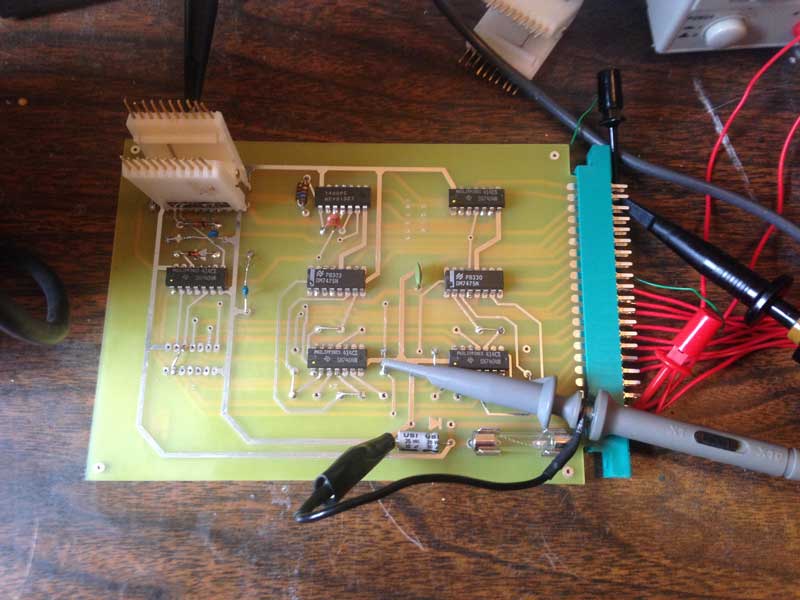
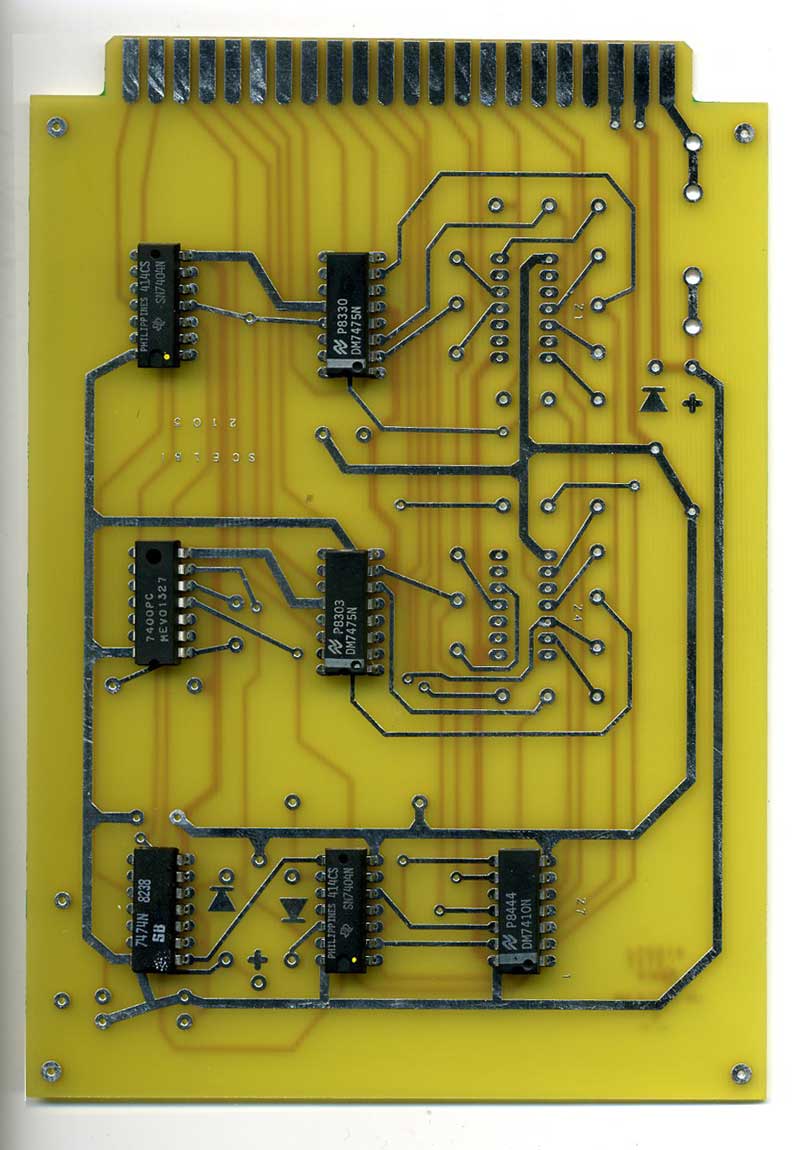
I have the layout for a reproduction SCELBI TTY PCB close to complete. This is essentially a TTL to current loop interface originally designed for interfacing the SCELBI to a Teletype. The board is about 4.5″ x 3.5″ with a connector on a .156 spaced edge for plugging into to an edge connector with solder tail pins. This is very similar to a “Vector” prototyping board. Schematics and a drawing are available on Cam’s SCELBI website.

http://www.scelbi.com/documentation.html

Here is a photo of an original SCELBI TTY interface board.

SCELBI TTY interface

SCELBI TTY interface

I’m not sure how many to make. I’m projecting a bare PCB price at $30 to $40, depending upon interest level. Let me know if you have interest in this board.

regards,
Mike W.

MAC 128K intermittent operation resolved.

Thursday, May 2nd, 2013

In this series of earlier posts and I had posted some notes on acquisition and repair of an all original MAC 128k. One thing I didn’t mention is that the video on the machine was a bit intermittent. This has bugged me a bit and yesterday, I decided to figure out what was going on. The symptoms were intermittent video, either working normally, or completely black. Taking the machine apart, I determined that wiggling or touching the connector that leads from the digital to analog board could cause the video to go on or off.

Some websites and an old book, “Macintosh Upgrade and Repair Secrets”, say that this sort of problem is often due to bad solder joints on the connectors on the analog board. Following those directions, I pealed off the plastic cover and resoldered the joints on the analog board. However, this did not affect operation. Figuring that I had nothing to lose, I then touched up the joints on the connector on the digital board. Wiggling this connecter seemed to affect the problem, so I was kind of hopeful that resoldering that connector would do the trick. Sure enough, the intermittent operation seems to have disappeared once I resoldered those joints. Now, I just need to find some foam with adhesive on both sides to use, to put the plastic panel back over the analog board and I think I’ll be back in business.

I hope I don’t have any further issues, at least for a while. By the way, my opinion is that those connectors could have used a bit more solder in the first place, and this probably contributed to the issues.

This experience with a MAC 128k shows how even a lightly used old computer that is in excellent cosmetic condition, may need some work in order to get it running like it was new. I had three problems with this machine that needed addressing.

  • two bad memory chips
  • floppy drive needed cleaning and lubrication
  • bad solder joint on motherboard connector
  • Note that there are high voltages in this system and it should only be operated by experienced technicians when the cover is removed.

    SCELBI Demonstrated at VCFse

    Tuesday, April 23rd, 2013

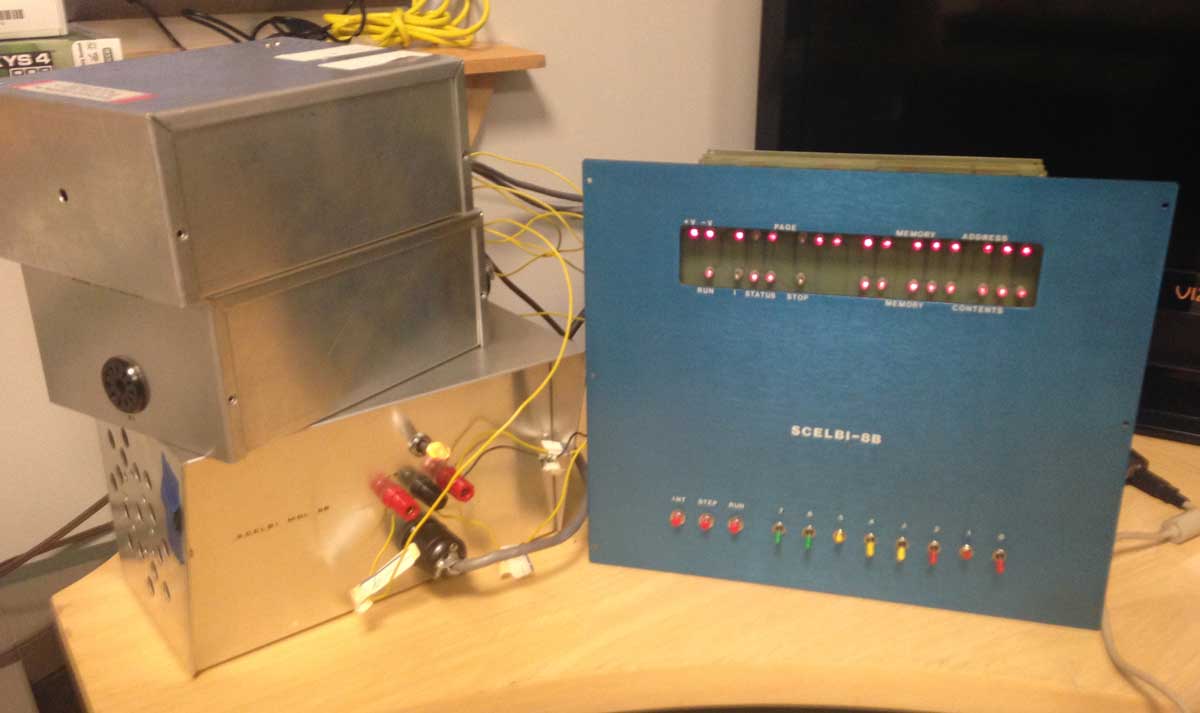
    I figured I would report on my SCELBI exhibit operations at VCF SE 1.0. I will also cross post this to the new yahoo group, retro-restore.

    Saturday was dedicated to running the SCELBI calculator program. Toggling in the bootloader before exhibit opening, went without major issues, though I found that focus on toggling was a little hard to keep with numerous other people around getting the facility ready and getting their exhibits ready. No significant problems with downloading and pretty soon I had the program running.

    I had left the divide by zero error handler to just halt the CPU. This turned out to be a good way to demonstrate front panel operations, as I just needed to divide by zero in order to halt the cpu. I would then need to toggle in a jump instruction in order to get the program running again. I did have a few issues during the day when the program appeared to stop accepting input. I think the main reason for this, is that the parser is rather particular, expecting only certain characters during input at any given time. Other characters are ignored, making it seem like the program or machine is stuck, when, in fact, the operator is typing the wrong thing. Anyway, the program ran all day, without any need to reload it, until I took it down to demonstrate during my talk.

    The second day, I was planning on demonstrating Mark Arnold’s 1K Mandelbrot program. I arrived just 20 minutes before exhibit opening and because I was also demonstrating a Mimeo and had to set that up, and didn’t have time to toggle in the bootloader before opening. I had to do it, while showing off my exhibit. The Mandlebrot program needs to use location zero, so I had to relocate the bootloader. Last time, I did this, I had no issues, but this time my math skills failed me and I spent a considerable amount of time trying to make the Mandlebrot program load right on top of the bootloader. Finally after realizing the error of my ways, I retoggled the bootloader into a better spot and got the Mandlebrot program loaded and running.
    If I had been thinking straight, I could have loaded the bootloader into the new location, with the bootloader that was loaded in the wrong place. The SCELBIgenerated Mandlebrot images for the rest of the day, without error.

    The bottom line is that the SCELBI ran all weekend, the clock remained stable enough to support RS232 bit-banged I/O without error. The power supply worked great.

    A lot of people that had never heard of it, were exposed to the SCELBI for the first time. And finally, I overheard one person say that the reproduction SCELBI was the coolest thing at the show.

    Things I would change. I would probably run the Mandlebrot on Saturday, when things were busiest. I also need to find a teletype or current loop terminal,because some people were confused by the Powerbook running a terminal program acting as the terminal.

    It was wonderful meeting everyone who came to the show and if you didn’t come I recommend you make an effort to attend a VCF, if you get a chance.