
Check out this early SCELBI price list that I managed to obtain. Notice the address is Nat Wadsworth’s residence.
Category Archives: Vintage Computing
Rod Holt’s Apple 2 Fix (part 2)
Well I found some time and pulled the DRAM bus termination resistors from one of my rev 0 replicas, to see what would happen. I expected to find the machine still worked but with some erratic behavior. I planned to take before and after O’scope shots of the DRAM address bus to be able to demonstrate the difference.
What I expected and what I got were quite different. What I got, was a machine that wouldn’t boot and give me a monitor prompt at all. I couldn’t really do before and after O’scope images, because I couldn’t generate an apples to apples comparison without putting the processor into the same tight loop for both test cases. However the display on the video was stable, so it shows that DRAM access was at least mostly working without the termination resistors.
I tried 4K and 36K DRAM configurations, and found no difference in behavior.
While my reproduction isn’t an original Apple preproduction board, I don’t think behavior would have been significantly different on a preproduction Apple II.
Just to speculate a little. There may have been enough board to board variation that some pre-production units worked better than others, but I imagine that on the whole, things didn’t look very promising when the first prototype Apple IIs were built. Imagine the struggle that the early Apple employees had, finding a way to stabilize the computer enough to show at the West Coast Computer Faire, and more importantly get it in shape for revenue shipments.
Rod Holt’s Apple II fix
There are stories floating around, about how early prototypes of the Apple II were not very reliable and Rod Holt made some fixes to make the design more reliable. A recent example is this Mike Scott interview.
Just what exactly was wrong and how it was fixed is not mentioned in any of these stories. I’ve always had my suspicions about what one of the problems was. However, without confirmation, I’ve been reluctant to speculate publicly in my blog or elsewhere. Last spring at VCF east, I had a chance to chat with Dan Kottke. Dan was very involved at the technical level with both the Apple 1 and Apple II. More importantly, he seems to have retained in his memory a great many details about those early days at Apple. Dan confirmed my suspicions about what one the of problems was.
Since I first heard the story of the flakey Apple II prototypes, I was very suspicious of the two SIP resistor modules shoehorned at the end of two of the three rows of ram. Here is an crop of an image of Geoff Harrision’s rev 0 board, #97 showing two blue SIP packages.
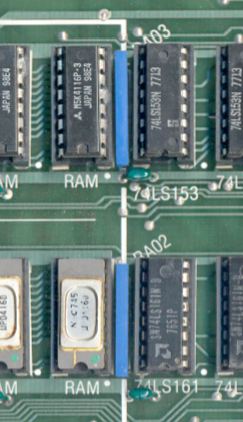
SIP Modules Shoehorned in between chips
(thanks to Geoff for permission to use this image)
These resistors are used to terminate the DRAM address bus. Termination is often added to a bus to improve signal quality in cases where noise and ringing cause performance issues. That was the first clue, but there are others. Nowhere else on the board are parts jammed so close together with so little spacing between traces. Also note the silk screen set at an angle – no other parts on the Apple II are labelled that way.
This image of the copper layer on my rev 0 replica shows how tight this area of the layout is.
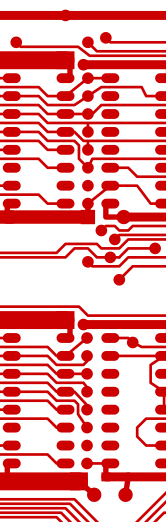
Copper layer around SIPs
Dan confirmed for me that these SIP packages were added after prototypes exhibited problems with a DRAM address bus that was, in Dan’s words, “all over the place”.
Satisfied that I have found and had confirmed at least one of the problems with the preproduction Apple IIs, I still have two questions left to answer.
Well, I think I have the means to get some idea of the answer to the first question. I will be doing some experiments in the future and reporting results in this blog.
The answer to the second question will only be answered if someone comes forth with a pre-production Apple II, without the termination resistors. Knowing how engineers save prototype hardware, I’m thinking that some early Apple employee will come up with one, at some point in time. Who knows, maybe Rod still has the one in which he grafted the resistors onto, in order to test his fix.
More SUPERPROTO ideas
Prototypers looking to save money – check out the how I changed the 1101 SRAM tester into a permanent solution, without dedicating a SUPERPROTO board.
http://willegal.net/superproto/index.php?title=Extending_to_Bread_Board_for_rapid_prototyping
I also added jumper selection of SUPERPROTO superpages to my SUPERPROTO experimenters board. I’m able to change personalities of my SUPERPROTO now, simply by changing out the breadboard and by changing jumpers.
Mike’s Hobby Podcast features the SCELBI this episode
Cameron Cooper and I discuss the SCELBI.
feed://www.willegal.net/feed.xml
or
“Mike’s Hobby Pages” podcast in itunes.
enjoy,
Mike Willegal
New SUPERPROTO “Experiment” Added to Wiki
This is really a practical application, not an experiment. Follow this link to see the details of the 1101 256×1 bit SRAM tester that I put together.
I bought a bunch of these SRAMs for my SCELBI project, and since it is going to be a while before I can actually use them, I wanted to get some kind of read about how good or bad this lot of chips was. I have the SUPERPROTO available, so I went to work and put this tester together in three days. Probably 3/4 of the time was spent writing and debugging the test program.
Oh – except for the one I ruined by connecting -9 volts to an address pin, all the SRAMs I’ve tried so far, test good.
SUPERPROTO Now Available
I’m going to open up general sales of SUPERPROTO kits and PCBs.
Price will be $65 for a SUPERPROTO kit.
Bare PCBs (no components) are going to be $35 each.
I’m also offering a bundle deal of 4 bare PCBs (no components) for $125.
Shipping will be a flat $10 to anywhere in the world. When I get busy, I often ship on Monday after packing during the weekend. Because of this, shipping may take up to a week after payment, though usually it’s less.
For detailed ordering information, send an email to: mike@willegal.net.
SCELBI progress
Making progress on the SCELBI – I now have draft layouts of all 5 of the cards needed for a basic 8H system in CAD. Some are much closer to production ready than others, but they are all there. One interesting thing to note is that, so far, I haven’t found a single error in the SCELBI schematics that I’ve used as reference.
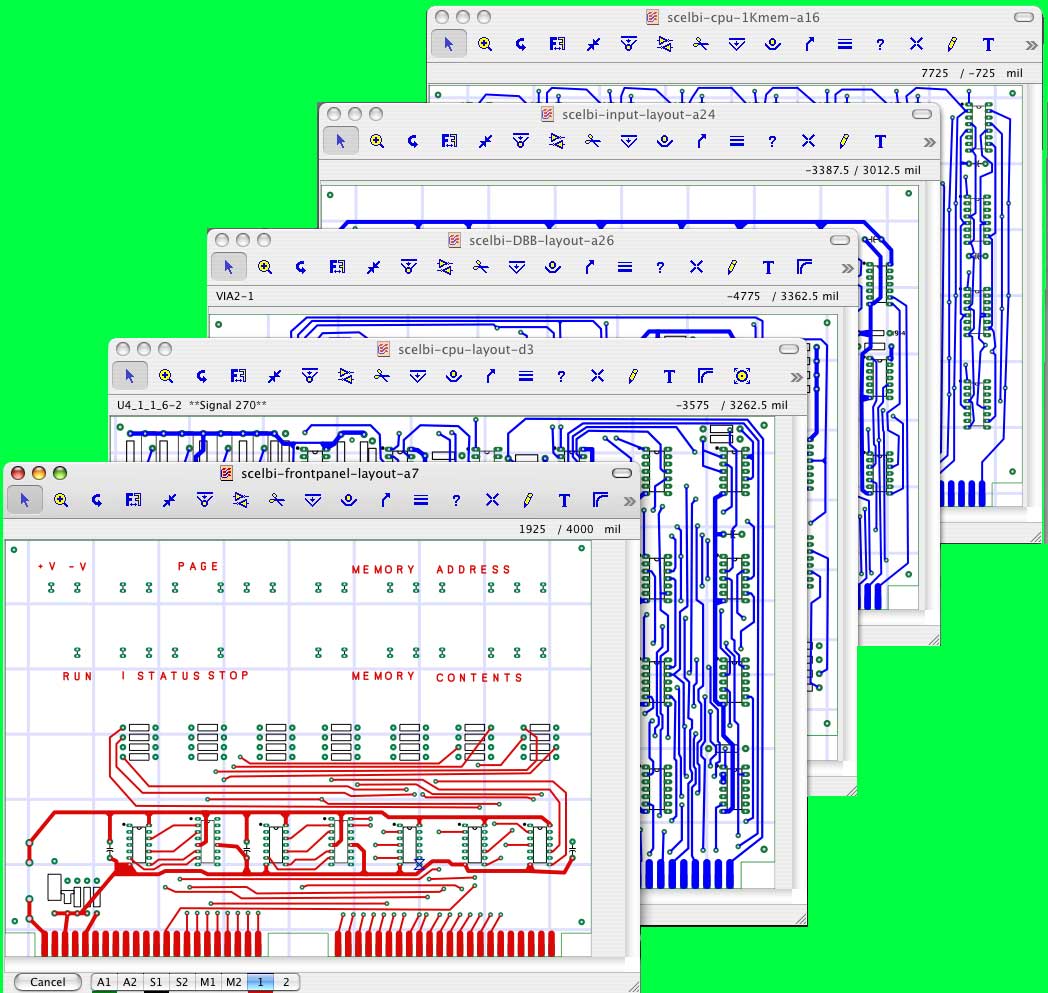
SCELBI card stack
I have also ordered enough 256×1 memories to populate 4 1K boards, so that I can build a full 4K 8H system. Turns out that American Microsemiconductor has 6000 MM1101A/A1 National parts with a date code 81 at 3.55 each. They are listed as 3-Input NAND-Function Logic Gate, but I’m convinced that that is a mistake. I hope I’m not wrong. 🙂 Older Intel 1101s will easily cost over $10 each and you’ll need 32 of them for just a single 1K board. Ignoring the price, you may have trouble finding that kind of quanity.
American Microsemiconductor usually has high prices, but I’ve been able to find a couple of fairly good deals for RAM there. By the way, if you decide to order a bunch for yourself, be sure to talk to someone and ask for a quanity discount.
http://store.americanmicrosemiconductor.com/mm1101a-a1n.html
For the SCELBI, I’m going to be selling bare card sets, so you will need to find your own components, which is why I mentioning this opportunity. Since I haven’t built up a system with these parts, I can’t guarantee that they will work in the SCELBI.
By the way, I just recently figured out what the H stood for, in 8H. H stands for hobby. We knew that B stood for business, in the 8B system, but somehow it never dawned on me that H stood for hobby. So it seems that from the beginning that SCELBI had plans to create a range of machines. One of the great questions is what would have happened if Nat Wadsworth hadn’t suffered the heart attacks. Could SCELBI, with their vision and engineering skills been able to evolve and remain competitive?
Lastly, I hope to get together a SCELBI podcast in the next couple of weeks.
SCELBI memory
The SCELBI 8H uses 256×1 bit MOS RAMs.
Doing the math, it would take 134,217,728, 256×1 bit chips to equal the memory capacity of a modern 4 Gigabyte memory module. I don’t know production figures, but I strongly suspect that adding all the 256×1 bit memory chips ever made together into one system, would not equal the memory capacity of a single modern 4 Gigabyte module.
SUPERPROTO Update
Check out the new light detector experiment that I just posted on the SUPERPROTO wiki. http://willegal.net/superproto/index.php?title=Photo_Detector It actually took me about 3 times longer to write up this new wiki page, as it took me to try this experiment out. The SUPERPROTO is really going to make experimenting on the Apple II a snap.
Thanks to Ken Gagne, I managed to sell a number of SUPERPROTOs at K’Fest. I also sold another to a person I know well. I expect to get some feedback with the next couple weeks, as well as get the few that did not sell at K’Fest returned to me. Assuming the feedback doesn’t reveal anything serious wrong with the design, I’ll be opening up general sales in about 2 weeks.
Regular price is still to be set, but will not be lower than the special K’Fest introductory price of $60. I know that this is quite a bit for a “proto” board, but the PCB and chip costs dictate price, and there is little I can do about it. However I will offer bare boards at approximately half the kit price, for those that can supply their own 75LS245, GAL, VIA and EEPROM, or don’t need them for their application. I’ll also consider quantity deals for folks that want a batch of bare boards to use as the basis for a limited production project. Drop me an email at mike@willegal.net if you have interest in a quantity deal.