While investigating maritime actives at City Point, I discovered an image of an apparent blockade runner at City Point. Here is crop of that image.
I think it is the USS Banshee, which was a captured blockade runner put to use by the US navy.
Note that since the proposed City Point layout involves a busy maritime port, I’ve been investigating Maritime activities. Though I’ve been reading about the Civil War for many years, I just discovered how little I knew about the war on the water. My revised City Point web pages now include the beginnings of a “maritime” page.
Let me know what you think.
http://crankcases.co.uk/iphone-cases-2.html
P.S. If someone asks to use an image or article, I almost always say, just credit the source and I’m fine with it.
Spent some time Friday Evening building a Alkem Scale Models water tank and Saturday where I learned about backdrop painting, visited the vendors and heard Bernie Kempinski give his Civil War talk. I enjoyed meeting and talking with Bernie and the other modelers present. Building the Alkem water tank was a lot of fun. I learned quite a bit from everyone.
Yesterday I painted and completed assembly of the water tank and I think it turned out great. This is probably the best looking structure I’ve ever built.
This will certainly help to inspire me to get moving on the City Point model. The first part of the City Point layout I’m planning to do will be the lead in tracks. This area is probably the most basic and will allow me to experiment without having to redo a lot of structures and details. I ordered several flat cars from Bernie, as several images show flats cars parked there.
Going to this convention might be the trigger that gets me off my butt and going on the City Point model.I have torn a Mantua General all apart for a planned rebuild, I just need to figure out how to mill down the flanges on those drivers.
The Brain Board review in Juiced GS included a description of a bad 74LS244. I have had one other report of problems with the Brain Board in an Apple IIe. In that second case, I had that person send back his board, twice. Though I wasn’t able to reproduce the problem in my Apple IIe with his board, I tried two different repairs, the second of which seems to be successful. The first was a simple swap of the 74LS244, which helped, but didn’t completely eliminate the problem.
After further analysis, I determined that the grounding of the 74LS244 is less than optimal on the Brain Board and switching on of the 74LS244 causes a lot of noise on the ground. Apple boards that use a similar data bus driver circuit (Apple FW card & Super Serial) also exhibit this switching noise. The stock Brain Board is somewhat worse in this regard. I found that adding an additional ground wire on the 74LS244 reduces noise to levels lower than the Apple FW board and appears to solve the problem.
This intermittent operation is typically seen as random characters input while at the console prompt, while not actually typing on the keyboard. If you notice this problem, add a wire between the ground pin of the 74LS244 and the ground lead of the decoupling cap near the other end of the edge connector.
Here is an image of a board with the fix applied.
One more word about this problem. Though I didn’t know of any issue with the ground, when laying out the production Brain Board, I considered shortening the ground connection to the 74LS244, running it across the center of the board, instead of the top. This change might have prevented this issue. However, I decided that, since, in several years of operation of the prototype “Brain Board”, I had seen no issues, that it was unnecessary. This is a case where the “if it ain’t broke, don’t fix it” approach, was the wrong approach. For now, the one wire fix will have to do. If I make another run of these boards, the ground trace will be widened and rerouted using the shortened path I considered before.
Also because of this issue, I’m going to have to make major changes to the layout of the protoboard that I have described earlier in this blog.
Finally, I sold the last of the 10 Datanetics PCBs that I had made last year. I don’t expect to make another run of these since the market for them is so tiny. I guess about the only way that that another run would happen, is if someone is willing to buy an entire batch and finances the whole thing.
I am glad I did this project, as now I have a nice matching keyboard for my personal Mimeo 1.
The one thing that surprised me about this project, is that no owners of original Apple 1s that needed a matching keyboard bought a PCB to build up. Original keyboards appropriate for Apple 1’s are extremely rare and a number of the original Apple 1s don’t have the original keyboards. I’m learning that many people get enjoyment out of owning, admiring and preserving original artifacts, without the risk of operating them. Other people, like myself, get more satisfaction out of operating the old style gear. I think that there is an important place for both types of people in this hobby.
Though the Datanetics keyboard project was a money loser, I am really glad that John Calande talked me into doing it. He also lent me the original Datanetics keyboard he owns, which greatly facilitated this project. Also thanks to Mike Gregory for fabricating the brackets and stiffeners.
It looks like I’ll be putting the per cycle Scelbi emulator on hold for a while, since I just started on this:
This is what the first rough draft of IC, resistor and cap placement for a replica Scelbi CPU card looks like. In the past, once I’ve started on layout, everything else usually goes on hold for a number of months.
Peter Neubauer wrote up an excellent review of the Brain Board and it is printed the in September, 2011 edition of Juiced GS.
http://www.willegal.net/scelbi/the8008andScelbi.html
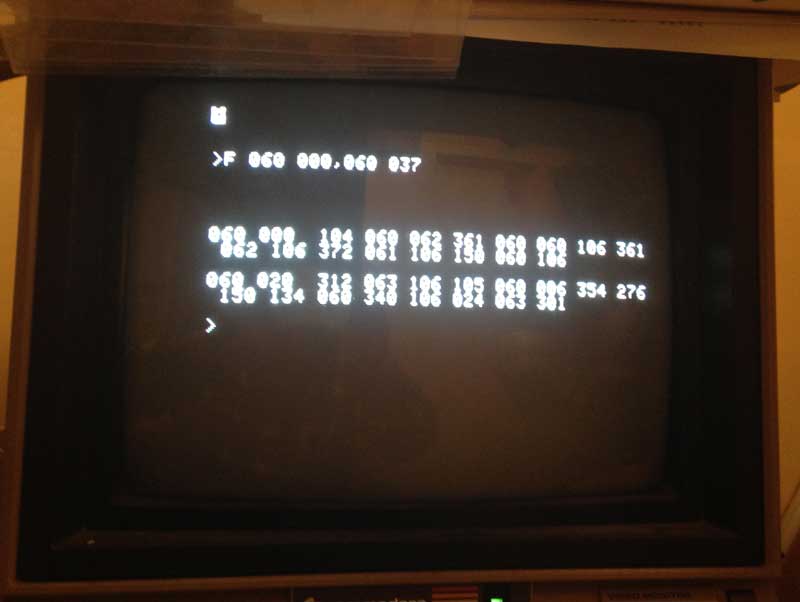
Check it out. Most of the relevant stuff from my blog has been put there and more, including a port of the starshooter game from May 1976 Byte Magazine that works in my Scelbi emulator. The original version, as published, lacked input/output drivers.
Several serious bugs resolved including:
For instructions and download links see my previous post:http://www.willegal.net/blog/?p=1705
For fun, try booting up Scebal and running this program:http://99-bottles-of-beer.net/language-scelbal-2472.html
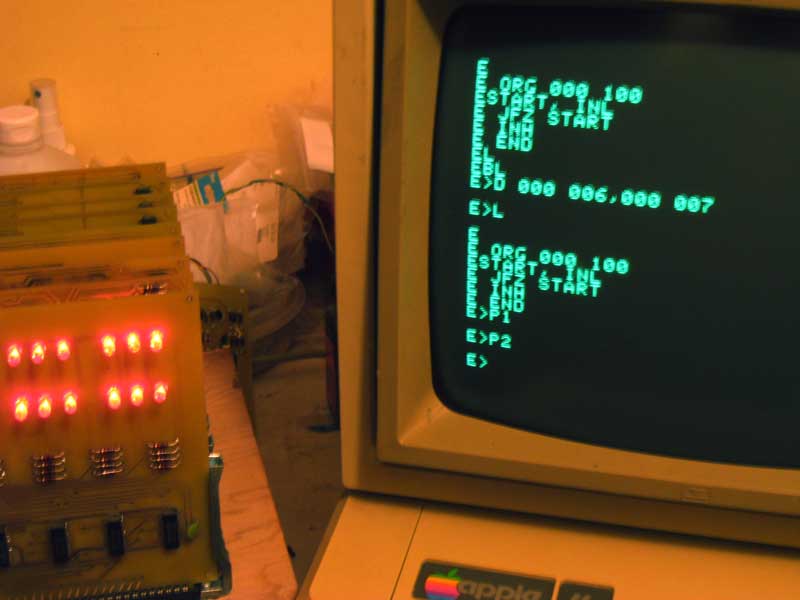
I’ve also been working on the per cycle emulator so that I can make the emulated toggle switches and leds work correctly.