Archive for the ‘8008’ Category

SCELBI TTY interface revisited.

Thursday, November 7th, 2013

I finally found time to revisit the SCELBI TTY card. The last time I tried, I had issues getting it to work with my Apple II serial card. To start with, I have been focussed on getting the SCELBI TTY receive interface, running.

Teletypes and the SCELBI TTY card use a current loop interface, which is a technology that I’ve long been aware of, but have had no practical experience with. Instead of using a signal level, current loop uses a current to indicate 1s or 0s. This current can be sourced from either side, but the transmitter will pass on a current of around 20 milliamps to indicate a 0 and a zero to a few milliamps to indicate a 1. The reciever’s circuit in digital equipment will typically convert the current to a voltage level for later processing by a circuit that will deserialize the incoming bit stream.

Here is a crop of the SCELBI TTY schematic showing the RX circuit.

SCELBI TTY Receiver Circuit

SCELBI TTY Receiver Circuit

The circuit is pretty simple. At the top is a 5 volt supply, that is current limited by resistor R7 going to the edge connector, pin M. This can be sent to the transmitter as the current source, or can be ignored, if the transmitter has it’s own current source. One of the challenges of using current loop technology is determining which end point sources the current. The SCELBI TTY reciever can support either sourcing the current or not. If the transmitter supports it’s own current source, there must be a ground return path between the SCELBI TTY card and the transmitter.

In the middle, coming in from the edge connector, pin L, is in the input current source. Capacitor C3 acts as a low pass filter, to prevent switching due to incoming noise. I don’t have TTY experience, but I’m assuming that TTYs were very noisy and adding this filter improved reliability. Transistor Q2 acts as a current to level converter. Low levels of incoming current will leave the transistor turned off, allowing +5 voltage source to pull the inputs of NAND gate Z1 high through resistor R1. Higher levels of incoming current will switch on Q2, causing the inputs to Z1 to go low.

During my previous attempt at transmitting from an Apple II serial card to the SCELBI TTY card, I was unable to receive any data. This is despite trying several connection methods.

This time around, I first built a LTspice model of the circuit, including both the Apple II Serial card transmitter and the SCELBI TTY reciever in order to determine theoretical behavior of the circuit. Here is the final schematic that I ended up with.

Apple Serial TX to SCELBI TTY RX

Apple Serial TX to SCELBI TTY RX

Since I couldn’t find a model of a 7400 NAND gate used as the output of the TTY card, I modelled it with discrete components. The connections between the boards are simple.

  • pin23 of the Serial card’s DB25, which is it’s current loop output is connected to edge connector pin L of the TTY card, which is the current loop input
  • pin 7 of the Serial card’s DB7, ground, is connected to ground of the TTY card
  • Next I setup a 1000 KHz square wave input into the serial card in order simulate the 2400 baud serial signal that I was trying to send from the Apple II to the SCELBI.

    Spice Simulation of Apple Serial to SCELBI TTY at 2000 baud

    Spice Simulation of Apple Serial to SCELBI TTY at 2000 baud (current loop)

    The result shows exactly why I was having trouble.

  • The green square wave shows the serial signal being input into the serial card
  • The blue signal shows the current loop signal being sent from the serial card to the TTY card
  • The red signal shows the output of the TTY card.
  • Once I ran this simulation, it became imediately obvious why I was having trouble. The TTY’s input low pass filter is filtering out the 1000 KHz signal. I confirmed this simulated result with a scope on the actual hardware.

    Changing the input signal to a simulation 100 baud (50 Hz) square wave results in the following simulation.

    Apple Serial to SCELBI TTY RX at 100 baud

    Spice Simulation of Apple Serial to SCELBI TTY RX at 100 baud (current loop)

    Clearly, if I had run my original test at 110 baud, I would have had better results. I confirmed this, by changing the baud rate on the serial card to 110 and monitoring the output of the TTY card with scope.

    Simulation shows that replacing the .1uF capacitor C3 with a .001uF capacitor should enable the circuit to work at 2400 baud, at the cost of much lower noise immunity. I have yet to test this simulated result on actual hardware, but I am pretty confident that it will work.

    Next up: I need to check out having SCELBI TTY transmit data to the Apple II serial card. Hopefully that will go a lot smoother than the TTY receive tests.

    More SCELBI Power Supply Information

    Monday, November 4th, 2013

    I just made contact with a SCELBI employee, who added some details about the power supplies that SCELI made. The power supply design that I’m talking about, is the one seen in the CHM’s online catalog.

    http://www.computerhistory.org/collections/catalog/X714.86A

    This is one of no more than 20 that were made. The same design was used for both the 8H and the 8B. The design incorporated 2 standard Power-One linear supplies. A 5 volt version and a 12 volt version. The 12 volt version was modified by SCELBI to produce 9 volts.

    The enclosure was lettered with rub on lettering, which was then clear coated with lacquer.

    SCELBI 8H is now capable of running BASIC!

    Friday, October 18th, 2013

    Thanks to Mark Arnold, who stripped down SCELBAL to the barest fundamental elements, I now have BASIC running on a 4K SCELBI 8H for the first time, ever. Mark, who created SCELBAL back in the mid 70’s calls his new stripped down version of BASIC, “tiny SCELBAL”. He removed all non-essential features, including support for floating point math in order to make it fit into 4K. There are only about 350 bytes for program space left in a 4K SCELBI 8H, but that is enough for some very simple games. I have ported a version of HILO from Ahl’s “BASIC COMPUTER GAMES” book, and made it fit. I’ll be making a video, posting source and object files very soon. I’ll also post the source of HILO and describe some space saving tricks.

    Mark says SCELBI considered doing this back in the 70’s, but determined the result would be too limited to be useful for most practical purposes.

    Exciting SCELBI 8H News Coming Soon…

    Wednesday, October 16th, 2013

    I hope to announce within a few days that a SCELBI 8H has done something that a SCELBI 8H has never done before…

    This is something that was possible back in the heyday of the SCELBI mini-computer, so no, I’m not connecting a SCELBI 8H to the internet.

    SCELBI front panels now available

    Monday, September 23rd, 2013

    I’m now taking orders for custom made reproduction SCELBI 8H front panels.

    Price is $65 plus $10 shipping continental USA or $20 international. I am pricing these more as service to SCELBI PCB kit builders than for profit. When I eventually sell most of the 20 that I have made, there may be a small profit in it for me, but it will not be much. Based on my experience, unless you were already set up for making custom front panels, making a single one for yourself would cost at least two to three hundred dollars.

    A couple of things to be aware of.

  • In my opinion, they look very good, but on close inspection you can tell that they are not perfect examples of what many people expect from modern machine made goods.
  • I will try to ship the best looking examples to first buyers, but even the ones with the most defects look very good.
  • The screen printed legends are rather fragile and can easily be damaged or rubbed off. I recommend you overcoat with some kind of clear satin spray. I have put 3 light coats of Minwax satin spray lacquer on my personal unit and it looks better than without the overcoat. I would do this myself for all units sold, but this sort of process takes a lot of time and care to get it right and it would make any tweaking or customization by the end user more difficult.
  • Send an email to:mike@willegal.net if you need more details on ordering.

    Progress on SCELBI Front Panels

    Friday, September 20th, 2013

    We are almost there.

    SCELBI Front Panels

    SCELBI Front Panels

    I need to reprint the bottom portion of a few that I printed last week. This weeks session went much better. There are a few minor defects in the printing, so I’m not guaranteeing perfection.

    The printing is pretty fragile. IPA takes it right off, with almost no effort. I’m going to experiment this weekend with spraying a light coat of clear as a protective overcoat before taking orders.

    Regards,
    Mike W.

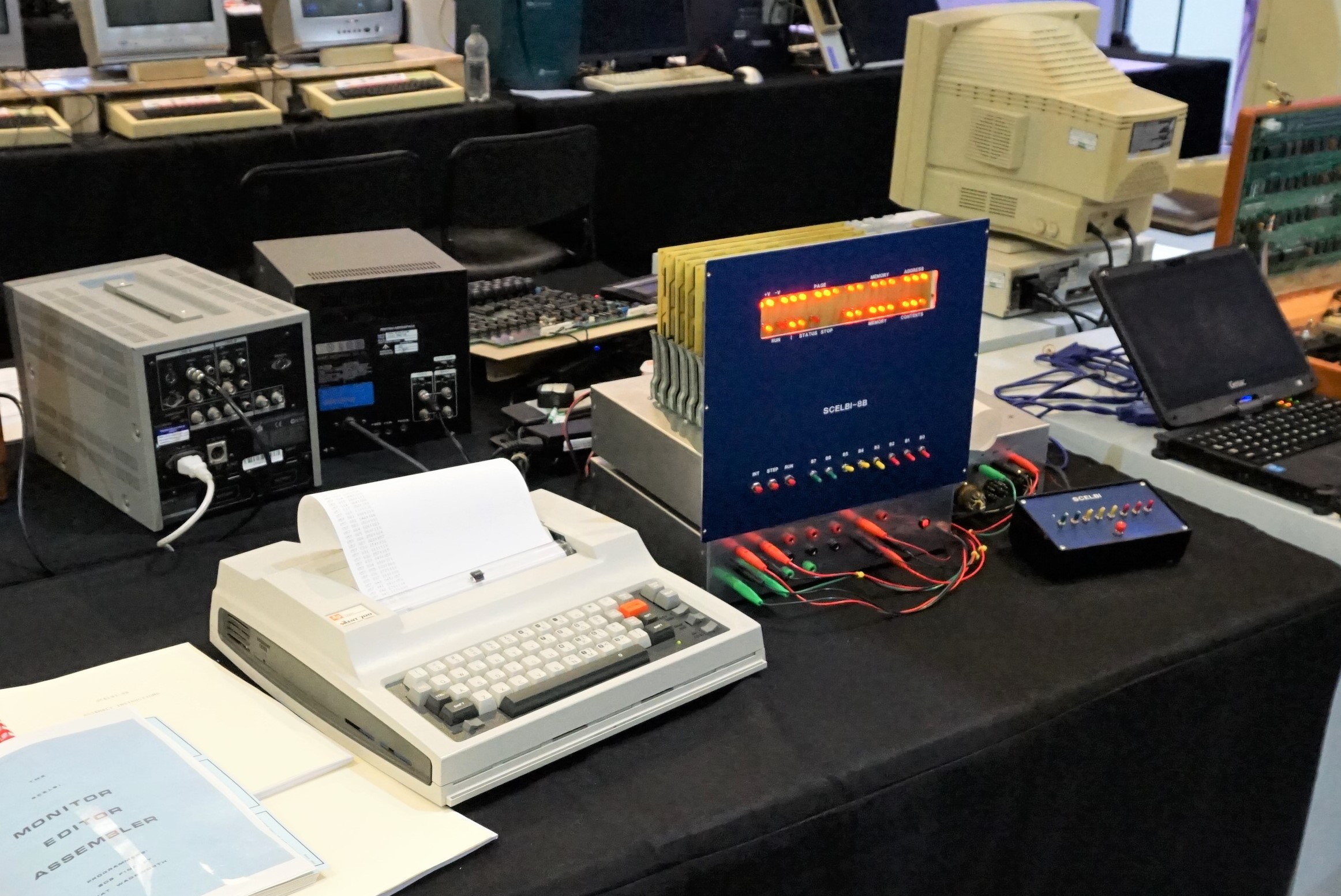
    SCELBI Front Panel Installed – new images

    Wednesday, September 11th, 2013

    I found a digicam and was able to take these photos.

    SCELBI Front Panel Natural Lighting

    SCELBI Front Panel Natural Lighting

    Front Panel - flash lighting

    Front Panel – flash lighting

    This panel has more scratches than most of them. Installed and in normal lighting it takes close inspection to reveal them. It is good enough that I’m going to use this panel on my “exhibition” SCELBI.

    Within the next week, I should be able to screen print the rest of the panels, figure out the best way to ship, and set a price.

    First Front Panel Screen Printed

    Sunday, September 8th, 2013

    Unfortunately I can’t find a decent camera, so this is a poor iPad shot. There are some small defects and a bit unevenness in the printing, but the overall appearance is good. I think I can improve the unevenness by using more “ink” during the “production” run.

    Trial Front Panel

    Trial Front Panel

    Front Panel II

    Front Panel II

    I have a jig made, so I can print the rest once I properly mount this trial unit and do a bit of checking on the how well the paint adheres to the anodized aluminum.

    Compare to some of the images at www.scelbi.com

    Kit and PCB availability Status

    Monday, August 26th, 2013

    Here is a summary of status of kits and PCB availability

  • Mimeo 1 PCBs – out of stock – new PCBs coming late fall 2013
  • Mimeo cassette interface kits – plenty in stock
  • Datanetics PCBs – less than 10 left – no brackets available – considering run of reproduction keycaps
  • PS/2 keyboard adapters – plenty in stock
  • Apple II rev 0 reproduction – out of stock – new PCBs coming fall 2013
  • Brain Board kits – less than 10 left – rerun plans are up in the air
  • SUPERPROTO PCBs and kits – less than 10 left – rerun questionable
  • SCELBI 8H PCB set – in stock – extra SRAM boards available, too
  • SCELBI TTY PCB – plenty in stock – still untested- caveat emptor
  • SCELBI front panels – probable Sept, 2013 – being anodized now, screen printing legend will be next
  • SCELBI 8B PCB set – layout work in progress – given the other ongoing projects, and other planned expenses, I’m realistically looking at 2014.
  • email: mike@willegal.net if you have any questions

    How Much Should 20 SCELBI Faceplates Weigh?

    Friday, August 16th, 2013

    THis question came to mind when determining why shipping cost from all the way across the country was only $4.95, which seemed low.

    I calculated this three different ways using the measurements of .1″ x 11″ X 12.75″ for the aluminum faceplate.

    1) Use this online calculator http://www.onlinemetals.com/calculator.cfm result was 1.4 pounds per piece for a total of 28 pounds. Actual weight should be a little less, because of the holes in the pieces.

    2) I looked up the mass of aluminum which is 2700 KG/M3. Then calculated the volume of 20 faceplates at 0.000226209 cubic meters. Multiplying the two results in 1.34 pounds per plate times 20 plates equals 27.87 pounds. Actual weight should be a little less, because of the holes in the pieces.

    3) Then I realized I should have just looked it up in the tracking information. Sure enough the weight of the package is 26.1 pounds, which is about what the calculations minus the holes showed it should be.

    I still don’t know exactly how the shipping was so low, but I’ll take it, knowing I have over 25 pounds of faceplates on the way.