Significant Updates to SUPERPROTO wiki

The reference section has been significantly improved with following topics added:

  • Power and Ground Planes
  • Prototype Area for ICs
  • General Purpose Prototype Areas
  • Apple II Bus Access
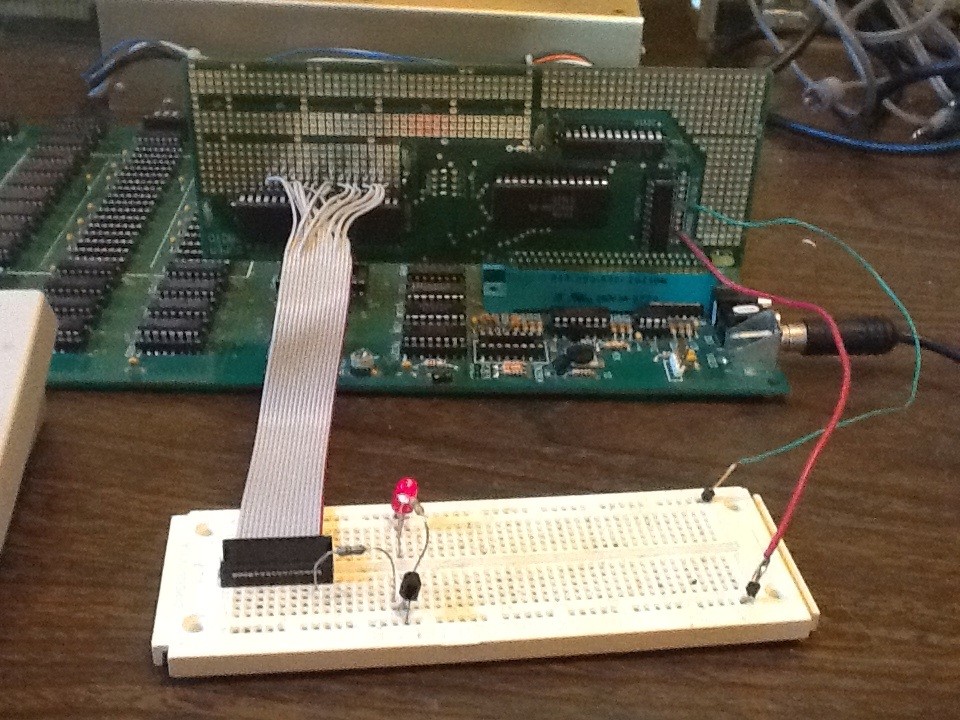
  • Extending to a Bread Board for rapid prototyping
  • I’m particularly excited about the breadboard section, as it opens up the Apple II to easy HW prototyping.

    SUPERPROTO connected to breadboard

    SUPERPROTO connected to breadboard

    A couple of years ago, James LittleJohn had offered a card (LittleProto II) with a breadboard built onto it. I think that the approach of a separate breadboard will allow you to easily work on your design, then when you feel that it is solid, move it permanently to the proto area on the card itself. In fact, Jon Titus had published a book back in the old days, that suggested a similar scheme for hardware interfacing. The book is called “Apple II Interfacing”. I talked to Jon about updating and releasing a modified version of this book a few months back, but at this point that project is in limbo.

    SUPERPROTOs will be at K’Fest

    I sent 10 kits to the show – they will be priced at $60 each. One additional kit has been donated to the organizers as a prize/giveaway.

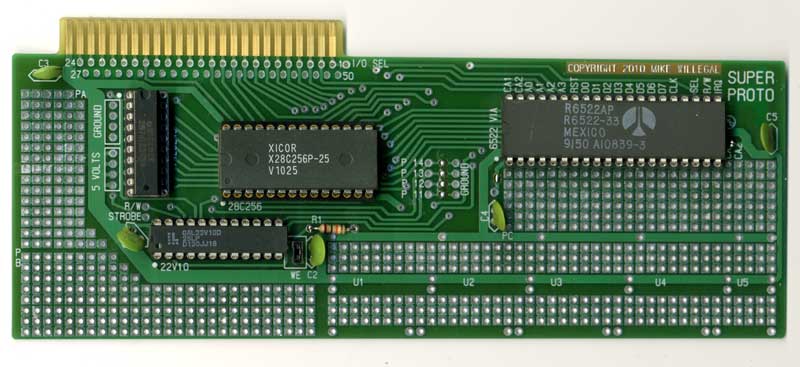
    Here is what the built up superproto looks like.

    SUPERPROTO

    SUPERPROTO

    More information is available on the SUPERPROTO wiki. This is currently a work in progress, as there are several areas that need more documentation. In particular is a description of how the copper layer in the proto areas is set up. It is kind of hard to see, since the solder mask tends to conceal the connections between the pads.

    I also need to add a page to show how to connect the SUPERPROTO to a separate breadboard for easy prototyping.

    More kits will be available in a few weeks, once I catch up on things.

    After the grounding issue with the Brain Board, I did as much research on grounding Apple II plug in cards, as I could. This included rereading some Apple Tech Notes on the topic, which were somewhat insightful, as well as examining existing designs.

    I really tried extra hard to make the ground plane on this board as good as I could make it, and still keep the 2 layer layout. The result exceeds my expectations, as the ground noise on the base SUPERPROTO card is almost non-existent. The 5 volt supply also received some attention, and it looks clean as well. In fact, the board looks much cleaner than my wire wrapped prototype, so I must have done something right.

    Mimeo update

    If you are on my waiting list for Mimeo kits, I should be contacting you in the next few days about PCBs. If you have been waiting for more than a month or two, feel free to remind me about your interest. PCBs will go first to those that have been on the waiting list the longest. The folks at Unicorn Electronics believe that they will have parts kits available as soon as next week. If you are waiting for assembled systems you will have to wait a while longer. I’m planning on doing enclosures this time and everything will take considerable time and effort to put together. I’m up to my ears in ongoing stuff, right now.

    New pricing and basic ordering information is posted on my Mimeo page:

    http://www.willegal.net/appleii/apple1-kit.htm

    Reminder – I will be supplying only PCBs (motherboard and monitor PROMs) – other parts for a complete motherboard kit should be obtained from Unicorn Electronics.

    For the smaller kits, like the Brain Board, ACI and PS/2 adapter, I’m still supplying the entire kit.

    Great Mimeo Kit News – Kits available soon

    PCBS

    The batch of boards I purchased last month were all sold as bare boards, so I’m getting a new batch made up. More than half of those boards went to a company in Los Angeles which turned them into non-functional props for the new Steve Jobs movie starring Aston Kutcher. I’m expecting that that movie will feature some cool looking props, when it comes out.

    Anyway the new batch of PCBs will take a couple of weeks to arrive.

    Kits

    I’m excited to announce that there will be some changes for those of you that wish to purchase Mimeo kits. I’ll be selling boards to you and parts kits will be purchased directly from Unicorn Electronics. I’ve sent BOM information to Rob at Unicorn, who is working hard to get all the required parts. Rob tells me that he has most parts on hand, already, but there are a few more to gather. I am really excited about this arrangement, as it should greatly increase the availability of Mimeo’s to the vintage computer hobbyist and free up time for me to work on new projects – a win for everyone. People wanting to build kits would have to take a couple of extra steps to get their kits. I think that this is a small price to pay for increased availability.

    Mimeo Assembly Manuals
    For hard copy assembly manuals, I’ll probably make it a separate, extra cost option, though I’m also considering using a print on demand service, so you would have to order the manual separately.

    Assembled Mimeos
    For those of you who want a built up Mimeo, I’m looking into building a few complete systems, with keyboard, enclosure and cassette player. Be forewarned, this sort of system will take a lot of time and money to put together. I haven’t set a price, but the number I have in mind will put it into the luxury item category.

    Apple II rev 0 PCBS?
    Ordering and putting together kits for Mimeo has been a huge time sink, and this change will allow me more time to work on new projects. If it works out well, I’ll also seriously consider making a new run of Apple II rev 0, reproduction motherboards. Unicorn would become the default parts supplier for that kit, as well.

    Simpler Kits
    For simpler kits, like the ACI, PS/2 adapter and Brainboard, I will continue to supply the complete kit, just like before.

    Vince Briel evaluating doing a cassette interface card

    Check out the post on his forum. I think all replica 1 owners should get a cassette interface for their units. Using an ACI is pretty essential to a faithful Apple 1 experience. Back in the the old days, it was…

  • the only Apple 1 expansion card ever offered by Apple.
  • the only way to share software between Apple 1 owners
  • Owners of original Apple 1’s or clones like my Mimeo or the Obtronix understand that without a Cassette interface, an Apple 1 Computer is nearly useless.

    Cassette interface technology can be challenging. Note that Vince’s unit is most likely to incorporate several design features that I first documented either on my web site, or on Applefritter.

  • input coupling cap change to .1UF- see my ACI page
  • referencing voltage comparator to ground instead of -12 volts: see the applefritter post
  • If you can’t wait for Vince to make an ACI board, I have authentic reproducion ACI kits in stock and ready to ship for $75. Drop me an email at mike@willegal.net

    8008 Performance

    To evaluate real world 8008 performance, I have done some performance measurements using SCELBAL in my 8008 emulator. The 8008 running a typical BASIC program, such as “99 bottles of beer on the wall”, executes around 32,000 instructions per second. That is .032 MIPS, for those of you that measure processor performance that way. In contrast, the 6502 is said to execute roughly 300,000 instructions per second. However that is not the whole story, as instruction set influcences performance of real world programs in a significant way. For example, a single memory access on the 8008 will require 3 instructions if the H and L registers are not set up in advance. The 6502 can access any memory location in the entire 64K address range with a single instruction, without any need for setting up registers in advance.

    Running a typical instruction mix, the 500 KHZ 8008 processor executes instructions about 10 times slower than the later 1MHZ 6502 used in the Apple ][.

    SCEBLI progress

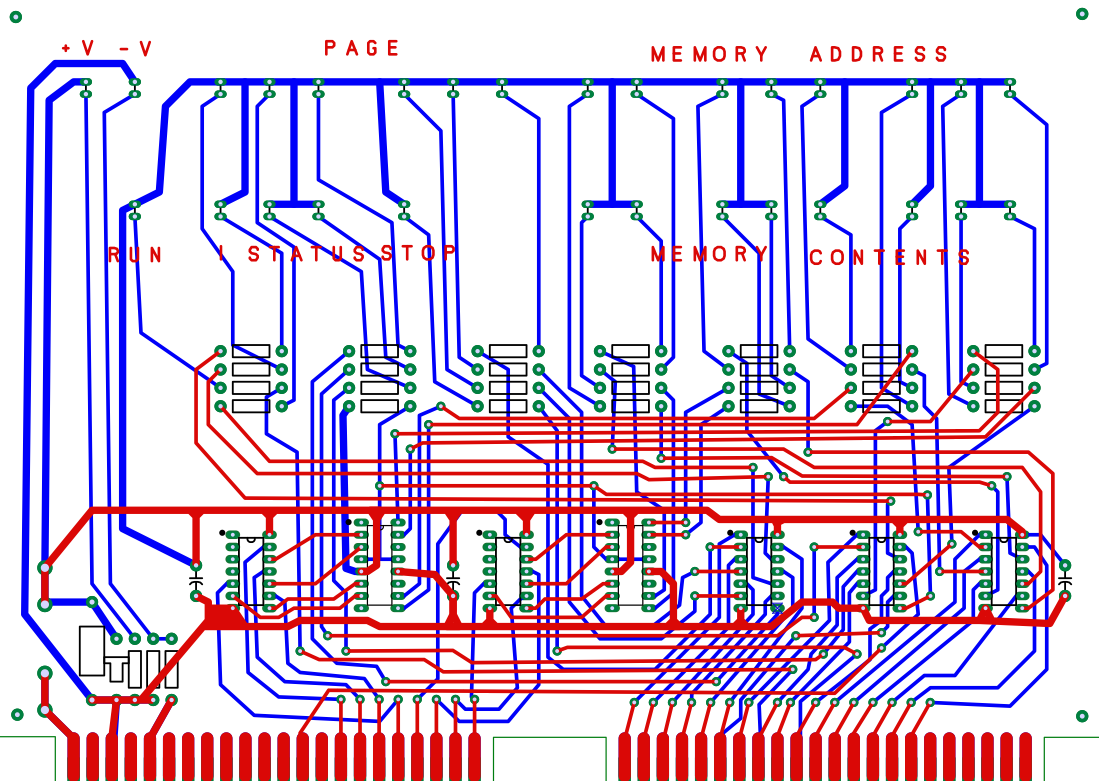
    Putting the CPU card aside for a while, I put some effort into the front panel card this weekend. First pass is already done, which is record time for a first pass. I guess all the work on the CPU card translated pretty well into basic layout and library stuff, which I could reuse.

    SCELBI Front Panel PCB

    SCELBI Front Panel PCB

    Next up will probably be the input card, which has a ton of complexity for a card with only 11 chips. Hopefully I can get a first pass of that card done in two weekends.

    First Lot of Super Proto Boards on order

    First, a little background.

    About a month ago, Rich Dreher tipped me off to an EEPROM issue he had seen in the past when interfacing an EEPROM to the Apple II bus. Well I didn’t have any issues with my prototype unit, but decided to do some additional testing with different EEPROMs. Back in the lab this EEPROM testing got confused with a flakey motherboard issue and the whole thing set me back a month.

    After moving to a different motherboard, I eventually figured out that ATMEL EEPROMs don’t play well with the Apple II address bus, just like Rich indicated. However, an alternate source, XICOR, makes EEPROMs that do seem to behave quite well, so I’m back on track. During initial bringup, I had done my original testing with XICOR, which is why I didn’t see the problem with ATMEL parts.

    So besides checking out EEPROM behavior, I made some design tweaks, checked out bus timing, made sure interrupts work and so on. At this point everything looks good,so I just pulled the trigger on a small trial run of boards. With any luck I may even manage to get some sent out to those of you HW hackers that are visiting K-Fest.

    I plan on completely documenting this board including the GAL online, so little to no printed documentation will be created. If I can figure out how to do it, I want to set up a wiki type documentation environment where prototypers can add their own designs and share their knowledge with everyone else.

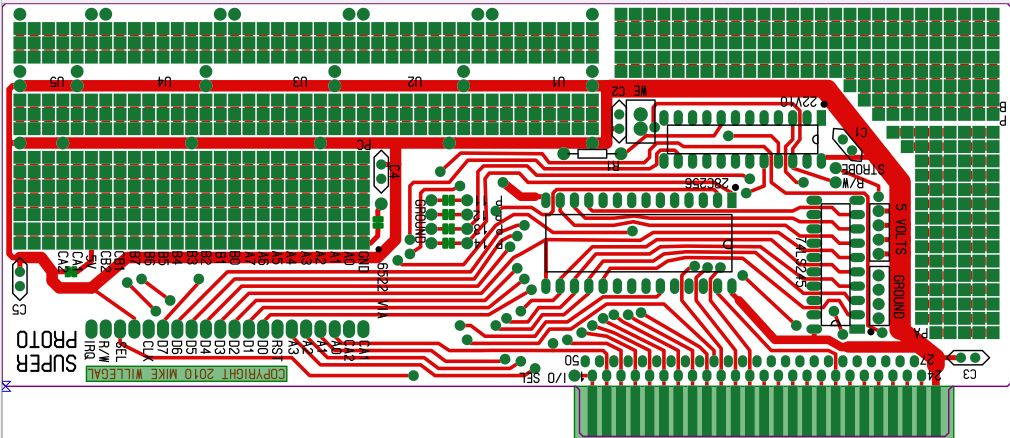
    Here is the top side layout:

    Super Proto Rev 0

    Super Proto Rev 0

    The base feature set includes

  • Onboard 32K EEPROM – only 2K is normally addressable from Apple’s C800-CEFF and CX00-CXFF I/O space
  • EEPROM is programmable directly from the Apple II’s 6502.
  • Glue logic integrated in 22V10 GAL – replaces a number of 74LS glue chips that are commonly seen in designs like the super serial card and the mockingboard
  • Data bus fully buffered with 74LS245
  • PCB location for 6522A VIA, with no additional glue logic required
  • Two general purpose proto areas
  • Locations for more than 5 300 mill DIP chips of varying pin count
  • With 6522 VIA, room for an additional 40 pin dip package. This does cut into 300 mill DIP area. but it should be possible build a 3 channel Mockingboard on the super proto board.
  • Synthesized psuedo PH2 clock available – was required for 6522 inteface
  • The hope is that this board takes care of all the heavy lifting of interfacing to the Apple II bus and lets you focus on the the fun side of hardware hacking on the Apple II.

    Pricing hasn’t been set, but it will be well under $100 for a kit. Bare boards will also be available.

    Stay tuned.

    New Version of OS/X Scelbi Emulator Posted

    Here is a summary of some of the main changes:

  • Mark Arnold (one of the original authors of SCELBAL) has fixed some mistakes in the version of SCELBAL I was originally using. These mistakes were introduced during the reconstruction of the program.
  • I have made changes to AS8 to support the RST instruction and my interpretation of how OUT port numbering should be implemented. If you are interested in this version, drop me an email.
  • The SCELBI expects that all inputted characters have the high bit set – and starshooter and SCELBAL have been reassembled to match. The power function such as 2^3 did not work in SCELBAL prior to this change.
  • The emulator itself now accurately counts cycles based on information gleaned from the 8008 data sheet. Each cycle takes 2 clocks and instructions take from 3 to 11 cycles. The emulator executes 250,000 cycles per second, same as an actual 8008. I should do some measurements using SCELBAL, but I’ve guessed that an 8008 might execute something like 30,000 instructions per second while running a typical program.
  • This version of the emulator uses port numbers to select serial or byte I/O, so the byte I/O menu has been removed. This effectively emulates a SCELBI with both serial and parallel (BYTE I/O) ports connected.
  • My 8008/SCELBI webpage can be found at this link-
    http://www.willegal.net/scelbi/the8008andScelbi.html

    Interesting Brain Board remote switch

    Corey Cohen came up with this easy method of creating a remote switch panel for the Brain Board. Here is an image of his prototype version. Knowing Corey, I’m sure that his final version will be mounted on a nice plexi panel.

    Brain Board Remote Switch Thingy

    Brain Board Remote Switch Thingy

    One DPDT switch controls which bank on the brain board is selected. Corey has loaded integer basic and the original monitor onto his second bank. The other SPST switch controls whether brain board or motherboard roms are selected after reset – this second switch is essentially the same as the firmware board toggle switch.

    One wire needs to be added to the back of brain board to connect Apples reset to the DIP socket at pin 2. Reset can be picked up from the onboard switch location. It is the center of the three holes.

    A ribbon cable is used to connect the remote switch box to the Brain Board. As you long as you stay within reason, longer ribbon cables than pictured should pose no issues. The only active signal is reset, which, when asserted, is held low for relatively long periods of time.

    Brain Board Remote Switch Setup

    Brain Board Remote Switch Setup