Keyboard Update

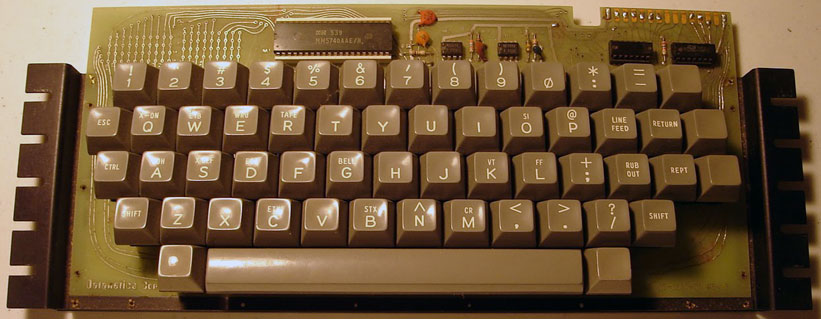
Keyswitches – though I have a batch of NOS (new-old stock) Datanetics key switches with straight stems, the original Datanetics had slanted stems. I decided that using straight stems on such an otherwise faithful reproduction would not be proper, so I’m doing a transplant from an older II plus keyboard that has the correct slanted stems. The NOS straight stems will go into the II plus keyboard. That II plus keyboard has seem better days, but is a fairly early one, so deserves to be restored. I’m waiting to attach the brackets and siffener to the Datanetics, before soldering the keyswitches into the Datanetics keyboard. There are more switches on the Datanetics than on an Apple II plus, but I have a few extra switches from a previous project that can be used to make up the difference.

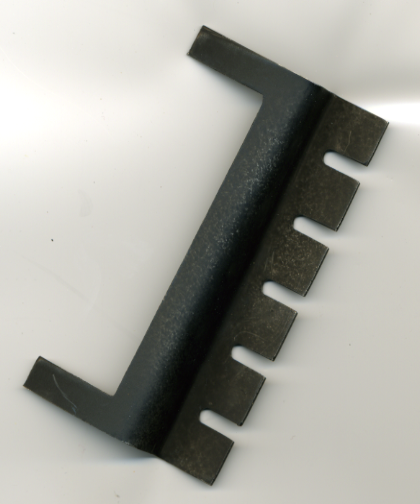
Brackets/stiffeners – I have bought a new 1/16″ drill bit in which to drill the rivet holes in these parts. I have rivets on order and will wait for the rivets to arrive before drilling. That way I can drill the first one or two holes, attach those rivets and be sure that registration of the rest of the holes will be good. I think Keystone #26 and #27 eyelets should do the job. This place has what looks like #26 eyelets, plus an eyelet setting tool. Mouser has both #26 and #27 eyelets.

http://volcanoarts.com/cart/eyelets/index.htm#1/16Tool

I’ll have to figure out final keycap solution at some point. For now I’ll manage with an Apple II plus set. Several folks are talking about getting a custom set made – so there may a group buy in the future.

There are two possible routes to go in regards to the connector. One solution is a PCB style board edge connector mounted onto a small PCB that will accept a 16 pin DIP header. The other is wiring the ribbon cable from the Apple -1 directly to a board edge connector. The row spacing is .156 and it has 15 positions/30 contacts. It seems like both Digikey and Mouser have stock of both PCB mount connectors and the ones with eyelets for direct wiring.

I drilled out the vias in the matrix on my PCB yesterday with a #67 bit and a pin vise. My bit wasn’t particularly sharp, but it worked out fine. I could have used a drill press, but using the pin vice ensured that I would go slow and helped avoid any mistake. I used an ohm meter to verify that the connections were broken and only had to go over a couple of holes a second time, to break the circuit. When doing this, you have to be careful that you only drill out the vias in the matrix area. There are some nearby vias that need to be left intact.

I also used a pin vise and a 1/16″ bit to ream out the slightly undersize mounting holes for the keyswitches. These are still a tight fit, so some more reaming may be necessary when I finally mount the keyswitches.
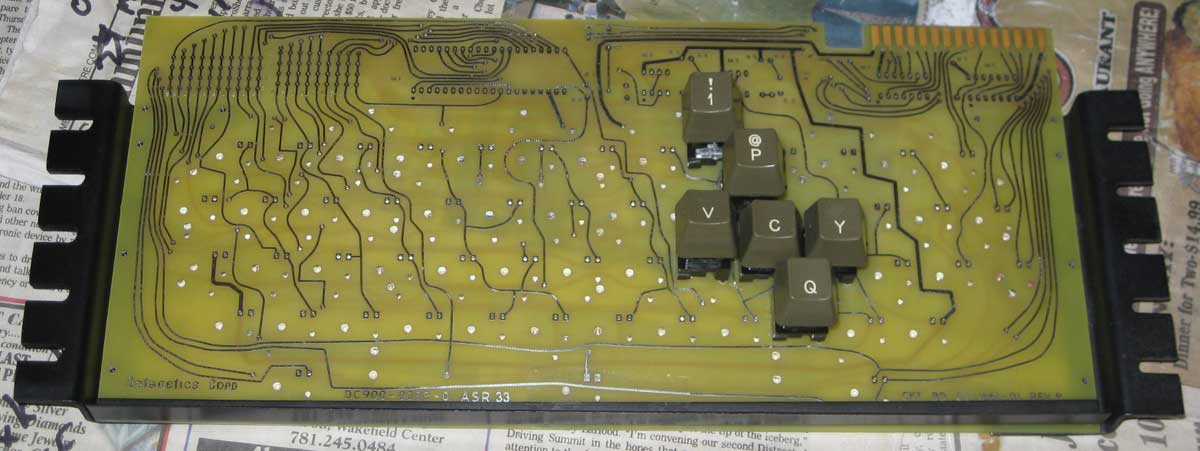

Datanetics PCB here

I’m really pleased with the result and think every Apple 1 owner will want one!

reproduction datanetics keyboard

compare the replica to the real thing which can be seen here http://www.willegal.net/appleii/images/dataneticsrevb.jpg

Many thanks to Mike Gregory for doing an excellent job cutting/bending and painting the brackets.

Besides finding your own components, it’s going to take some extra skills in order to put this together, including some drilling of brackets, mounting of eyelets, drilling out of vias and reaming of the keyswitch mounting holes (some were made just a bit too small). No detailed instructions will be provided, either. I’m calling this a level 5 kit (the hardest) in my new kit skill level grading system. Grades of other kits are as follows.

1) Apple Cassette Interface
2) PS/2 keyboard adapter
3)
4) Apple 1, Apple 2
5) Datanetics keyboard

Only 10 are have been made and most are already accounted for. Send me an email if you want more information and to get on the interest list.

Build-able Source for 4 versions of Apple 1 Basic

I have taken Eric Smith’s disassembly of Apple 1 Basic and made it build-able with an Assembler called DASM.  But there is more,  I have compared the object code with 5 published versions of Apple 1 Basic and modified the source so that any of 4 slightly different versions can be built.  At some point, when I get a better understanding of what the differences functionally accomplish, I’ll document and put a page up on my web site.

This work is derived from Eric’s original disassembly, Eric has been gracious enough to allow me to distribute.

http://www.willegal.net/appleii/a1basic.asm

I understand that there are likely to be more versions out there, as Apple 1 basic was a work in progress during the life of the Apple 1 and WOZ distributed improvements as time went on.

Datanetics reproduction PCBs on order!

After dragging my feet on this for a number of months, I finally pulled the trigger. 10 PCBs are on order.  Anyone who asked about buying them in November will get first chance to buy.  Any left over will be made available, first come, first serve.

Brackets and stiffeners are being fabricated also.  I have the first prototype end bracket on my desk here and it appears to be an outstanding reproduction of the original in all respects.  Part of this project will require drilling out the rivet holes in these pieces.  You will be able to use the PCB as guide to ensure proper registration of holes between the PCB and the end bracket or stiffener.

end bracket

Pricing is up in the air, as I will save some money by drilling out the plating in the matrix area of the PCB myself. On the other hand,  I haven’t factored in the cost of the end brackets/stiffeners.

Datanetics PCB update

I’ve had a pretty small response to the offer on the Datanetics PCB.  Despite the small numbers of folks interested, I’m still going ahead with this as a one time deal.  Before doing so, I’m going to spend the next couple of days looking for better pricing on the PCB.  Ordinarily I’d stick with my current fab house, since since I have had such good luck with them.  However this PCB doesn’t have a solder mask or silkscreen, so I should be able to find a cheaper place to do this board and still get good results.   Since I haven’t collected money yet – if I turn up a better price, I’ll adjust the pricing.

The ACI Parser Bug

I don’t know if this is really a bug or a compromise in the design needed to get it into 256 bytes of code space.

Always enter all four characters of 16 bit hex address when entering addresses into the ACI parser.  The parser doesn’t clear out preexisting addresses, so unless you enter all four address characters, you will use whatever was already present in memory mixed in with the new address.

EXAMPLE:  to load Hamarabi enter the following

004A.00FFR 0400.0FFFR

Datanetics Keyboard Plans

These PCB boards are turning out to be very expensive to make, partly because of the need for the array of unplated vias in the encoding matrix on the upper left side of the board.  These unplated holes push this project into a custom fab process pricing, which increases cost by 25%.  Because of this, and the specialty nature of this project,  I’m not sure how many to order.  What I’ve decided to do, is to make November a pre-order month.  At the end of November, I will order enough to fill the pre-orders only.  There are no plans to stock or inventory any of these PCBs to sell later on.  The cost of the PCB will be $79 and will include no hardware, chips or other components.  I can’t even guarantee the PCB will be error free.  Actually I’m reproducing a design error that was on the original, but beyond that I can only say that I’ll do the best that I can.  However, if they turn out to be unusable, I’ll eat the cost and either get a new batch made or refund your money.  Shipping within the lower 48 US states will be free. Add $25 for overseas shipping.

Pre-orders will the accepted through the end of November.  Fabrication of the PCBs is expected to take a month, and shipment to you about a week after that.  Which would put the PCB in your hands in the first half of Janurary.

send email to “mike@willegal.net” for preordering information.

PS. If one of us can find a sheet metal vendor to do the stiffeners, I’ll be glad to coordinate a batch purchase of those at cost.

Small Apple Cassette Interface update

I have had it confirmed from an independent source that the ACI works fine with Vince Briel’s replica 1 SE.  This same person has also successfully tried a  Radio Shack 14-109 (no longer sold) as well as the CTR-80A which is a cassette recorder packaged with the TRS80s.

If you have used a particular cassette recorder, successfully or not, let me know and I’ll share the information.

We have both noticed erratic operation of the LED, but I have previously reported that the LED can not be reliably used for setting playback volume.

Possible A2 Hobby Board Project

Here is another project that I am considering.

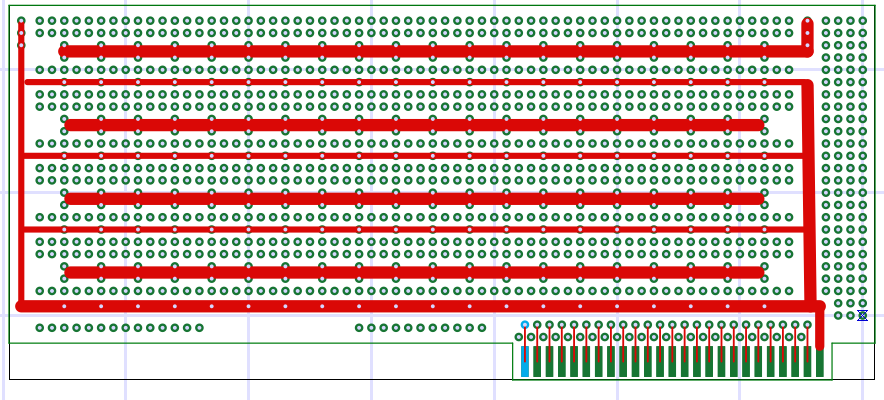
A2 Hobbyboard Layout

This is the beginnings of a layout replicating an original Apple 2 Hobbyboard.  This is a prototyping board intended for creating your own Apple II expansion card.

I’m thinking of building a batch of  either exact replicas or possibly modified with some improvements that I have in mind. This board layout is ideal for wirewrap applications, but I’ve moved beyond wirewrap a few years ago, so I’m likely to modify it for point to point wiring.

I’m also thinking of putting together some project kits that could be implemented on this board.  Projects I have done already that could be easily adapted, include my shutter tester and the improved firmware card.   I have other ideas like a spectrum analyzer for audio frequencies.

Let me know what you think and if you have ideas for projects for this hobby board.  Also if you have ideas for what features you would like to see in a prototyping board, let me know.