Apple II rev 0 replica kit status

March 23rd, 2010

Have you noticed that we’ve seen more Apple 1’s on eBay over the last year than A2 rev 0 boards. Who would have believed that.

I currently have 5 Apple 2 rev 0 replica motherboard kits and 1 built motherboard ready to go. Once these are gone, I’ll will not be reordering until I build a respectable wait list of 10 or 12 people. Shipments of these kits are slow, so it may take several years to build up the wait list to that kind of level.

Thinking ahead a bit, I’m considering asking for a small deposit to get on this wait list. If the list doesn’t reach critical mass within a set period of time like a year, I’d refund deposits, but keep you on the list as long as you maintain interest in obtaining one of these kits.

New Batch of Mimeo Boards Ordered

March 23rd, 2010

For those waiting or otherwise interested, I’ve shipped the last of my first batch of Mimeo boards last week. Today I ordered a new batch. It will be about 2 weeks before I can start shipping Mimeo kits again. Just in time for your tax refunds to come in – right? If everyone one on the wait list comes through, I still should have a few extra kits to have in stock and ready to ship.

City Point Railroad Planning

March 14th, 2010

With most of the engineering work done on the Apple-1 motherboard, I’m looking again at the City Point Railroad.

First module is going to be the tracks that lead into the yard. This is a fairly simple area that will allow me to develop some basic tracklaying and landscape techniques without involving too many complex structures. Here is my current plan, the grid is 100′, but when I printout my hi-res working version, the scale is 87′ to the inch, which should make transferring the plan to the actual layout fairly easy.

Based on current plans this module will be 7′ long and about 2.5′ wide at the widest point.

Extremely limited quanities of kits shipping to folks on wait list!

March 12th, 2010

I’ve got a very few full kits ready to go and I’ve started shipping to folks on the wait list! Currently quantities are very limited, so I’m working through the wait list, in a first come, first serve basis. Some folks are declining this opportunity, so if you are on the wait list and haven’t received word, stand by, you may receive word soon. If I already sold you a bare board or partial kit, I’m going to give the others on the wait list a first chance, before giving you a second chance. This may not be the fairest way to go, but I’d like to give more people a chance at getting their hands on some hardware.

I need the income from these first kits to fund building a second batch of boards, so as soon as I sell the last kit from this initial set, I’ll be ordering the second batch, plus a few, easy to find, parts that I’m short of. If you don’t get a shot at a kit from the first batch, the second batch will not be far behind.

I’ve got a tentative plan on how I’m going to price partial kits. You will be asked to fill in a spreadsheet with numbers of each type of part you want to include. I’ll simply use the ratio of my costs, of the parts you choose, to my costs of an entire kit. This ratio will be multiplied by 666.66 to determine your cost. If your cost is totals less than something like $300, I’ll probably add a reasonable surcharge, since it is a lot of work to put together custom partial kits. Actually full kits are a lot of work to organize and put together, but at least I can do them in batches.

Also, I’ve got word from a reliable source that a beautiful unmodified example of an original Apple-1 is due to go up for auction soon, along with some wonderful Apple II related stuff. Among other things, is the very first production Disk ][ drive(serial number 1), prototype disk controllers and an Apple II rev 0 modified by Apple engineering into what was essentially a rev 1 engineering prototype. All this and more comes from the stash of a former member of the Apple engineering team.

Capacitors Arrived

March 9th, 2010

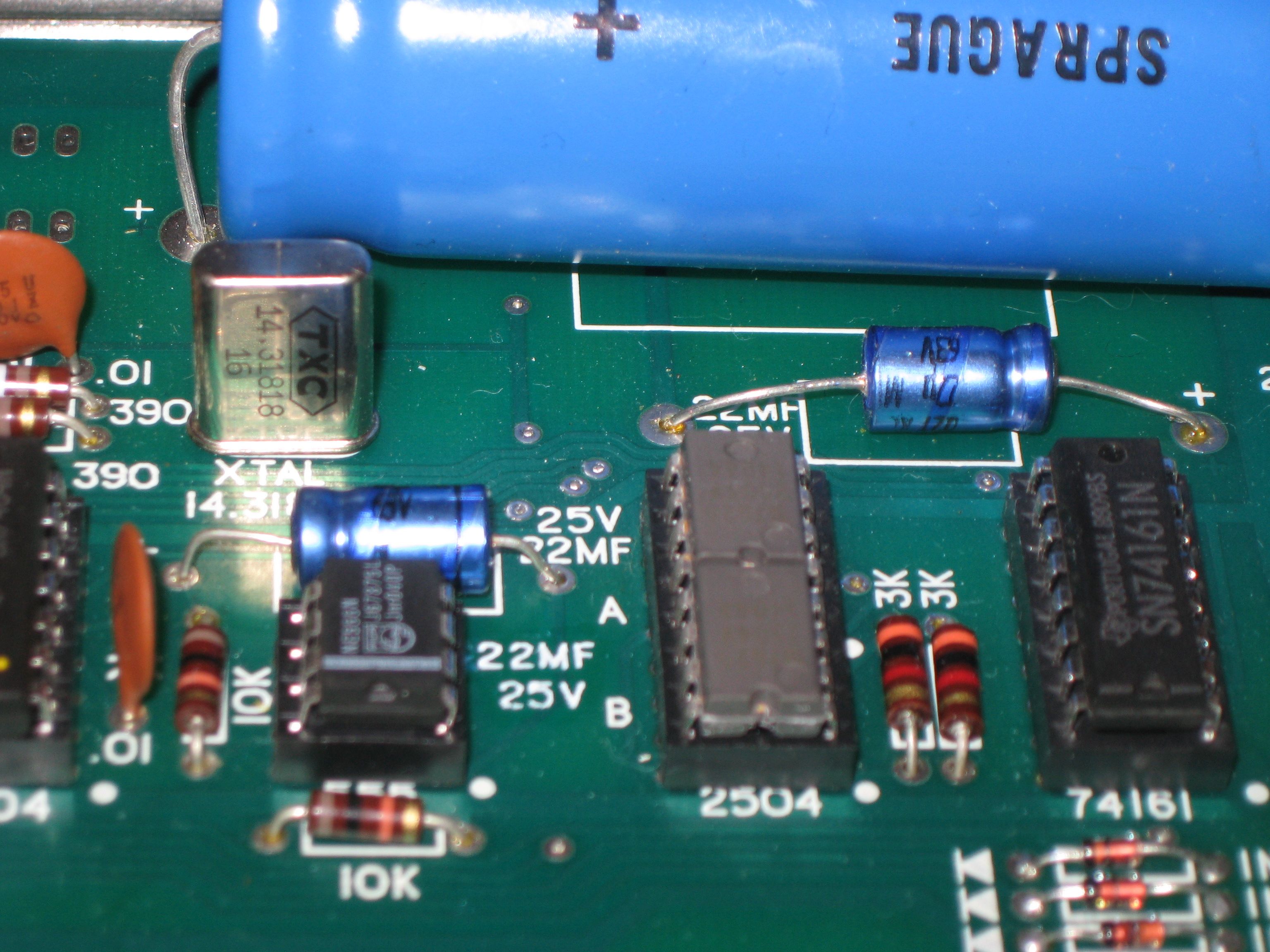
These are ceramic disk caps. A little smaller than the ones used on original Apple 1s. However I like the look a lot better than the monolythic caps I had originally purchased. I’ll get a good quality image up on my website, so prospective purchasers can see the component selection that I will provide. Then, I’ll send emails out offering kits to first few folks that got on the waiting list. Once I sell out the remainnig stock of PCBs (I only have 3 left). I’ll use the income to order a new batch which only should take a couple of weeks to arrive. Except for the PCBs and a few easily obtainable parts, I think I have enough of the other components to supply kits to everyone who is currently on the waiting list.

I also received the lower beta transistors with the caps. Results are mixed. One version didn’t have enough amplification and the video signal was barely visible at max monitor brightness. The other improved results, but didn’t completely eliminate the video glitch. If you are interested in fixing this issue, I’m going to recommend pulling C13, pin 6 down to ground with a 2.2K resistor, which completely eliminates the issue. This can be done in a completely reversible fashion without altering the PCB by soldering the resistor from pin 6 to pin 8 directly on the legs of the 74175 at C13.

Various Thoughts…

March 5th, 2010

Capacitors and transistors still not here, but I expect them any day.

Although I have more testing to do, I believe that the software for the PS/2 to ASCII keyboard interface is working the way I want it to. I still need to hook it back up to an Apple 2, as well as try a different keyboard(all testing to date has been with a single example). I plan on building a small batch of printed circuit boards, once I get a few of the Apple 1 kits shipped out. The Apple 1 project has been expensive and I’m going to need to recoup some of the investment before spending more money.

If you stick to acquiring old units through flea markets, word of mouth and yard sales, retro-computing doesn’t tend to be an expensive hobby. However cloning an obsolete design can get expensive, real quickly.

Now that the Apple 1 is nearly complete, my mind has been free to start revisiting some projects that are on hold. I have been looking to see if I have overlooked any internet data on the City Point and Army Line Model Railroad. So far, it looks like my previous research efforts have turned up most of what is readily available. Once the Apple 1 stuff has settled down, I plan on building an initial module in order to try out some construction techniques. I also have some thoughts about animating the layout using my Mimeo 1 as the brains. Animation of a layout in this era might be a bit different than more modern eras, since the internal combustion engine and electric power were not developed. However there was plenty of wind, steam, human and horse power available to move things around. Also the sounds of a busy wharf might make for some interesting computer controlled sound effects.

One other thing I’ve got on the drawing board, is putting together a short video podcast demonstrating operation of the keyboard interface and the Apple 1 monitor. Be forewarned, if you have subscribed to my podcast you might have a large file coming your way, in the not to distant future.

Caps not arriving until late next week (at the earliest)

February 26th, 2010

Seems like my supplier has had a glitch and hasn’t yet shipped the caps. I want to try these caps, before I finalize decision on which caps to ship with Mimeo kits. This will set back putting kits up for sale until I get them and have a chance to try them out. Maybe I’ll be ready a week from Monday. The lower beta transistors I want to try on the video output, are also part of this order.

Meanwhile, I’ll see if I can solve the power up problems with the PS/2 to ASCII converter. I have changed the brownout detector setting, which helped, but that didn’t completely solve it. I have significantly rewritten the initialization code, closing some holes and adding some retry logic, but haven’t had a chance to try the new code yet.

PS2 to ASCII interface work

February 21st, 2010

Since I didn’t get the new caps and transistors yet, I went to work on the PS/2-ASCII interface. Well except for an issue with booting up reliably, it seems to be working. I need to work on the AVR fuse settings for power up and/or add power on reset circuit.

PS2 to ASCII adaptor test setup

For the Apple-1 clear function I added a diode to the AVR’s output, similar to what is seen on the input to D15, pin 9. This is necessary because there is another TTL output that can drive this signal.

PS/2 to ASCII adaptor

The three jumpers on the right side of the board are to disable/enable the following functions.

  • enable automatic arrow mapping to Apple 2 – ESC-char cursor control sequences
  • enable inverted data – not needed for Apple 1 or Apple 2, but added in case some other vintage computer needs inverted data
  • enable/disable Control – RST and Control -CLR – reset and clear screen sequences
  • There are several options for mapping the wiring from 16 pin dip ribbon cable to the AVR.

  • It can be wire wrapped as I did on my prototype
  • The header can be left off and it can be done directly with jumper wires
  • You can build a plugable jumper block in a housing that plugs onto the header
  • Beta Version of Assembly and Build Manual Posted

    February 17th, 2010

    http://www.willegal.net/appleii/A1-assembly-v0.8.pdf
    Take and look and let me know what you think. If you find problems or mistakes let me know. Actual printed manual that comes with full kits will include full color image of the front of my prototype board on the covers.

    I have also put up an initial draft of my kit information page.
    http://www.willegal.net/appleii/apple1-kit.htm

    Video Imperfection

    February 16th, 2010

    There is a small flaw in the video section of the Apple 1, that causes spikes in the video signal. This results in extra pixels in the display. Here is a worst case display, with brightness turned way up, of those pixels, with no characters displayed ( the screen should be blank).

    I have been able to confirm with some help that this fault also occurs on the Obtronix and original Apple Is. I’ve tracked this down to cross talk between the video signal from C13-6 to the 3K resistor and CLK03, which feeds the 2504s clocks. These two signals share adjacent traces across the top of row D, just above the large ground trace.

    Wendell S. has done some further analysis and has determined that the fault is caused by the high impedance nature of the video output circuit. Wendell writes “The node driving the 3K can be very high impedance when both C13-6 and D1-13 are high so the network is very susceptible to pick-up as you described (nice catch!). The impedance of the node is set by the base current of Q5 as it pulls down the emitter followers in the TTL outputs.”

    I’ve ordered some transistors with lower Beta in order to see if I can eliminate this noise. I also did a quick test by pulling down the output C-13, Pin 6, with a 2.2K resistor and as expected, the noise completely disappeared. Another fix is to bypass the trace by lifting one leg of the 3K resistor and C-13, pin 6 and running a jumper wire, avoiding the crosstalk.

    Along with the aforementioned lower beta transistors, I’ve ordered some capacitors that I hope more closely mimic the originals. The assembly manual is also moving along, though I had a bit of a setback recently, when I accidentally put the whole manual into a bullet type format. I’m still undoing that. I’ll put a PDF version online once I finalize it.

    I’ve been getting a number of inquiries about bare boards and kits. Bare boards should be shipping in about a week and will cost $150. Kits should be ready about a week after that and will cost $666.66.

    Folks that are on the wait list will get first chance to order. I may have to order a new batch of boards, before I get completely through the wait list. Delivery of my first batch was pretty quick, about 2 weeks, so I don’t expect huge delays if I do run out.