Archive for the ‘Apple 1’ Category

Updating Mimeo web pages and the enclosure is started

Saturday, April 17th, 2010

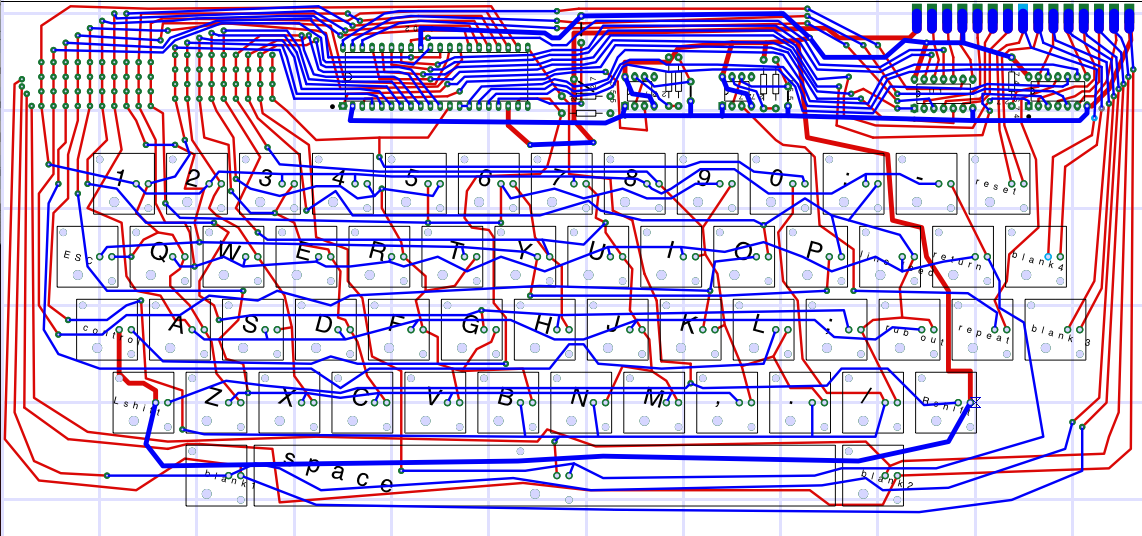
Revamped my Apple 1 web pages – basically splitting information into separate pages that should be easier to browse:

http://www.willegal.net/appleii/apple1.htm

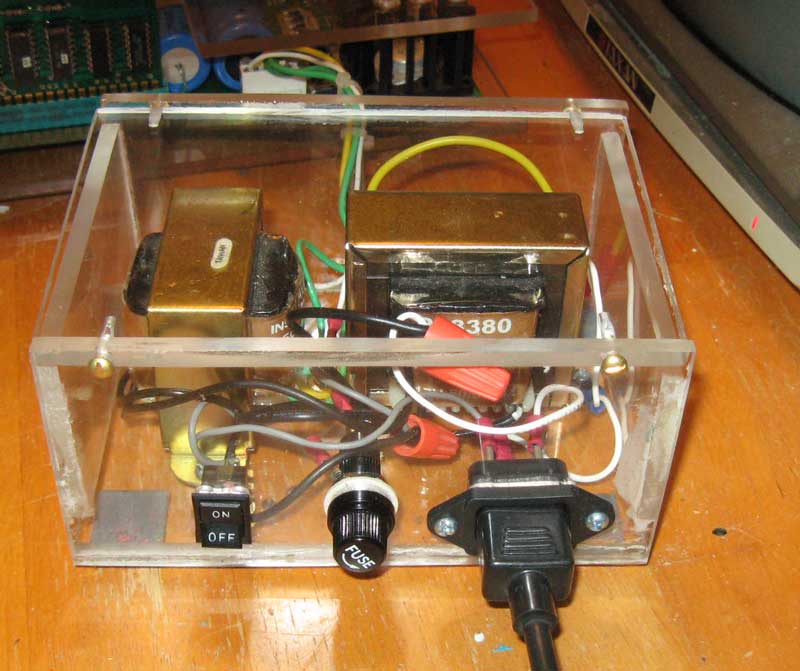
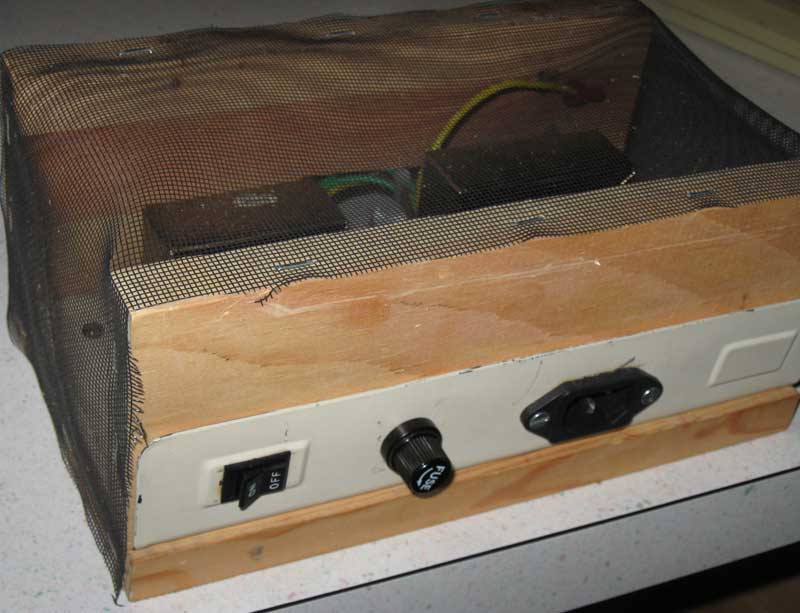
I also have started work on my Mimeo 1 enclosure. I’ll document work on this web page:

http://www.willegal.net/appleii/apple1-enclosure.htm

My “process page” now includes a close up side by side detail of a small part of the original and Mineo PCBs.

http://www.willegal.net/appleii/apple1-process.htm

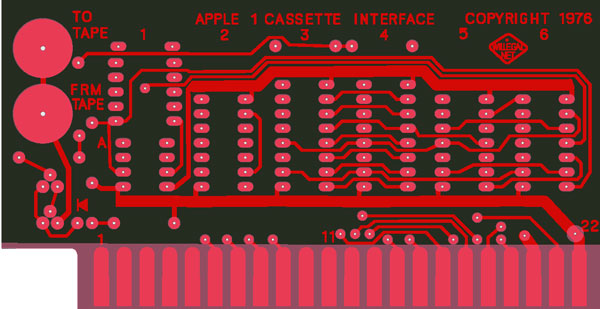
Apple Cassette Interface Revisited

Sunday, April 11th, 2010

Yesterday, I spent the good part of the day with the ACI and finally have a good fix that makes it far more robust without changing the board layout. In the past I had discovered that the Apple II cassette interface is far more reliable than the Apple 1 was. I did spice simulations of both and quite a bit of fooling around with the actual ACI in order to see if I could figure out the problem. The best improvement I could come up with, was to add a low pass filter on the input. This was done by adding a .01uF cap between the input side of the comparator and ground.

In revisiting the ACI yesterday, I finally discovered the real difference in the design that makes the Apple II so much more reliable. The Apple II uses a .1uF capacitor for input coupling versus a .01uF on the ACI. When I looked at this in the past, I must have forgotten to make this change when evaluating the designs with spice. This change provides a lot more noise immunity in the comparator inputs.

Here is the ACI input signal with the stock .01uF input coupling capacitor. The source of the signal is the 1HZ tone (all ones) at the front of Wendell Sanders Hammerabi clip being played from an iPod with the equalizer set to “treble reducer”. All signals are displayed at .5 volts/division on this page.

In the image, above, the input is the bottom signal and top signal is how it is presented to the comparator input after passing through the capacitor. Note how the signal spikes and then returns to the value set by the 10K resistors.


Above is the same input and output signals with a .1uF capacitor. The signal follows the shape of the input waveform much more closely. The bottom trace is input signal and is the same as in the first image. The top trace is input to comparator after passing through cap. Note how the extra capacitance prevents the resistors from quickly returning to the base value set by the resistors.


This image shows both inputs to the comparator with the stock .01uF capacitor. Spiky looking trace is input signal to comparator (same signal as seen in first image). Other trace is reference signal with hysterisis. The reference signal is pulled up and down slightly as the comparator switches state to prevent instability. This results in the square wave.

In the picture above, the output switches state when input signal (more spiky looking signal) passes the level of the reference signal as can be plainly seen in this image. The problem with this design is the limited amount of room between the input and the reference, any input noise with an amplitude of around .2 volts or more may be enough to trigger a switch in output levels.

Below are the same two inputs to the comparator with the .1uF cap. This wave form increases noise immunity to almost a volt, about 5 times improvement over the apple 1 stock implementation.

Unless you are interested in maintaining complete commonality with the original Apple 1, I highly recommend using a .1uF capacitor in your replica cassette interface instead of the .01uF used in the original design. Keep in mind that the folks at Apple recognized this improvement before coming out with the Apple II, as that design includes .1uF cap for this application.

Since I was using a clone ACI, built with components based on the schematics, I wondered if Apple actually shipped with .1uF caps on the ACI. I exchanged a couple of emails with Wendell Sander. He confirmed that the schematics are correct and the Apple ACI did indeed ship with a .01uF caps. He also confirmed that he had independently come to the same conclusion regarding the reliability improvement that could be attained with a .1uF cap.

PS/2 RS232 to ASCII Keyboard Adapters Now Available

Wednesday, April 7th, 2010

Go to this web page for details:
http://www.willegal.net/appleii/appleii-kb-int.htm

In my opinion, building one of these adapters is not very difficult. I have been able build and test one of these adapters in about an hour.

If you can get a piece of Apple 1 software into Apple Monitor Command format, I believe that this RS232 interface is one of the most straight-forward ways to download software from a PC to your Apple 1.

Silk Screen Problem Resolution

Tuesday, April 6th, 2010

The last post mentioned a problem with the silk screen with my new batch of boards. Well, I contacted the fab house, Advanced Circuits, and explained how critical the silk screen is to the people I share the boards with. They are going to rerun the boards- hopefully I’ll have the new boards in my hands at the end of the week.

One more thing – Advanced also explained why they like to mask off the silk screen from the copper. If you decide to flow solder your board, keep in mind that the flow soldering process may cause the silk screen that is located directly on the copper layer to lift off.

In case you have any thoughts of getting a deal on the boards with the bad silk screen, Advanced asked me to send them back, so it isn’t going to happen.

6502 Memory Test Posted

Saturday, April 3rd, 2010

I put together a 6502 memory test that can be loaded through the monitor. This is to help A2 and A1 kit builders test out their boards. Here is the link:http://www.willegal.net/appleii/6502mem.htm

Next batch of Mimeo’s is due to arrive Monday along with the first batch of PS/2-RS232 ASCII keyboard adaptors.

PS/2 RS232 ASCII Interface Manual Posted

Saturday, March 27th, 2010

While waiting for the new PCBs to arrive, I’ve been working on the PS/2 RS232 to ASCII keyboard adapter manual. Currently at 14 pages, this manual seems quite long for a device with 2 chips, some connectors and a few capacitors.

I just posted a preliminary draft of it here – Since I don’t yet have production boards to test, assume that the manual may have errors, but it will give you an idea of the capabilities of the device.

PS/2 & RS232 to ASCII Keyboard Interface Update

Tuesday, March 23rd, 2010

Well I bit the bullet and ordered a lifetime supply of these boards. I’m sure I’ll have enough that someone will end up throwing them away when I die. Economics of these small boards is such that increasing numbers does not significantly increase cost. You can get 50% more for 15% more cost. Actually the curve is so steep that it is kind of nuts.

These boards are going to solve 2 problems for Apple 1 owners. First is finding a keyboard, which is a harder problem for many people than I originally anticipated. The second problem is loading software. The RS232 part of the interface is write only, but it will allow you to dump a program into memory using monitor commands using a PC’s application such as hyperterm. I plan on putting some programs for the Apple 1 on my website in “monitor format”, such as Apple Basic.

I’m thinking that the price for a kit will likely end up at around $39, postage paid for shipments within USA. You will need to provide a PS/2 keyboard and/or a serial interface to your PC along with the right cable.

Including the RS-232 cable adds a lot to the cost and weight of shipping, so I’m not including it as an option. Many of you may have such a cable laying around or be able to build one. Digikey sells the cable I’m using:part # AE9879-ND. I’ll post specs soon on my website.

New Batch of Mimeo Boards Ordered

Tuesday, March 23rd, 2010

For those waiting or otherwise interested, I’ve shipped the last of my first batch of Mimeo boards last week. Today I ordered a new batch. It will be about 2 weeks before I can start shipping Mimeo kits again. Just in time for your tax refunds to come in – right? If everyone one on the wait list comes through, I still should have a few extra kits to have in stock and ready to ship.

Extremely limited quanities of kits shipping to folks on wait list!

Friday, March 12th, 2010

I’ve got a very few full kits ready to go and I’ve started shipping to folks on the wait list! Currently quantities are very limited, so I’m working through the wait list, in a first come, first serve basis. Some folks are declining this opportunity, so if you are on the wait list and haven’t received word, stand by, you may receive word soon. If I already sold you a bare board or partial kit, I’m going to give the others on the wait list a first chance, before giving you a second chance. This may not be the fairest way to go, but I’d like to give more people a chance at getting their hands on some hardware.

I need the income from these first kits to fund building a second batch of boards, so as soon as I sell the last kit from this initial set, I’ll be ordering the second batch, plus a few, easy to find, parts that I’m short of. If you don’t get a shot at a kit from the first batch, the second batch will not be far behind.

I’ve got a tentative plan on how I’m going to price partial kits. You will be asked to fill in a spreadsheet with numbers of each type of part you want to include. I’ll simply use the ratio of my costs, of the parts you choose, to my costs of an entire kit. This ratio will be multiplied by 666.66 to determine your cost. If your cost is totals less than something like $300, I’ll probably add a reasonable surcharge, since it is a lot of work to put together custom partial kits. Actually full kits are a lot of work to organize and put together, but at least I can do them in batches.

Also, I’ve got word from a reliable source that a beautiful unmodified example of an original Apple-1 is due to go up for auction soon, along with some wonderful Apple II related stuff. Among other things, is the very first production Disk ][ drive(serial number 1), prototype disk controllers and an Apple II rev 0 modified by Apple engineering into what was essentially a rev 1 engineering prototype. All this and more comes from the stash of a former member of the Apple engineering team.

Capacitors Arrived

Tuesday, March 9th, 2010

These are ceramic disk caps. A little smaller than the ones used on original Apple 1s. However I like the look a lot better than the monolythic caps I had originally purchased. I’ll get a good quality image up on my website, so prospective purchasers can see the component selection that I will provide. Then, I’ll send emails out offering kits to first few folks that got on the waiting list. Once I sell out the remainnig stock of PCBs (I only have 3 left). I’ll use the income to order a new batch which only should take a couple of weeks to arrive. Except for the PCBs and a few easily obtainable parts, I think I have enough of the other components to supply kits to everyone who is currently on the waiting list.

I also received the lower beta transistors with the caps. Results are mixed. One version didn’t have enough amplification and the video signal was barely visible at max monitor brightness. The other improved results, but didn’t completely eliminate the video glitch. If you are interested in fixing this issue, I’m going to recommend pulling C13, pin 6 down to ground with a 2.2K resistor, which completely eliminates the issue. This can be done in a completely reversible fashion without altering the PCB by soldering the resistor from pin 6 to pin 8 directly on the legs of the 74175 at C13.