Checkout went well and no problems found on the new PCBs. Check out my Mimeo page.
For detailed ordering information, send an email to: mike@willegal.net.
regards,
Mike W.
Checkout went well and no problems found on the new PCBs. Check out my Mimeo page.
For detailed ordering information, send an email to: mike@willegal.net.
regards,
Mike W.
I made a few changes for this batch based on several years worth of feedback. First of all, previous purchasers should not feel left behind, as the changes are minimal, and would not be noticeable to the vast majority of vintage computer hobbyists. A person not aware of the specific change made would have to study the boards for a long time to find any difference. To give you the idea of the scope of the change, I’m calling this new version, “version 1.01”. I believe Mimeos have always been the best reproduction Apple 1 motherboards made, and this tweak raises the bar, just a little bit more.
What follows is summary of changes.
1) I changed the solder mask to matte. I’ve had a few people bugging me for years to do matte, and have finally been convinced to change. I did a matte run a few years ago on the Apple II rev 0, but thought the glossy look gave a superior “look”, though not quite as authentic. I have been doing glossy since then. Even a board made with matte solder mask will not exactly match with an original board, as PCB manufacturing technology has changed and is not possible to replicate exactly with modern processes. I suppose someone could attempt to replicate old manufacturing process, but keep in mind that many of the raw materials going into a PCB have changed since the 70’s, not just the solder mask. In any case, once you populate the board with components, the difference isn’t very noticeable. If I had to pick which bare board I was going to frame, I’d pick a glossy board, since it just looks a bit flashier. Be aware that he matte boards also look awesome, and will be a step closer to the original in appearance.
2) A few minor changes were made to the silk screen, to better replicate an original board. Some of these minor differences from the original were found by me and some reported by other people. Most of the differences I’ve known about, are so minor, that no one other than me, ever noticed them.
3) A few minor changes were made to the copper layer on the front. Same comments as with the silk screen layer.
4) The board grid coordinate numbering and lettering along the edges has been slightly reduced in weight, to better match to original.
5) Mounting holes were shifted ever so slightly to better match up with original Apple 1 mounting holes.
So here is a partial view the rev 1.01 PCB. Unless something unexpected happens, I expect that this will the last update for a long time.
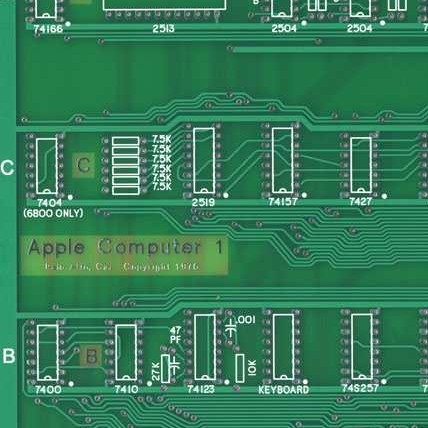
Since I made changes, I need to assemble and test the new PCB before shipping PCBs. The good news is that the first board is up and running memory tests at this moment and testing should be complete by Tuesday. I should be able to accept orders starting on Wednesday and plan on shipping the first batch next Monday (10/14).
Just a note to those looking for assembled systems, this prototype Mimeo needs an enclosure and soon I’ll be working on the building a prototype enclosure for this unit. I’ve also been working on a custom datanetics style keyboard for fully assembled systems that will use modern components.

While working on a micro-controller replacement for the MM5740/AAE keyboard decoder used on the Datanetics keyboard, I discovered a way to send the unique Apple 1 backspace keycode (0x5F). You need to connect line X4 of the matrix to one lead of a blank keyswitch and Y3 to the other lead of the same keyswitch. Then by holding down shift and pressing that blank key, you can generate the 0x5F needed to backspace the Apple 1 monitor.
Note that you could also rewire the left arrow key of a MM5740 based Apple II keyboard to accomplish the same thing. Unfortunately there is no easy way to avoid the requirement of pressing the shift key to generate the correct code.
Mac OS/X users, Egan Ford sent me a PI generation program that can be run with my SCELBI emulator. Check it out at the bottom of my 8008/Scelbi page.
I use this utility to convert files in Apple monitor format files to AIFF. Once in AIFF format I can download them to a real Apple II using a portable music player (iPod) and the cassette port on a real Apple II. This is the easiest and fastest way I know of, to move files to real Apple II and is an essential part of the cross development process I use for developing Apple II programs.
This version has only been tested on Intel MAC, but it was converted from a Mac PPC program, fixing endian and word length issues, so it may work, as is, on other platforms. I have a similar version for Apple 1, but it hasn’t yet been converted to Intel Mac. Here is the source for the Apple2 monitor to AIFF program.
Cameron Cooper has put his SCELBI website online. It contains a ton of SCELBI information, some of which cannot be found anywhere else on the web. Check it out: www.scelbi.com
I had to program a new batch of micro-controllers, so I decided to make a few minor tweaks to the firmware.
Check out the manual that is downloadable from the PS/2 keyboard adapter page.
Next batch of Mimeo boards are now on order. I should be able to pick them up in about 3 weeks. Sorry for the delay, to those that I promised boards in September, but a lot has been going on here at Mimeo headquarters.
This order was delayed, because a couple of weeks ago, I decided to investigate the possibility of using a different supplier, that would be able to work with me a little bit more. Though Advanced Circuits does fantastic work, they are set up to produce boards in a standard way. Whenever I have asked for them to do something a little different, I really haven’t received much help, or have been asked to pay for custom service, which is often more than I can afford.
An example is the Datanetics keyboard PCBs that I had made a couple of years ago. Even though those boards have no solder mask or silkscreen layer, I had to pay standard price. Other “online” PCB fab places have similar policies.
Yesterday, I visited a local place that I placed the order with. They took about an hour to talk to me. They even took me on a complete tour of their facility. I was pretty impressed at the complexity of the process. Anyone familiar with etching PCBs at home, would hardly recognize what is going on in a real production facility. I know I hardly did.
Pricing was competitive. I’m taking a slight hit on a one time set up charge, but I think the personal service will be worth this one time cost.
Stay tuned for an update as we proceed through these uncharted waters.
Cameron and I (well mostly Cameron) has been accumulating SCELBI docs, software, flyers, images, books and information. Cameron is working on putting this online, so soon we will have a comprehensive SCELBI site available for everyone to enjoy.
Check out this early SCELBI price list that I managed to obtain. Notice the address is Nat Wadsworth’s residence.