Rising Ebay Prices for Apple II Systems

I’ve noticed a trend in rising prices for A2 systems on ebay. I usually buy parts machines when I need a new system or components for a project. In the past, I’ve been able to get parts A2 plus systems (often with a lot of extras) for around $50 plus shipping.

Within the last week an A2 (not plus) system listed as parts or repair went for $810! Granted, this system had a few desirable components – but still…

An A2 plus system also listed as parts or repair went for $183.49!

Also, I’ve seen several A2 plus systems go for close to $300 lately. These were not parts systems, but it’s not long ago when that was the expected price for a non-plus system.

Is this a temporary situation, or is the day of the dirt cheap, $50 A2 plus parts system, behind us?

At least IIe’s are still dirt cheap.

How many original Apple 1’s are left?

Well 32 are clearly documented in my registry.

Another 4 are listed on the registry page, as most likely to exist, but since I don’t have good enough information to eliminate them as duplicates, I have them listed as probable.

I have less concrete information on 4 or 5 more. Some of these may be listed soon, as the owners are planning on providing more details to me in the near future.

That puts my count of probable units at around 40. Keep in mind that I’ve only been investigating this for about a year and a half.

How many more are in private hands? That is anyone’s guess, but I’m sure that a number of owners don’t want to publish the fact that they own a collectible computer that could be worth as much as $200,000.

It wouldn’t surprise me if the number of undiscovered units was as high as 20 or 30. That means the previous estimates of under 50 remaining Apple 1’s is probably low and the actual number could be as high as 60 or 70, perhaps even more.

On the other hand, maybe everyone who has an Apple 1 has had something published on the web about it and there are only 40 left. What do you think?

Apple IIc – first impressions

THE BACKGROUND:

I’ve had Apple computers since I bought my Apple II in the first half of 1978. Within a year I had a job as a programmer for Systems Enginering Laboratories, and my interest in personal computers dissipated significantly. In early 1984, my home computer was upgraded to a 128K mac with imagewriter. Since then, I’ve been using macs as my primary personal machines.

It was only in 2004, when I pulled my original Apple II down from that attic in order to make a shutter tester, that I became interested again in the original Apple II line. Because my computer interests moved in other directions, I had little experience with the Apple II line since about 1980. Until recently, I never had any particular interest in the Apple IIc. It seems that it might be useful as a portable machine, especially since so many modern TVs have composite video inputs.

Well a few months ago, I was given a IIc without power supply. Since then, I’ve been very busy with the Brain Board and Mimeo 1 work and haven’t had time to cobble the power supply together. Well this morning I found a few hours and finally was able to bring this baby up.

First challenge was the power supply. Apple specs 1.2 AMPs DC at 15 volts. I have a Radio Shack (realistic) bench power supply rated at 1 AMP, with variable output, up to 25 volts, DC. I figured that since the power supply could be turned up to 25 volts that maybe it would source the 1.2 AMPs at 15 volts. After wiring the connector, I connected it up. The computer made a beep but then shut itself down. After several attempts, I realized the power supply couldn’t hack it and was shutting itself down. OK, now I’m looking for a wall wart with something close to the correct parameters. The first one that looked close, was rated at 1.2 AMPs at 12 volts DC. Now this same wall wart wasn’t hefty enough for the DISK II-USB project, so I was skeptical, but decided to give it try. I hooked it up with a voltmeter on the DC outputs so I could see how much the voltage sagged when the disk drive was turned on. To my surprise, this wall wart seemed to be able to handle the IIc, at least without anything external plugged in. It did sag down to around 11 volts at times, but I think the internal power supply will accept anything down to 9 volts. Ok, so now I have an Apple IIc powered up, what are my initial impressions.

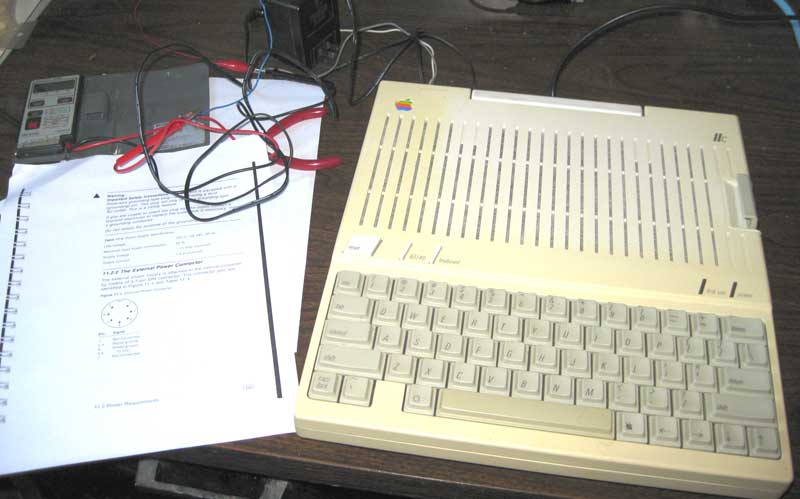
Apple IIc test set up

THE REVIEW:

  • First of all, the IIc’s disk drive is quieter than what I’m used to. It’s not silent, but certainly much quieter than the old Disk IIs.
  • The keyboard really isn’t that good. Maybe mine is old and out of shape but the keys seem clunky to me.
  • I run a lot of old integer basic programs and use firmware cards instead of language cards in my II and II plus machines. This isn’t really a knock on the IIc, I just have to make sure I boot with a disk that has integer basic on the drive. Same problem exists with the IIe, which is pretty much the same machine, only with slots.
  • It would have been nice, if they could have squeezed one expansion slot into this form factor.
  • For some Brain Board compatibility tests, I had to open up the machine to borrow the 65C02 processor. Though it is not hard to get into, there are some rather fragile tabs that help hold the case together. Be careful, if you decide to open this unit up.
  • I haven’t checked composite video compatibility with any digital monitors, but I’ll have to check that out before I actually try taking it somewhere.
  • Summary…Other than the clunky keyboard, I think that this is a cool machine and I may actually end up dragging it along on a trip in the future.

    Brain Board Update #2 – Beta Almost Complete

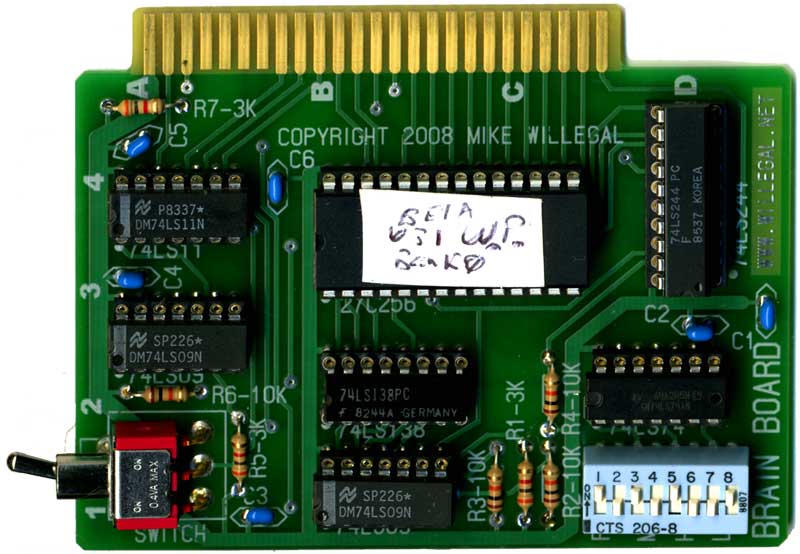
    The Brain Board/Wozanium pack web page is up and includes a link to the Beta Manual with has all kinds of information about the implementation. I have a little more to add, including an example downloadable driver that allows a user to control the machine through a super serial card.

    I have had some good feedback from the Beta team. Several improvements have been made to the Wozanium firmware and will undergo testing this week. I plan on starting general shipments on 3/21/2011.

    Cost for kits will be $59 with free shipping in USA and $10 shipping internationally. I also plan on offering built up units, once I get through any flurry of initial kit orders. Send me an email, if you have any questions.

    Brain Board Update

    I have shipped several Beta kits to some Mimeo builders who also have Apple IIs. Once I incorporate any feedback from the Beta Testers, I’ll open up for ordering. Hopefully this will take only a couple of weeks. My own testing of the production board has revealed no bugs.

    In some ways, this is the most complex retro-project I have yet attempted. There was a pretty decent blue print for the Apple 1 and Apple II projects. The complexity involved making sure I didn’t overlook any of the content in the blue print and filling in a few blank pages. The Brain Board project involves creating a way to map the blue print from one fairly complex architecture into another. It also involves mapping the software systems along with the hardware systems. With the motherboard projects, the software was a given. A similar project was the PS/2 to ASCII keyboard adapter, but that mapping is much more constrained.

    Several folks have suggested I take pre-orders for this project. Though demand on this project is hard to estimate, I think I have enough parts on hand to supply immediate demand and pre-orders are not necessary.

    I have decided to classify this kit as a level 1 kit – it is very easy to build. If you can figure out which end of a chip has pin 1 and have a decent soldering iron, you should be able to build it. Here is a list of projects that I have offered with their skill levels.

    1) Apple Cassette Interface (stocked), Brain Board (shipping soon)
    2) PS/2 keyboard adapter (stocked)
    3)
    4) Apple 1 (stocked), Apple 2 rev 0 (discontinued)
    5) Datanetics keyboard (several PCBs left)