New Apple 2 Rev 0 Revelations

I did a comparison of the hidden traces on my rev 0 replica with the fantastic image of the front bare Apple II rev 0 PCB, that I just received from Stanford University. I found that all of these “hidden” routes were precisely the same as the actual rev 0, except for two.
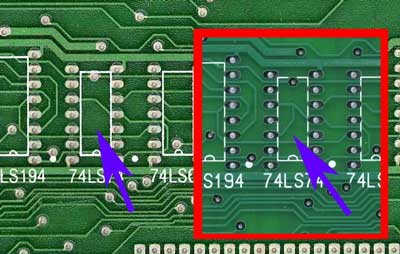
  • First was a trace I connected, that didn’t exist on the rev 0, but was later added on the rev 1. This is the pull up on pin 12 of the 74LS74 at B-10.

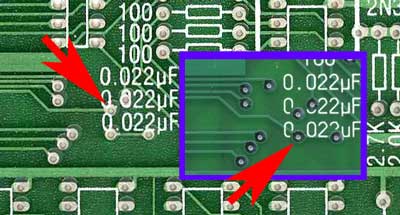
    missing pullup on rev 0

    The image on the left, is the original. Note that this missing trace is actually an undocumented bug in the rev 0. The trace connects the D input of a flip flop with a pull up. Without the D input to the flip flop being pulled up, it is left in a “floating state”, That means that when a clock edge is seen on the flip flop, that either a positive or negative level will be clocked in, depending on exactly where the input is floating at. Usually this will be a positive level, since 74LS input logic tends to float high, but it’s far from guaranteed. This flip-flop is used to indicate to the computer when a character is pressed on the keyboard. This floating input could cause the computer to miss keystrokes. I don’t remember this being a problem on my original rev 0, but the possibility is there.

    When laying out the replica PCB, I ended up cutting up a socket on a later rev board in order to determine the route of this trace, not realizing that it wasn’t even present on the rev 0. The poor photocopy in the “RED BOOK” occasionally wasn’t good enough for me to solve a puzzle, and I had to resort to this sort of tactic, from time to time. In this case it failed me. Looking at the image now clearly shows that the trace wasn’t present, but there are other places on the photocopy where present traces are barely visible. For some reason traces that ran vertically often show up poorly in this photocopy.
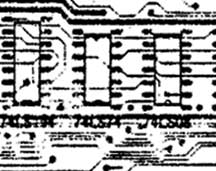
    74LS74 photocopy area

    It you have one of my replica’s and want to experience authentic behavior, lift pin 12 of the flip-flop out of the socket (or you can bend it under so the change doesn’t look obvious). You probably will not notice any difference in behavior. You could also cut the trace, but I would recommend that you leave well enough alone and run it as is, with the input properly pulled up.

  • The second difference is also interesting. This difference resolves a misconception I had about the implementation of the fabled USER1 bus line on the Apple expansion slots. The USER1 jumper is documented incorrectly in the Apple II reference manual. The vias that need to be connected to enable USER1 are partly obscured by the ear of the Slot 7 connector, so adding this jumper, would have to be done from the back of the board. In Apple’s “Hobby/Prototyping Board” document it says “The function of this line will be described in a later document.” USER1 must not have been used by any I/O cards since it was reused on the IIe as 65C02 sync and changed again on the IIGS to M2 SEL.

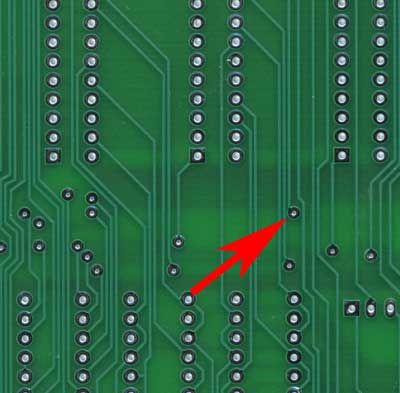
    The routing of trace in question is partly hidden by the ear of the slot 7 connector. I connected pin 39 of the peripheral bus, USER1, from the peripheral bus to the wrong via. This via directly connects to the enable on H12. USER1 should have connected to another via, that is not connected to anything else. The user was supposed to add a jumper between two vias to make this connection.
    If you have one of my rev 0 replica’s I would do nothing. I have heard of no issues of peripheral card compatibility from replica builders over the years. You are more likely to have peripheral card problems because of the other changes that were introduced to the bus than with USER1 being connected to the enable of the decoder at H12.

    There is a very minute possibility that you may have an issue with an unusual peripheral card that uses USER1 in an unexpected fashion. In this case, you can disconnect USER1 by carefully cutting the trace on the back of the PCB that leads from pin 39 (USER1) of the peripheral bus to the via that takes to the trace to the front of the board. Instead you could try cutting the trace where it connects to the via near the edge of the slot 7 connector. This will be more difficult because the ear of the connector partly obscures the via.
  • Stanford University’s “Apple 1”

    Turns out that the Stanford “Apple 1” is an unpopulated Apple II, rev 0 PCB. The only other unpopulated A2 rev 0 I know of, is the one that the Hudson Brothers just sold. As rare as this is, it would have been nice to find a bare board Apple 1. By the way, during this investigation, an archivist at Stanford Library sent me the best image I’ve ever seen of the front of a bare original Apple II rev 0 PCB. More on that in the next post.

    Blown Transformer

    Just a heads up folks. One Mimeo 1 builder had a P-8667 transformer fail. The windings must have shorted out. Good thing that the Mimeo was being monitored and could be shut down before any serious damage to the Mimeo or building in which it was operated, occurred. Anyway, the result was a smokey, smelly transformer that no longer works, but no damage to the motherboard or anything else. I’ll put up a picture of the transformer, when I get a chance. It is unclear what triggered this failure, but it probably was a manufacturing problem with the transformer.

    As I point out in the build manual, do not operate your Mimeo, unless someone is present to take immediate action in case of component failure. These old designs don’t have all the safety features of modern consumer electronics. Some of the components supplied with the kit are over 30 years old, so unexpected, early failure is always a possibility that should be accounted for.

    One more little tidbit I picked up from the owner of this unit. Mounting the two transformers at right angles to each other, should help reduce stray coupling between them. I don’t know how much of an effect this has on performance, but I figured I’d share the tip.

    ACI update

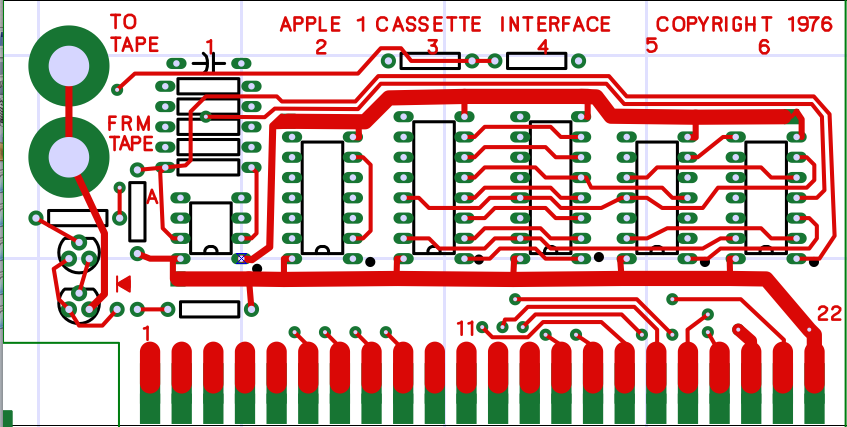
    I’m making headway on the Apple Cassette Interface clone layout.

    ACI developmental CAD view

    Here are my current plans.

    1) Finish the layout – I’m estimating that will take a couple of weeks. This will be laid out to the same replication standard as the A1 motherboard.
    2) Find a current production cassette recorder that works well with the ACI.
    3) Come up with pricing for the kit – right now I’m estimating between $75 and $100. I want to make it $75, the cost of an original ACI in 1976, but that low price point might be difficult to attain.
    4) Build an interest list of potential purchasers. This time around I don’t plan on ordering any parts or the PCB until I get about X number of folks on the interest list. I’ll determine what X is when I figure out the cost of kit. This number will probably be between 12 and 25 individuals.
    5) When the interest list reaches critical size, but before finally ordering parts and the PCB, I may well ask for pre-order payment to confirm that this is financially viable. A lot of folks will express interest and get on the interest list, but back out for one reason or another when asked to actually part with their money.

    PS/2 Keyboard Interface Design Decisions

    Someone sent me an email asking if I could have created a PS/2 adapter that was reconfigurable in software to work with either an Apple 1 or Apple II with no hardware jumpering. I started to compose a long answer and before sending it, realized that this would be a good blog entry. So here it is.

    The AVR to DIP wiring mechanism was the most difficult part of the design process, for the PS/2 keyboard adapter.

    First of all I couldn’t do a software switch between the A1 and A2 pin outs without some external power switching circuitry, as the power and ground connections are different. For example, minus 12V on the Apple 1 is connected to the same pin as a data bit on an A2 keyboard.

    I wanted to support S-100 and other systems with possibly different pin outs, with a standard ribbon cable. I thought about creating a user interface with the serial port to allow tweaking configuration, but decided it was too much work and could cause too much confusion, if configured wrong.

    I was also concerned about increasing potential for bugs. The code for the PS/2 keyboard is pretty complex, as it is. Besides doing the bit banging to move stuff over the wire, you have to keep track of key states. Some single key state changes result in 3 bytes being transferred to the adapter. You don’t really know what is going on with the keyboard until all three bytes are recieved. When you finally decide that you have a character for the host, you then have to map a generic key code into an ASCII equivalent. A depressed shift, control or other key affects the translation.

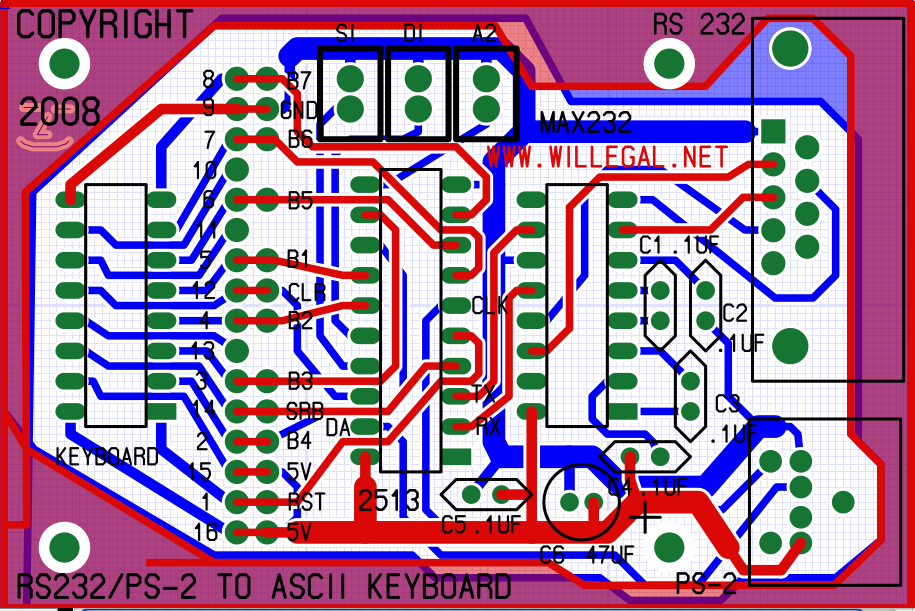
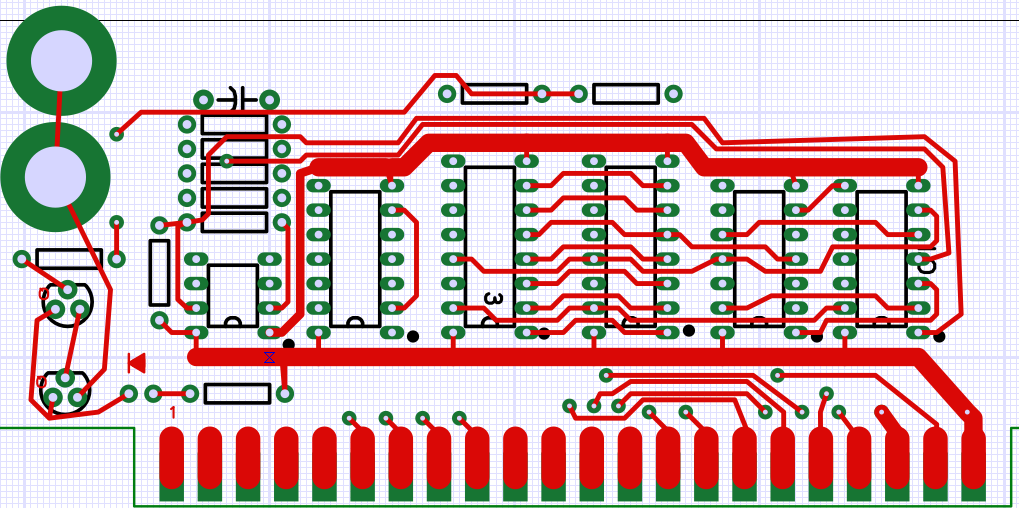
    I actually laid out at least 3 variations of this board over the past couple of years. First version was a single sided PCB and A2 specific. This one can be seen at the bottom of my keyboard adapter web page. The next version was A2 specific, but you could cut existing traces and add jumper wires for other systems. Here is a CAD image of this version.

    A2 version with option to cut and rewire

    The Data bits are optimized for the A2 connection, not ease of wiring. Notice that I also reversed connector ends between this version and the final version. This was to make the ribbon cable connection between an A1 and this adapter more straight forward. I think that in most cases with an A1, the adapter will be to the left of the motherboard. With the original configuration this would require twisting the ribbon cable to connect correctly.

    Finally, I decided I needed to create the most generic version possible, because of the desire to support systems which could have any sort of pin out. I considered making it default to A1, and then allow cutting traces and adding wires to adapt to other systems, but decided that cutting traces was destructive and not very elegant for non-A1 applications.

    Once I decided that I didn’t want to force non-A1 folks to cut traces, I rearranged the pads and pin out to make hookup as straight forward as possible. I think in this regard, I succeeded. When I wired my first boards, I found it much easier to do, than when I built a wire wrap A2 keyboard to A1 converter using two wire wrap sockets. I also figured that it was going to be sold as a kit. A little extra work on the kit builder’s part, really wasn’t necessarily a bad thing. 🙂

    I guess this long winded blog indicates how much I thought about the problem. The optimum design would to make a different board for each application, but it would not have been economically feasible.

    I’m very happy with the result and have been exclusively using a PS/2 keyboard with my A1. The long cord and keyboard layout is much more user friendly than using an A2 plus keyboard with ribbon cable connection.

    Get your Mimeo 1 or A2 rev 0 replica, signed by WOZ

    Cameron Cooper had his Mimeo 1 signed by WOZ. I had another Mimeo 1 builder mention that he was going to have it done, as well. This second builder pointed out the web site that offers the mail in service.

    http://www.signedbywoz.com

    On the site, there happens to be a picture of WOZ signing Cameron’s Mimeo 1!

    http://www.signedbywoz.com/shop-mail-in.php

    Note that Cameron was told that this was the first replica Apple 1 that WOZ has seen. It seems that it will not be the last.

    I’m tempted to send in a batch of bare boards, but I’ll leave it up to the replica builder to decide whether it is worth the trouble or not. I’ve already spent enough money on this project.

    Limited quantities of Mimeo Kits now available

    I have finally finished working through the wait list and now have a very limited quantity of Mimeo 1 kits available. Shipment should be within a few days of ordering, though it could take a few weeks, if I run short of any specific component. Send me an email, and I’ll let you know what you should expect.

    I have an ample supply of PS/2 keyboard adapters in stock.

    Finally, if you can’t find the parts you need to complete your Apple-1 clone, send me an email, and I’ll send you a price list. Just a word of warning – don’t expect distributer type pricing.

    Updating Mimeo web pages and the enclosure is started

    Revamped my Apple 1 web pages – basically splitting information into separate pages that should be easier to browse:

    http://www.willegal.net/appleii/apple1.htm

    I also have started work on my Mimeo 1 enclosure. I’ll document work on this web page:

    http://www.willegal.net/appleii/apple1-enclosure.htm

    My “process page” now includes a close up side by side detail of a small part of the original and Mineo PCBs.

    http://www.willegal.net/appleii/apple1-process.htm