Colorized City Point Engine House Picture

May 13th, 2014

Just learned how to colorize a black and white image with photoshop. It’s easier than I thought it would be. Though this image is just a hack job, it shows what it possible. It also can be used to help pick the colors in my actual model.

Colorized Engine House Picture

Colorized Engine House Picture

Let me know what you think of the color choices.

First Mantua General Remotoring Experience

May 8th, 2014
Mantua Remotoring

Mantua Remotoring

I generally followed Al Muellers recommendations for replacing the drive line – though I did have difficulty drilling and soldering the music wire into the brass rod on the engine side. The tender side was easier, since I drilled the smaller hole and used it as a pilot hole for the motor shaft. This caused the drive wire to be lined up with the shaft, even if it wasn’t perfectly centered in the brass rod.

The shortened drawbar was cut out of scrap PCB material. The copper side is cut, so that there is no short circuit between the tender and the cab.

The other thing I changed was mounting the Nichibo PC-130 motor. I found I had a couple of screws that fit the mounting holes on the face of the motor. I presume that these are a metric size. I decided to use some scrap sheet metal to make a mount. It is bent at a 90 degree angle and using a #6 screw, mounted to the tender floor, opposite the hole that is used for feeding track power back to the tender. This provides a solid mount that, if necessary, can easily be removed or adjusted. I will eventually add DCC, but not sound, as I am looking at developing an external sound system, which will be able to produce far more dramatic effects that the small speaker in a tender could produce.

The Nichibo PC-130 motor produces incredibly improved low speed operation. I’m just amazed at the dramatic difference that this made. I haven’t yet calculated scale top speed using a traditional 12 volt power pack, but I’m guessing that it is way below capabilities of a real 4-4-0. Since I’m only modeling the yard and port, where speed would be low anyway, I’ll probably live with it.

I have some more things to do with the locomotive.

  • improve tender truck electrical pickup
  • replace front truck and tender wheels
  • address an issue with tractive effort, which seems inadequate at this point – perhaps more weight is all that is needed
  • add tender couplers – may use knuckle couplers initially in order to do some testing, but eventually I want to use link and pin
  • paint and detail as Liet. Gen Grant
  • Brass Bands at City Point

    May 5th, 2014

    During lunch hour today, I took the opportunity to visit the Addison Gallery of Art on the campus of Phillips Academy in Andover, Mass. The purpose of my visit was to see the original painting, “City Point, Headquarters of General Grant” by Edward Lamson Henry. The painting is currently in storage, but by arranging with them in advance, the curators were kind enough to bring it out for me to see.

    City Point by Edward Lamson Henry

    City Point by Edward Lamson Henry

    What a treat to see the painting in person. The painting is incredibly detailed and digital images do not do it justice. Here is a better image than what I was able to capture. View the zoomable image to see the amazing degree of detail in this painting. Among them, is a brass band, playing in front of Grant’s Headquarters. Brass Bands were a fixture at City Point, especially during the winter, when active campaigning was of questionable value, due to what the weather could do to the the Virginia road system.

    Brass Band at City Point

    Brass Band at City Point

    I expect that the figure sitting on the bench at the left side of this detail, is meant to represent Grant, himself. I think Mr Henry was trying to tell a story with this painting, much like some model railroaders do. I’ll try to make an effort to post some more images with details over the next few days.

    ambrotype studio at city point

    May 4th, 2014

    I just noticed in the corner of this picture of the turntable and engine house at City Point that there is an ambrotype studio.

    Turntable and Engine House

    Turntable and Engine House

    A high res version can be downloaded front the National Archives or from Wikipedia.

    A few observations. The wagon isn’t a typical military wagon, so I suspect it might be a support wagon for the photographer. The Ambrotype sign written on the side of the railroad machine shop on the left side of the image also is a bit puzzling. I doubt that the army would allow a private photographer to advertise on the side of their building. The most likely explanation that I can think of, is that this is actually A.J. Russel’s studio, as he was an army captain tasked with documenting by photograph, the US Military Railroad during the Civil War.

    Here is a crop of just the Studio. Notice the north facing open roof. Before the advent of high intensity lighting and flashes, photography studios typically would have large north facing windows to indirectly light the scene. Looks like that in this case, they just opened up the roof.

    Ambrotype Studio at City Point

    Ambrotype Studio at City Point

    The remaining question, which I can’t answer, is whether Russell was also doing some freelance work while at City Point.

    City Point Engine House dimensions calculated

    May 3rd, 2014

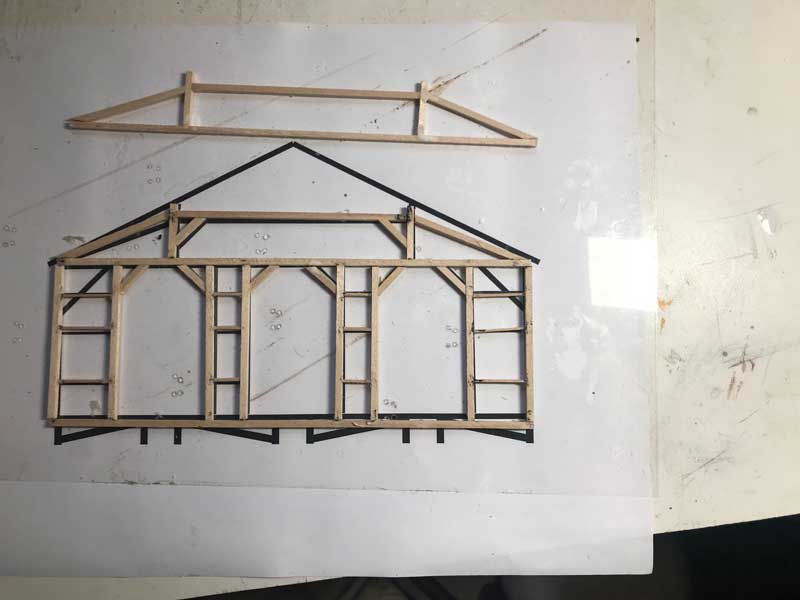
    Using some of the same techniques that I’ve used for circuit board reproduction, I’ve estimated the end dimensions of the Engine House at City Point as well as come up with an estimate of the height of the bluff. Check out my updated City Point Facilities page for some details.

    Vintage Humor

    April 18th, 2014

    I found this in Volume 1 – Issue IV of the SCELBI Computer Digest, which can be found online at scelbi.com.

    THE NAVAL ADMIRAL HAD JUST PURCHASED A MINICOMPUTER TO HELP HIM RUN HIS MIGHTY FLEET. HE QUICKLY UNPACKED HIS UNIT, SET IT UP IN HIS STATE ROOM, PLUGGED IT IN, AND WITHOUT WASTING ANY TIME.. PROCEEDED TO ASK HIS NEW COUPUTER AN INPORTANT QUESTION.

    “WILL THE WEATHER BE SUITABLE FOR LAUNCHING PLANES FROM MY AIRCRAFT CARRIER TOMORROW – OR WILL IT RAIN?”
    “YES.” ANSWERED HIS NEW LITTLE BRAIN.
    “YES WHAT?” SHOUTED THE EXASPERATED ADMIRAL.
    “YES SIR!!” PIPED UP HIS LITTLE MINI.

    Updated PS/2 Adapter Firmware (version 3.0)

    April 17th, 2014

    I have enabled stretched as well as the possibility of an acked strobe output on my PS/2 adapter. I’m calling this version, 3.0. This should make it easier to use the adapter with some vintage gear, such as an OSI system, which doesn’t latch strobe, but only polls for it. Read the updated doc on my PS/2 adapter page.

    skinned knuckles

    April 13th, 2014

    Last night, a little after midnight, I finished replacing a power window regulator in my wive’s mini-van. I’ve done motors before, but not the regulator. I expected the job to come with a few obstacles to overcome and I wasn’t disappointed. I’d like to know how they connect the lock rods and lock actuator in manufacturing – what a pain. It also took some time and effort to get the window properly seated in the regulator guides, but I think that might have been an issue with the aftermarket regulator that I bought.

    The reason why I do this is cost – my cost was $70. The last time I had one repaired by a shop, it was over $400.

    Proposed PS/2 Keyboard Adapter Stretched Strobe Change

    April 11th, 2014

    As I mentioned in a previous post, my PS/2 keyboard adapter requires some strobe stretching in order to work with some kinds of early microcomputers, such as some OSI models.

    I think I have come up with a convent way to accomplish this, with only a small firmware change.

    Here is what I have in mind.

    As before, when the CR jumper is inserted, it disables recognition of the CNTRL-RST and CNTRL-CLR keyboard/RS232 sequences, which assert the reset or clear screen outputs, as appropriate. With my new design, in addition to disabling the aformentioned reset and clear sequences, inserting the jumper will change the clear screen output to an input. Now here is the key part of the change; whenever a character is typed and strobe is asserted (high true), if the CR jumper is inserted, strobe will remain asserted until:

  • minimum of 125 useconds have elapsed AND
  • the input to the clear I/O port is asserted (also high true)
  • To maintain current behavior (a 125uSec long pulse), you just need to tie the strobe output directly to the clear input.

    In order to stretch strobe out a bit, you have a few options:

  • Tie strobe output to clear input through an RC timing network in order to slow down the response to the clear input. For example – connect strobe and clear together with a 10K resistor. Then connect the clear input side of the resistor to a 1 uF capacitor and connect ground to the other side of the capacitor. Doing a basic RC timing equation shows that this should yield a delay of approximately 10 milliseconds. Change the values to attain a strobe length that meets your requirements. You do have to be careful to limit current through the resistor, so you don’t blow the strobe transmitter, though.
  • Use external logic of your choice to assert the clear signal to the PS/2 adapter
  • Behavior with the CR jumper disconnected is exactly the same as with the previous version of firmware.

    The main assumption behind this change is that the clear output, is only required for the Apple 1. I have found little to no need to disable CNTRL-RST and CNTRL-CLR on the Apple 1 (or Apple II) and those features are probably of little value to other platforms. In any case, the PS/2 keyboard sequence of CNTRL-ALT-DEL will still assert reset no matter whether the CR jumper is in place or not. In fact, using the CNTRL-ALT-DEL combination from a PS/2 keyboard will be the only way to assert reset if a system needs both reset AND a stretched strobe output. Said another way, you will not be able to assert reset from a device connected with the RS232 port, if your system also needs a stretched strobe.

    I’ll do some trials over the weekend and assuming that it works ok and I get no better input or ideas, I’ll have a new version of the firmware available very soon, possibly as soon as next week.

    SwyftCards Now Generally Available

    April 11th, 2014

    Swyftcard kits are now generally available for $55, which includes shipping.

    Check out my SwyftCard page for more information about the SwyftCard and Information Appliance, Inc.

    Or send email to:mike@willegal.net for ordering information.