jOBs Movie Stills Posted

January 24th, 2013

Mimeo owners might recognize what Kutcher/Jobs is holding in the first photo.

http://www.usatoday.com/story/life/movies/2013/01/15/steve-wozniak-steve-jobs-biopic/1815651/

SCELBI edge connectors

January 24th, 2013

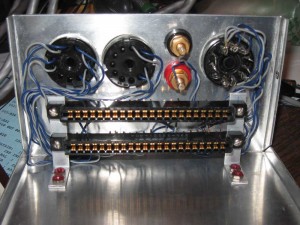
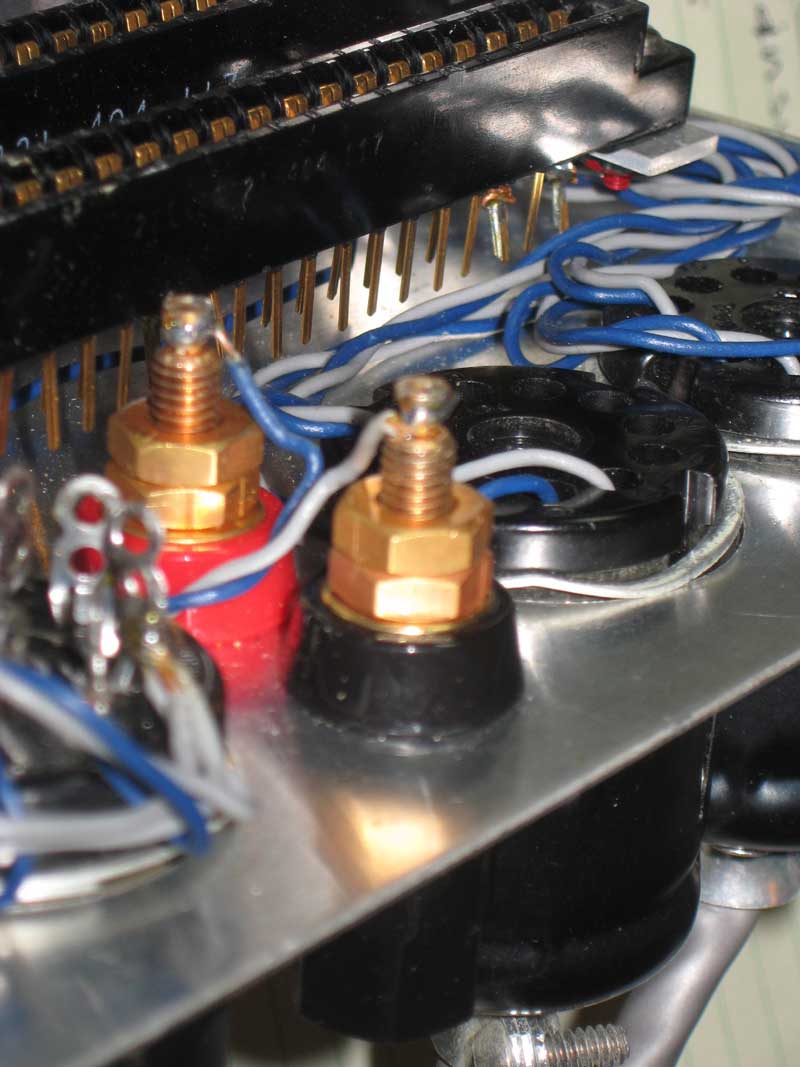
Here is an close up image of an original SCELBI backplane. Note that though wire wrap wire was used to wire the backplane, that the wires were soldered to the edge connector tails.

back backplane - original sockets

back backplane – original sockets

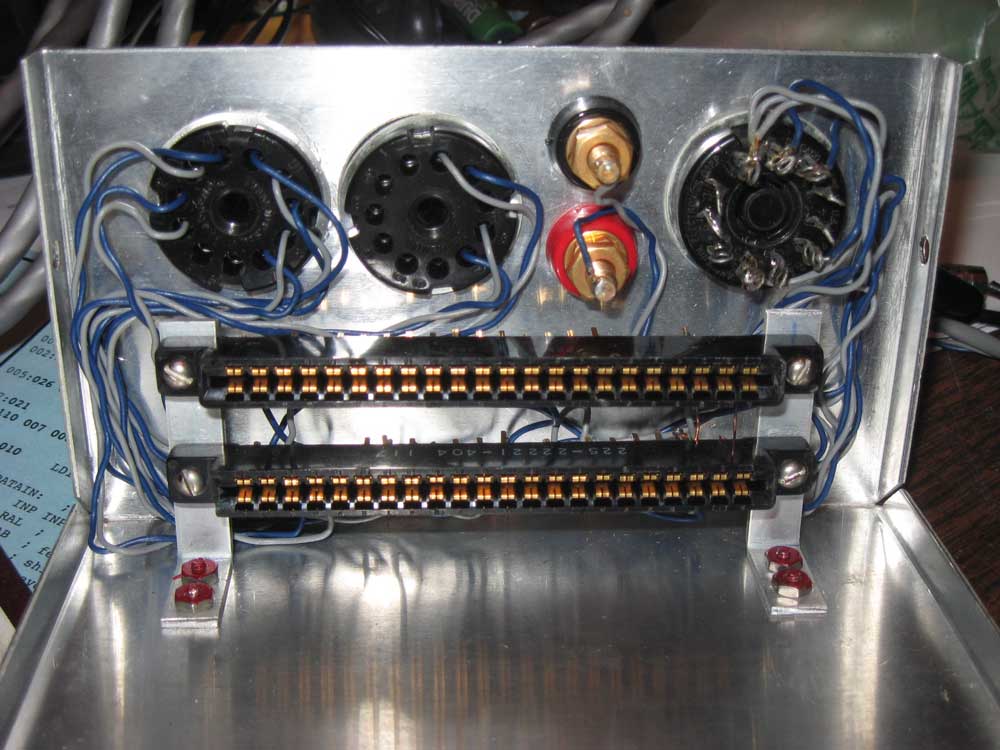
Here is an image of one of my (faulty) backplanes, with a current production edge connector.

back backplane - my sockets

back backplane – my sockets

So far, this is about the best match that I’ve been able to find for the original edge connector pins. I couldn’t find any exact matches at any of the surplus vendors. The part number I’m using is EDAC 305-044-520-202. these are in green and I found then in stock at onlinecomponents.com. As far as I know, all production SCELBIs used black connectors, but I couldn’t find the black version of the EDAC in stock, anywhere. They would have to be special ordered- part number for the black version of the EDAC connector is 355-044-520-202. In case you are wondering, pin spacing is .156″, row spacing is .140″. The holes in the backplane are .054″.

Be aware that there many .156″ pin spaced edge connectors found these days have a row spacing of .2″. These will not fit well into a SCELBI backplane, as it was designed for .140″ row spacing.

SCELBI front panel turn on – and some parts suggestions

January 22nd, 2013

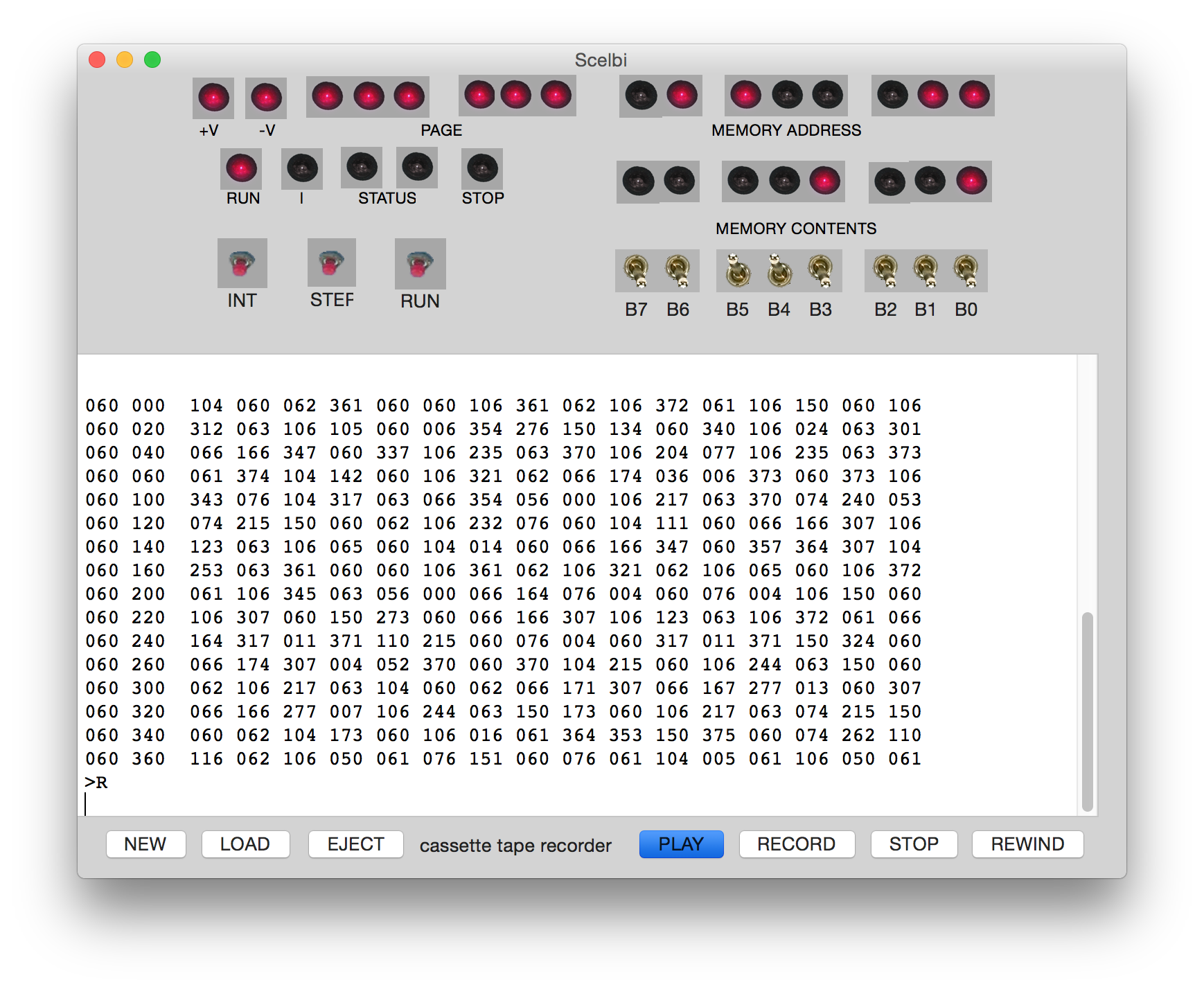
front_panel

It looks real pretty lit up like this. I still need to straighten out the LEDs and cut off the leads from the back side. I simply connected a +5 volt supply to +5 and ground connections on the edge connector.

The three lights that are not on are -9 volts, run and stop. Run and stop are not driven by on board drivers. The other lights are driven by on board buffers. The inputs float high, so the LEDs come on, even with nothing attached.

In this configuration, the board is drawing about 220 milliamps.

The 6.3 volt zener which is used for overvoltage protection, is not installed.

Based on the description in the assembly guide and the early flyer picture, the LEDs originally used in the very first units were mounted in metal case. Here is a link to an image of this type of LED.
http://www.wired.com/gadgetlab/2012/10/the-history-of-led/

And here is a link to the flyer with a SCELBI with this type of LED.
http://www.scelbi.com/files/docs/advertisements/Flyer.pdf

Later SCELBI’s had the same type of T1 3/4 package that we commonly see today. They are red in color and have clear lenses. All the surviving SCELBIs that we know about use this common LED. The LEDs I’m using are part number L05RWC from led-switch.com and seem like a good match for the originals.

The fuse holders are Littelfuse 102074 which can be found at onlinecomponents.com and elsewhere.

SCELBI almost, but not quite…

January 21st, 2013

Almost there, but not quite – the backplane was printed reversed on the bottom side, so I need to get it redone. I accidentially sent the PCB vendor a reversed image for backplane bottom, and they blindly made it backwards. I need to get a new batch of backplane boards made before I can take money or ship. The PCB vendor have generously offered to redo and expedite the replacement backplane PCBs.

The good news is that everything lines up nicely, with no issues. The other cards pass the visual inspection and mechanical fit tests.

reproduction SCELBI mock up

reproduction SCELBI mock up

we are getting close, stay tuned for updates …

– Mike W.

SCELBI PCBs on truck for delivery

January 21st, 2013

No work today due to MLK holiday, I’m like a kid waiting for Santa…will send update to blog with early assessment and details on early adopter program later on…

SCELBI: things to be aware of SCELBI

January 19th, 2013

As I layed out the PCBs and researched things SCELBI, I discovered several things that other SCELBI builders should be aware of. I fully expect that other things will crop up, like they did during my Apple 1 and Apple II builds, but here are a few things that I know about already.

  • Missing connection on +5 volts on DBB board – there is a missing +5V connection on the DBB board – add the wire between the resistors as seen on this image of an original DBB board
  • +5 volt wire on DBB board

    +5 volt wire on DBB board

  • I did find an error on the CPU Schematic. The wires going to IC Z20 pins 12 and 8 are swapped on the schematic
  • There is apparently a problem with the step switch. This is described in the “Improving the Operation of the Step Switch ” document, which can be found on this page. When I first looking at this issue, I thought I found some discrepancies between these instructions and the actual board layout, so perhaps this version of the DBB board already has a fix incorporated – or perhaps the instructions are wrong. I have not seen an actual SCELBI with the fix applied
  • anyone know about using Molex pins to make a IC socket?

    January 17th, 2013

    From the SCELBI CPU assembly manual….

    Molex pins to make socket?

    Molex pins to make socket?

    Anyone heard of this technique?

    Please send an email to mike@willegal.net with a description of the exact molex parts to use, if you have.

    Sellam’s Great Loss

    January 16th, 2013

    Through a tragic series of event’s, Sellam Ismail has lost the part of his vintage computer collection that was in a storage facility. Apparently Sellam was unable to pay his rent or remove his property from this facility. After some months, the proprietor took possession of the goods and has contracted with someone who is selling it off on ebay.

    Though I haven’t met or spoken with him, by all accounts, Sellam is a nice person, and certainly an asset to the vintage computer community. It is unfortunate that he didn’t find a way to relocate the collection or pay his bills on time. I wonder if he had taken the simple expedient of selling off a few valuable items when money got tight, he might have been able to maintain the bulk of his collection. Certainly this isn’t unprecedented, as the Huston brothers decided to part with some of their valued items, when money became tight for them.

    The breakup of this collection should be taken as a warning to those people in our community who pursue collecting at unreasonable financial risk. I often receive email from folks who would love to have a Mimeo, but can’t afford it, or from people that don’t have much experience with vintage computers and want to start out with a Mimeo. I frequently advise people in this category that there are many ways to enjoy vintage computers, without spending a lot of money and incurring a lot of financial risk.

    I generally don’t like to editorialize on my website or blog, but in this case, I think a little word of warning to those that might spend beyond their means is appropriate.

    SCELBI Update

    January 15th, 2013

    Boards are expected to arrive next Monday. I’m still weighing details of the early adopters plan, but I’m leaning along these lines.

    Assuming that board pass the eye test and some basic mechanical checks, I’ll probably accept payment for a shipment on the next Saturday or Monday after board arrival for those that want the best price, and are willing to risk untested HW.

    Then I’ll ship a second wave after two more weeks, still with reduced pricing, but not rock bottom pricing.

    After that, I’ll go to a standard price that I can live with going forward.

    Just to give you an idea of pricing range I’m thinking about is in the range of $200 to $300 for a six board set, with no components.

    SCELBI computer sold kits, as well as build up computers. Be aware that building a chassis for the SCELBI 8H can get surprisingly expensive, depending upon how close to a production system that you want to make it. For a bare bones setup kit type setup, you’ll need 10, 44 pin edge card connectors, and +5v and -9v power supplies, plus some switches and a chassis of some sort. You will need wire to connect the power supply and front panel switches.

    For a more authentic “production” system, SCELBI used 14, 78S11 relay sockets for I/O and a total of 16 edge card slots. Also, each slot had card guides in production systems. The power socket is a 78S4 and the plug is a 86CP4.

    The chassis is similar to a BUD AC-413, only 3.5″ high, instead of 3″. Cory is looking into the cost of getting a custom chassis made that is a close reproduction of the SCELBI original, along with an anodized blue front panel.

    I’ve ordered a set of edge card connectors – once I confirm that they will work, I’ll post the part number. Also, I believe I have identified the correct card guide, but need to confirm that before I publish the number.

    I think that all existing SCELBI 8H documentation, including assembly manuals and schematics can be found online at one of the following sites.

    http://www.scelbi.com
    http://bitsavers.trailing-edge.com/pdf/scelbi/
    http://www.olson-ndt.com/Scelbi/

    regards,
    Mike W.

    More on Apple 1 -5 Volt Supply Issues and a Solution

    January 14th, 2013

    My friend Lionel, from Australia, reports to me about an issue with DS0026 clock driver chip on his Mimeo build. The Apple 1 was originally designed with a DS0025 clock driver chip, but the DS0026 should be a compatible replacement. The DS0025 drive a pair of clocks that are used for shifting video data through the 2504 shift registers. This clock low level is -12 volts and is the same clock that is coupled to video output and causing the video dot problem described on my Apple 1 Hardware Notes page.

    After doing some investigation, Lionel and I have determined that the 2504s are coupling this clock
    http://www.willegal.net/blog/?p=1623 onto the -5 volt supply. This is what is causing a large part of the noise on -5 volts and manifests itself as intermittent DRAM problems (failure to pass memory tests).

    Lionel has tested a fix that involves adding decoupling caps to the -5v supply in the area of the negative supply regulators and around the 2504s. Here is Lionel’s report:

    Hi Mike,

    Good news!

    It definitely looks like decoupling the -5V on pin 4 of the 2504’s is the way to go. I’ve added some 0.1uF caps to GND across both the negative regulators, and one on pin 4 of the group of four 2504s at D4-D5, one on the pair at D14, and one on the single 2504 at C11. This cleans up the -5V rail substantially to the point where using the DS0026 works! See attached photos for how I added the capacitors.

    Before I did the mod I had a look at pin 4 of each of the 2504s and there was an unbelievable amount of noise on them. It was far higher than what was across the -5V decoupling cap near the RAM. In fact, on the 2504 at C11 there was about 4V p-p of noise, when using the DS0026. I think the switching current of the 2504 must be very high, which in conjunction with the inductance of the traces on the board gives a lot of ringing.

    I’ll leave my Mimeo running for a while to burn in and check stability, but so far so good.

    Let me know how you go if you try it.

    Regards,

    Lionel…

    Here are a few pictures showing the caps added to the back of the board.

    2504D4D5

    2504D14

    2504C11

    Before Lionel came up with his solution, I tried a fix that involves adding .0022 UF capacitors between the clock outputs of the DS0025 and +5 volt supply. That also helped by softening the edges of the clocks. Lionel’s solution is much preferable, though my attempt did greatly reduce the extent of the video dot problem.

    Lionel says Unicorn shipped the DS0026 with the Mimeo parts kit. After contacting Unicorn about the problem, Lionel says that Unicorn has promised to send a replacement DS0025.