MPS10 Microprocessor Set Introduction

This series of posts will be a detailed review and commentary about the MPS10 Microprocessor Set manual that I recently acquired. First I’ll provide a bit of background.

I first encountered information about the Digital MPS-10 8008 based computer system several years ago. There is a lot of information about this system in the bitsavers archive at: http://www.bitsavers.org/pdf/dec/mps/. In fact, there is nearly enough information online, to enable someone to build a reproduction of the hardware. However software information is very sparse.

When I won the recent eBay auction for a DEC MPS10 manual, I wasn’t sure what I had won. In fact, I had forgotten about the bitsavers information that I had already downloaded and examined. After reviewing this manual and comparing to the information downloaded from the bitsavers website, I’m pretty well convinced that this manual was a DEC internal product plan of some sort. What makes this manual interesting, is the perspective it gives the modern reader, regarding marketing potential of the microprocessor based systems that were just coming into existence and their potential impact on the mini-computer business. As a mini-computer industry veteran, I figure I can provide a unique analysis of this document.

I plan on reviewing this document section by section and I’ll start with the first 5 pages, which is an overview of just what a microprocessor was.

http://www.willegal.net/blog/wp-content/uploads/2019/10/introduction-logic-products-MPS-10-plan-1.pdf

To start with, the introduction in this “book” describes the microprocessor and the system made up with a microprocessor. It notes that the complete microprocessor system ends up being made up of from 25 to 40 ICs, quite a few more than in theory. It also notes that future systems will benefit from N-channel MOS and bipolar TTL, which will contribute greatly to increased speeds in future devices.

The next paragraph describes the advantages of microcomputers. This section compares microprocessors primarily to special-purpose logic, rather than mini-computers. The listed advantages over special purpose logic include faster product design time, changes easier to implement and an increase of reliability.

The next section compares the microcomputer to the minicomputer. Differences are described in a chart and include the optional use of core memory in the minicomputer. Software on the minicomputer is described as being more complete and comprehensive compared to more basic tools for the microprocessor. In addition, programs must be created off-line on a more capable host machine, such as a PDP-8 in the case of the microprocessor. Price is listed as medium on the minicomputer versus low on the microcomputer. The last comparison is support and service, where the microcomputer is listed as having no field service compared to the full field service available to the minicomputer owner/operator.

While this information seems rather basic and obvious to the modern reader, remember that microprocessors were brand new devices at the time, and the authors believed that they needed to cover the basics of the microprocessor. Also keep in mind that the authors worked for DEC, which generated a vast majority of it’s current revenue directly or indirectly from the PDP series of mini-computers. Though the authors were obviously excited about the possibilities of the microprocessor, they apparently needed to make sure that the reader understood that the microcomputer was supposed to be a replacement for special logic designs, not a replacement for DECs successful line of mini-computers.

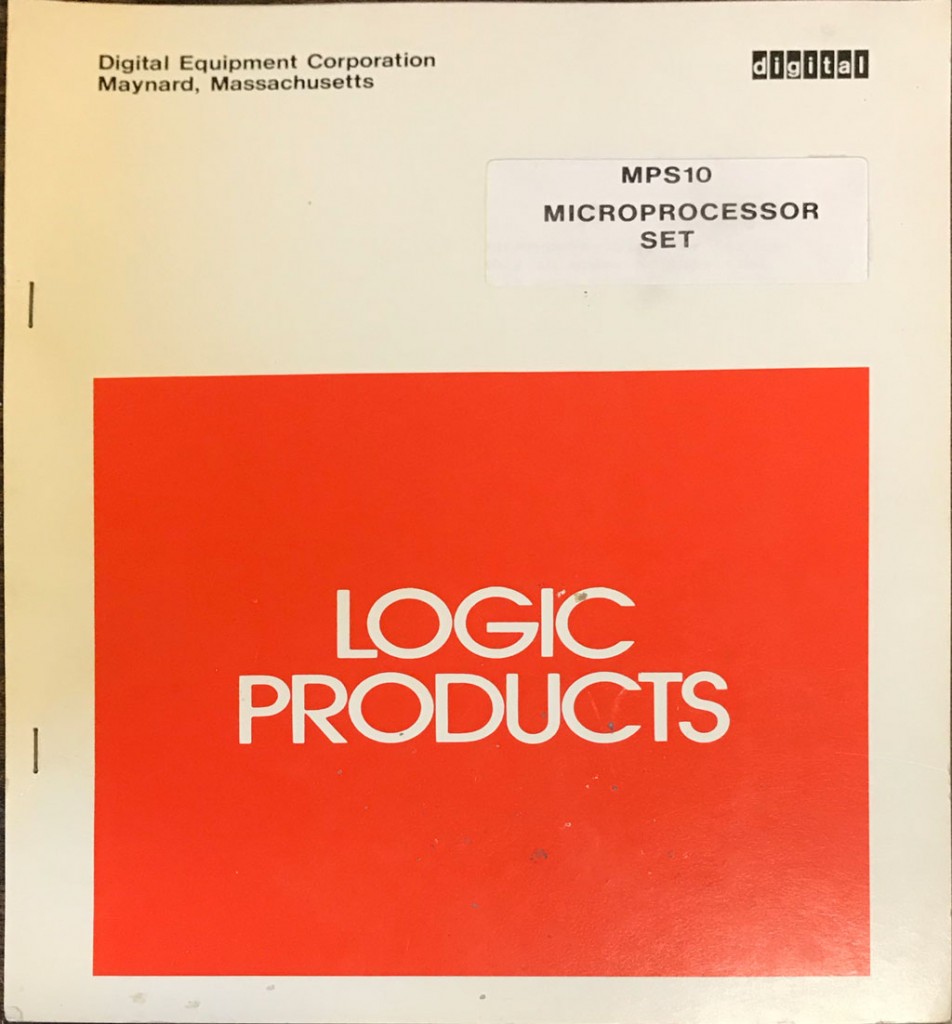
Digital MPS10 Book

I recently obtained this MPS10 book from eBay. The Digital MPS10 was a little known Intel 8008 based system produced by Digital Electronics Corporation back in 1974. I ran across a reference to this system a few years ago.

Since then I have had a standing search on eBay for MPS10 items. This is the first relevant item that actually showed up. I managed to win the auction at a quite affordable price. The book is kind of interesting as it appears to be almost more of a corporate marketing plan than an end user document, though it could be the later. I plan to scan it and share the contents on my website or blog.

Digital MPS10 Book-cover

I’m guessing that the Logic Products group at Digital produced logic cards for the rest of the business, not complete computers. Perhaps someone with more knowledge of DEC’s internal organization could add a comment with more accurate information about what the Logic Products team were responsible for.

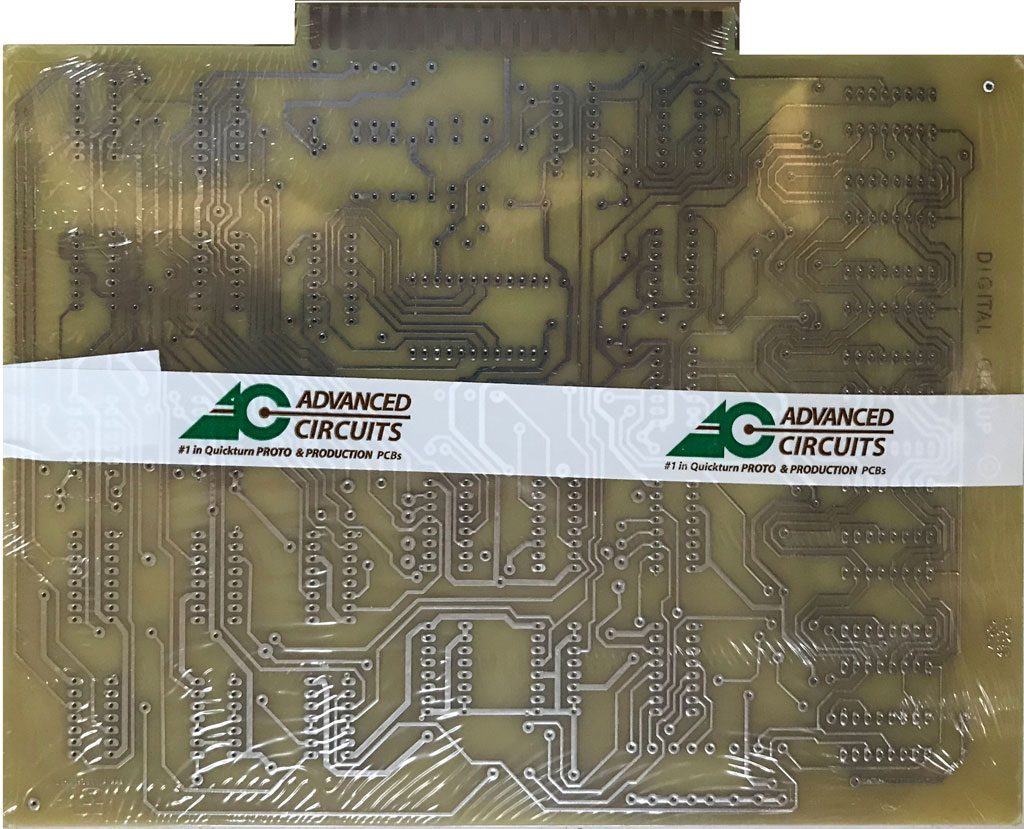
Digital Group Video Cards in Hand!

I’ve had the layout done for a while, but haven’t had time to build them. Thinking I might as well get the PCBs made, I finally pulled the trigger.

DG Video Card

As far as building and testing them goes, free time is still scarce, and I will not get the needed 5MHz crystal until early December, but I have the rest of the parts on hand or arriving shortly. I may be able to build them and run them with an external frequency source, so the lack of a crystal may not be a complete show-stopper. It may or may not be quite a while before I get them up and running.

One other thing. I explored getting these boards made in China, but since I had a batch made, the end cost was about the same as using Advanced Circuits. Getting one or two made would be vastly cheaper if I had them done in China, but I always have taken the chance and have reasonable sized batches made.

Original Digital Group Video Cards are scarce, but I don’t believe that the market for these cards will be very big. I expect the 20 that I had made, will cover the demand, plus some.

Reproduction Digital Group Video Cards on order

I finished the reproduction Digital Group Video Card PCB layout a few months ago. This summer, I’ve been busy with other projects, but I’ve finally ordered a batch of PCBs. I should have them in hand in another week or so. I have all components in hand or on order. I’ve found the 5 MhZ crystal is not exactly common. I currently have a few on backorder at Mouser. Expected ship date is early December, so I may not be able to fully check out this card for a while.

I don’t expect the software to be very difficult, as the hardware interface is very basic. If you want to change any characters or do anything like scrolling, it looks like you need to write out the whole page of display data. The easiest thing might be to keep a mirror of video memory in main memory and write out the whole thing anytime that there is a change.

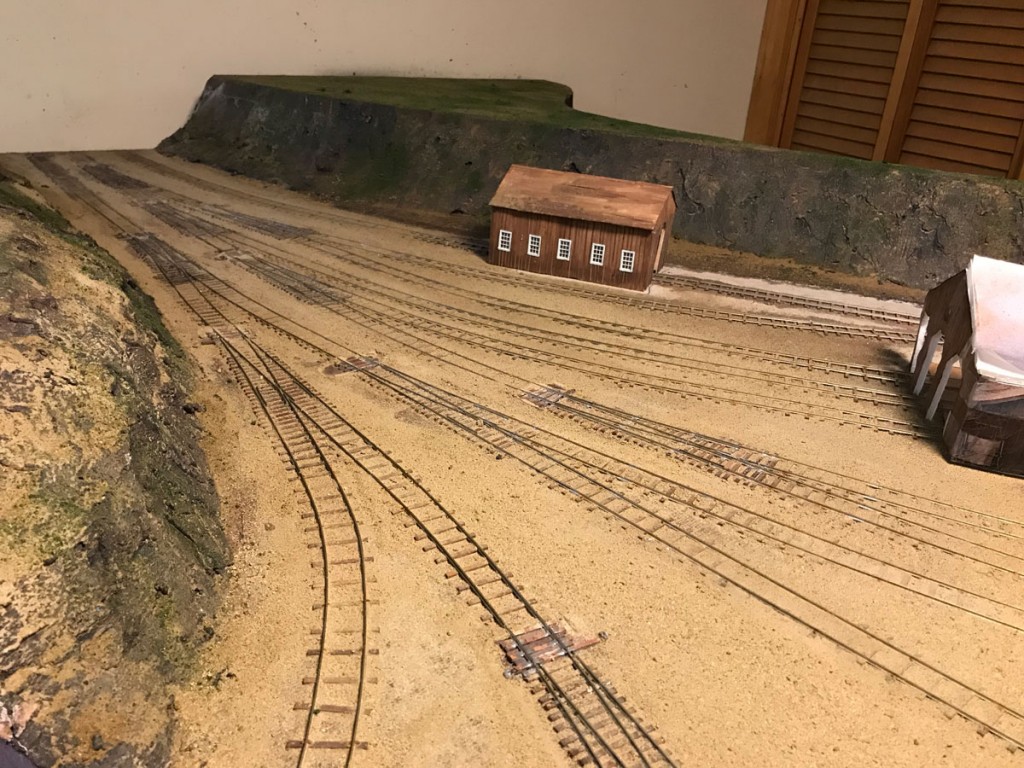
City Point Railroad Yard Ballast

Railroad Yard Ballast and Dirt

Most of the railroad yard now has ballast and dirt installed. The bluffs also have basic ground cover in place. The dirt comes from a yard of clay that I had purchased for use in a horseshoe pit.

For model railroad purposes, I baked it in an outdoor BBQ in order to kill any living organisms and then sifted it. The baking also removed excess moisture, which made it easier to sift.

I think the clay looks great in this application. My last model railroad used commercial ballast, which appeared oversized and too light in color to me.

Next part of the project is to clean up the track and get the switches moving freely again. I then need to wire the switch machines to the control panel and get all the switches and track operating.

When I get the track issues all straightened out, I will move onto installing the car repair shed. After that, I will finally be able to focus on the centerpiece of this module, the engine house.

DC-DC Converter Tested

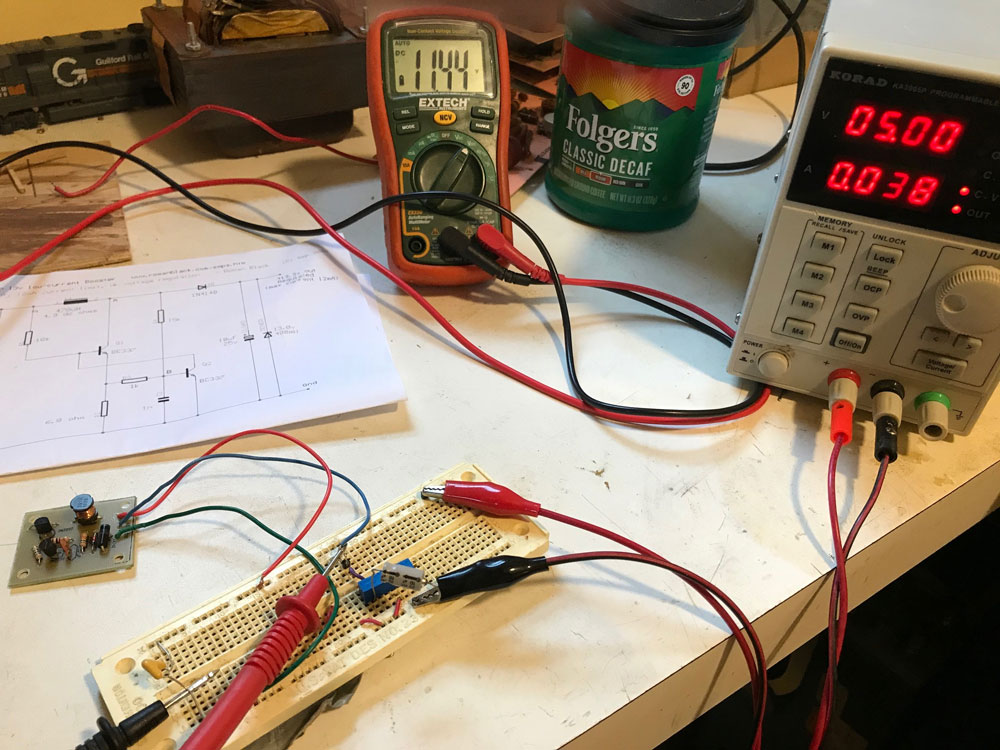
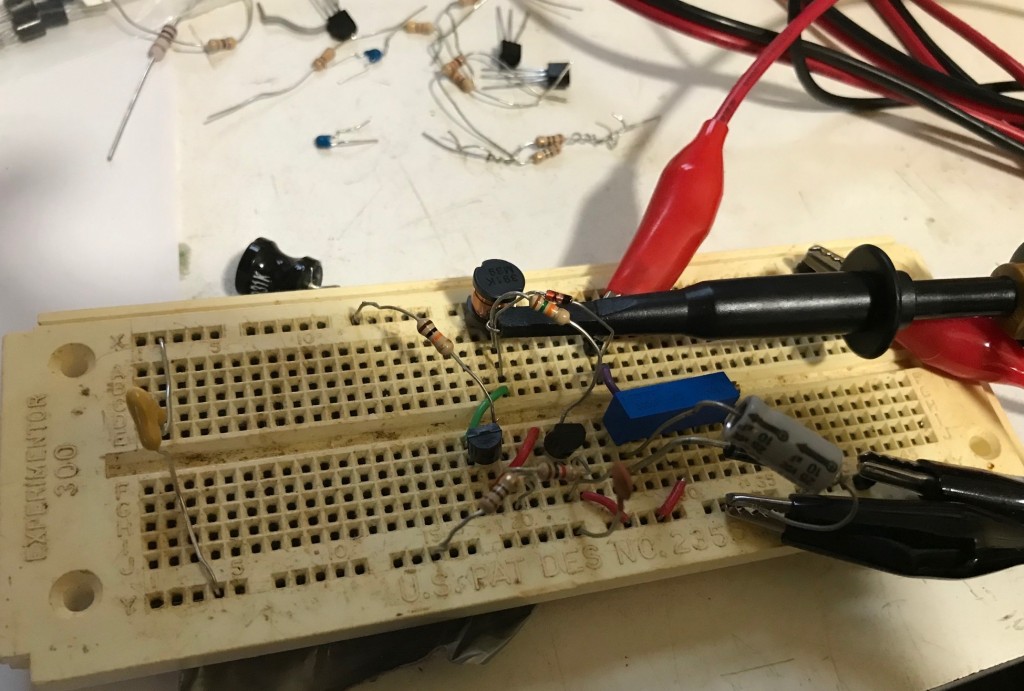
Here is my test setup for the finished DC-DC converter. The power supply supplies 5 volts DC. The bread board includes filter capacitors and a potentiometer that is used to supply a load. These items emulate the final circuit when the DC-DC converter is installed on the Digital Group video card.

DC-DC Converter Under Test

The supply shows that the current draw is 38 milliamps. With the potentiometer set at about 1K ohms resistance, the DC-DC converter is supplying 11.44 volts, which I think will be sufficient for the final application on the Digital Group video card.

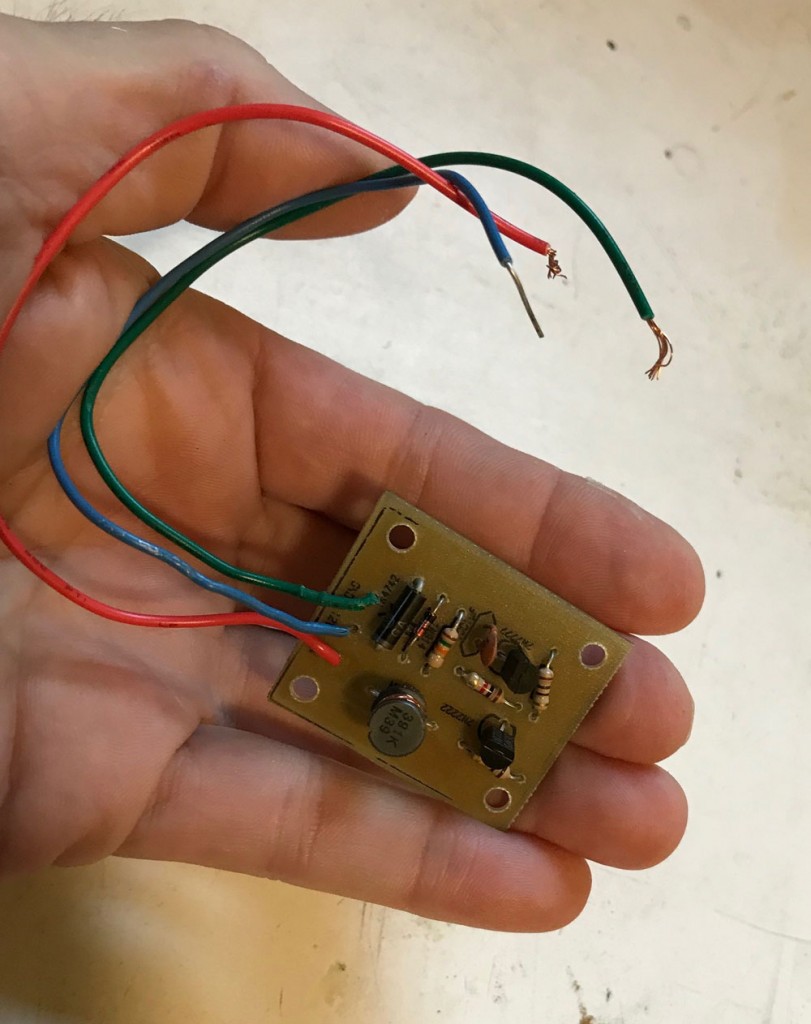
One final comment on this converter. This thing seems very small to me. In fact, when I first made the PCB, I wondered if I had mistakenly scaled it to a smaller than 1:1 size.

Here is the finished board, ready and waiting for a Digital Group video card.

DC-DC Converter In Hand

Mike, What Are You Doing?

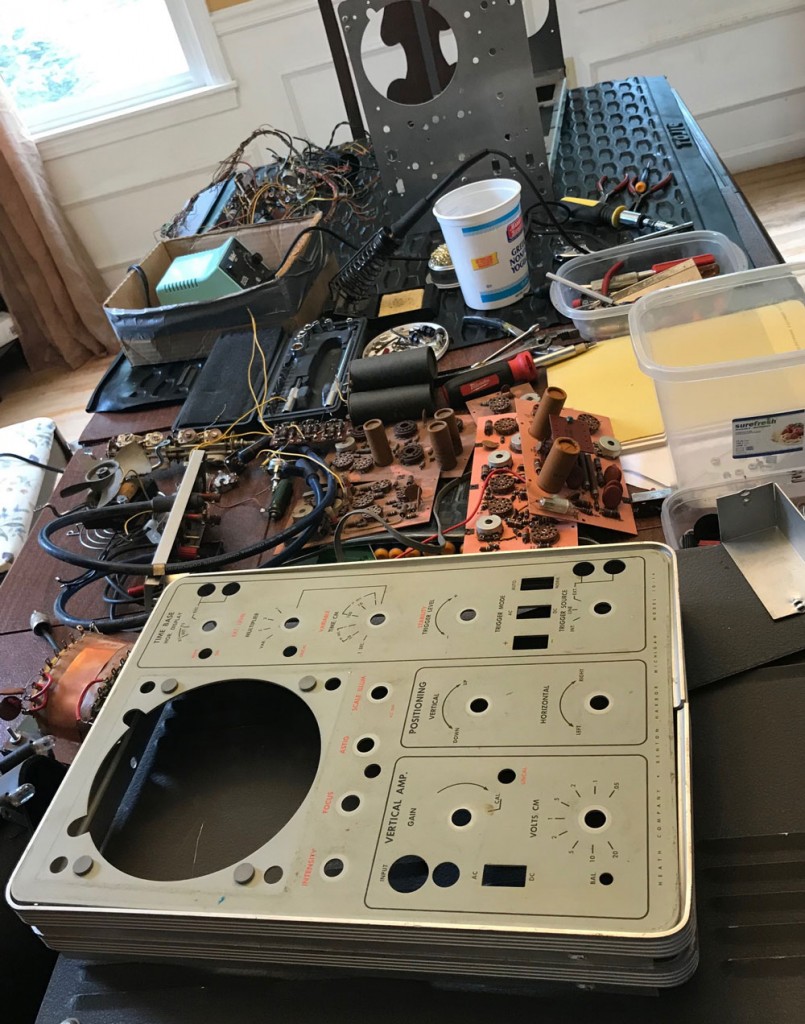
In Pieces
In Pieces

This thing used to be in one piece. I’m pretty sure I’m in over my head on this one. I wonder what the chances are that it will ever work again. The good news is that I have two more copies of this model that are still in one piece that can be used for parts. I also have a manual, which is pretty comprehensive and includes construction instructions.

+5 Volt to +12 Volt Boost Converter for Digital Group Video Card

In a previous post, I have noted that the MCM6571 character generator on the DG video card requires a +12 volt power supply. +12 volts isn’t normally available in a SCELBI computer system. Now that the PCB layout of the DG video card is nearly finished, I took some time to look into building a circuit that could supply the +12 volts for the character generator.

Here are the basic requirements that I came up with for this supply.

According to the data sheet, the MCM6571 requires a 12 volt supply that will supply 8 milliamps of current, worst case.

In order to keep things simple, I think it is best to generate the 12 volts without the use of a transformer or use of mains power. That leaves the 5 volt supply as the source of power to a voltage boost circuit. This circuit would have to boost those 5 volts up to 12 volts. Not being a power supply expert, I hoped I could find a design on the internet that could do this for me.

It turns out that there are lots of modern, inexpensive solutions for generating 12 volts from a USB interface’s 5 volt power, but almost all of those, use modern linear ICs. In order to keep things vintage, I want to use components that were commonly available to hobbyist in the mid 1970s.

Continued searching of the internet revealed a few transistor based solutions. I looked for a design that might be made up from components that I already had in my stash. This would make building a prototype easier and avoid the expense of ordering or spending time looking for parts in the one store we have in my area that stocks electronic components. I picked out a likely design and then searched my stash for the needed components. I managed to find enough parts to put together the circuit on a bread board. Unfortunately, after spending several hours debugging it, I found that I couldn’t get this circuit to work.

I gave up and went back to the internet. A new search revealed a slightly simpler circuit that used many of the same components that I had used on the first circuit. I already had found most of the needed components while building the first prototype. I built this second, similar, circuit in almost no time. After replacing a bad diode, and correcting the orientation of the transistors, which I had inserted backwards, this circuit sprang to life. One thought I had, was that the bad diode probably was the source of the problem with the first circuit. I decided to not to revisit the first design and I pressed onward with this new circuit.

My prototype has a few slight changes in component values. The nearest value inductor I have on hand is rated at 390uH. I didn’t have a 6.8 ohm resister to use for R2, so instead I used a 10 ohm resistor. I used 2n2222 transistors instead of the BC337 specified on the schematic. I used a 1N914 diode instead of the 1N4148, as my understanding is that these are equivalent parts. One other difference is that the zener I had in my stash is rated at 12 volts, not 13.

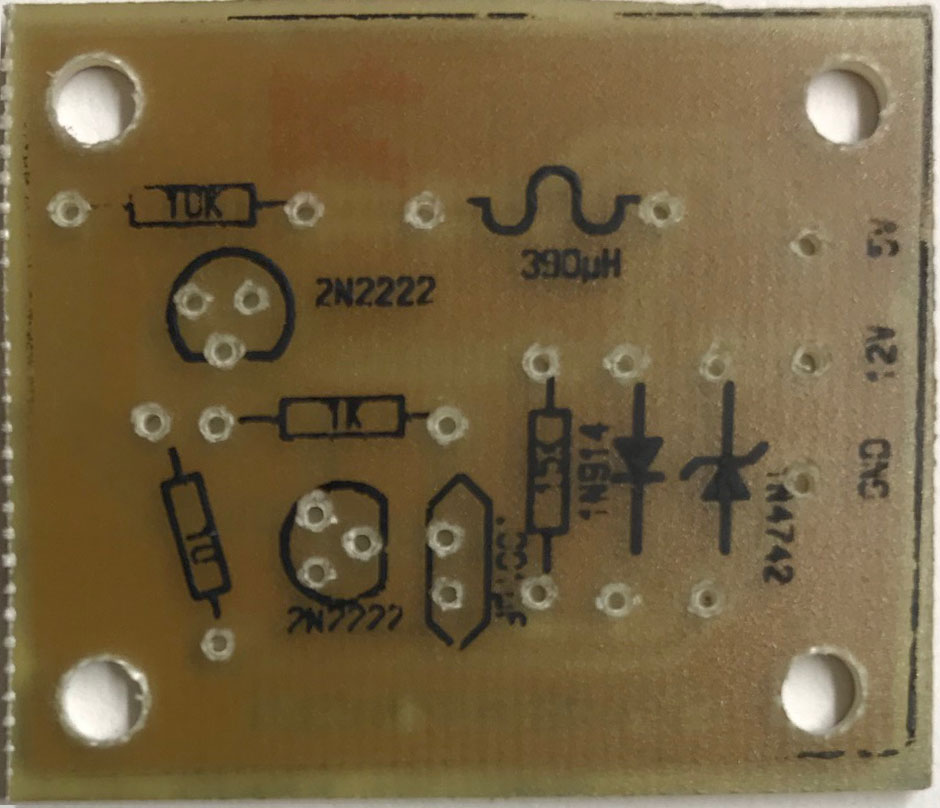
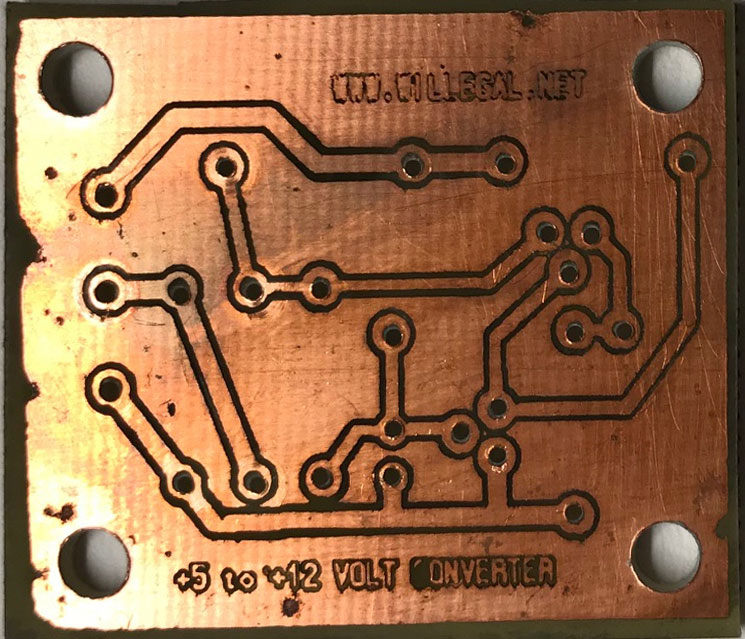
5 Volts to 12 Volts Boost Converter
5 volts to 12 Volts Boost Converter

There are decoupling and smoothing capacitors on my prototype, as shown in the schematic. However, depending upon how I connect it to the DG video board, I may just rely on the DG video card smoothing capacitors that are present on both +5 and + 12 volts. This will allow me to eliminate the 47uF and 10uF capacitors in the final implementation. Should I go this route, this circuit will be composed of only 1 capacitor, 1 inductor, 2 diodes, 2 transistors and 4 resistors. This is a total of only 10 discrete components.

I tested this power supply using a bench supply set to 5 volts as the input voltage. The bench supply was set for a maximum of 200 milliamps current in order to prevent destroying components during debug. It turns out that this voltage converter draws less than 40 milliamps. I tested the output by connecting a 5K ohm trim pot between the output and ground as a load. I adjusted the pot until I could see when output voltage started to significantly decrease. Measuring the resistance on this pot at this setting and using ohms law, I was able to confirm that it should support the power requirements of the MCM6571, and have a little bit of margin to spare.

Brain Board CAD Files Released

Since I’m no longer making or selling Brain Boards, I’ve made the Gerber files and CAD files available for download from my website. This board has been cloned by a few different folks, but if you want to make one, it’s easier than ever.

http://www.willegal.net/appleii/brainboard.htm

I’m aware that Superproto WIKI is currently broken. I’ve made a couple of half hearted attempts to fix it, and will hopefully find some more time in the near future to properly repair it.

Have fun,
Mike