Archive for the ‘8008’ Category

Early SCELBI Price List

Friday, September 14th, 2012

Check out this early SCELBI price list that I managed to obtain. Notice the address is Nat Wadsworth’s residence.

SCELBI Price Guide

Mike’s Hobby Podcast features the SCELBI this episode

Sunday, August 26th, 2012

Cameron Cooper and I discuss the SCELBI.

feed://www.willegal.net/feed.xml

or

“Mike’s Hobby Pages” podcast in itunes.

enjoy,
Mike Willegal

SCELBI progress

Saturday, August 18th, 2012

Making progress on the SCELBI – I now have draft layouts of all 5 of the cards needed for a basic 8H system in CAD. Some are much closer to production ready than others, but they are all there. One interesting thing to note is that, so far, I haven’t found a single error in the SCELBI schematics that I’ve used as reference.

SCELBI card stack

SCELBI card stack

I have also ordered enough 256×1 memories to populate 4 1K boards, so that I can build a full 4K 8H system. Turns out that American Microsemiconductor has 6000 MM1101A/A1 National parts with a date code 81 at 3.55 each. They are listed as 3-Input NAND-Function Logic Gate, but I’m convinced that that is a mistake. I hope I’m not wrong. :-) Older Intel 1101s will easily cost over $10 each and you’ll need 32 of them for just a single 1K board. Ignoring the price, you may have trouble finding that kind of quanity.

American Microsemiconductor usually has high prices, but I’ve been able to find a couple of fairly good deals for RAM there. By the way, if you decide to order a bunch for yourself, be sure to talk to someone and ask for a quanity discount.

http://store.americanmicrosemiconductor.com/mm1101a-a1n.html

For the SCELBI, I’m going to be selling bare card sets, so you will need to find your own components, which is why I mentioning this opportunity. Since I haven’t built up a system with these parts, I can’t guarantee that they will work in the SCELBI.

By the way, I just recently figured out what the H stood for, in 8H. H stands for hobby. We knew that B stood for business, in the 8B system, but somehow it never dawned on me that H stood for hobby. So it seems that from the beginning that SCELBI had plans to create a range of machines. One of the great questions is what would have happened if Nat Wadsworth hadn’t suffered the heart attacks. Could SCELBI, with their vision and engineering skills been able to evolve and remain competitive?

Lastly, I hope to get together a SCELBI podcast in the next couple of weeks.

SCELBI memory

Friday, August 10th, 2012

The SCELBI 8H uses 256×1 bit MOS RAMs.

Doing the math, it would take 134,217,728, 256×1 bit chips to equal the memory capacity of a modern 4 Gigabyte memory module. I don’t know production figures, but I strongly suspect that adding all the 256×1 bit memory chips ever made together into one system, would not equal the memory capacity of a single modern 4 Gigabyte module.

8008 Performance

Monday, June 18th, 2012

To evaluate real world 8008 performance, I have done some performance measurements using SCELBAL in my 8008 emulator. The 8008 running a typical BASIC program, such as “99 bottles of beer on the wall”, executes around 32,000 instructions per second. That is .032 MIPS, for those of you that measure processor performance that way. In contrast, the 6502 is said to execute roughly 300,000 instructions per second. However that is not the whole story, as instruction set influcences performance of real world programs in a significant way. For example, a single memory access on the 8008 will require 3 instructions if the H and L registers are not set up in advance. The 6502 can access any memory location in the entire 64K address range with a single instruction, without any need for setting up registers in advance.

Running a typical instruction mix, the 500 KHZ 8008 processor executes instructions about 10 times slower than the later 1MHZ 6502 used in the Apple ][.

SCEBLI progress

Sunday, June 17th, 2012

Putting the CPU card aside for a while, I put some effort into the front panel card this weekend. First pass is already done, which is record time for a first pass. I guess all the work on the CPU card translated pretty well into basic layout and library stuff, which I could reuse.

SCELBI Front Panel PCB

SCELBI Front Panel PCB

Next up will probably be the input card, which has a ton of complexity for a card with only 11 chips. Hopefully I can get a first pass of that card done in two weekends.

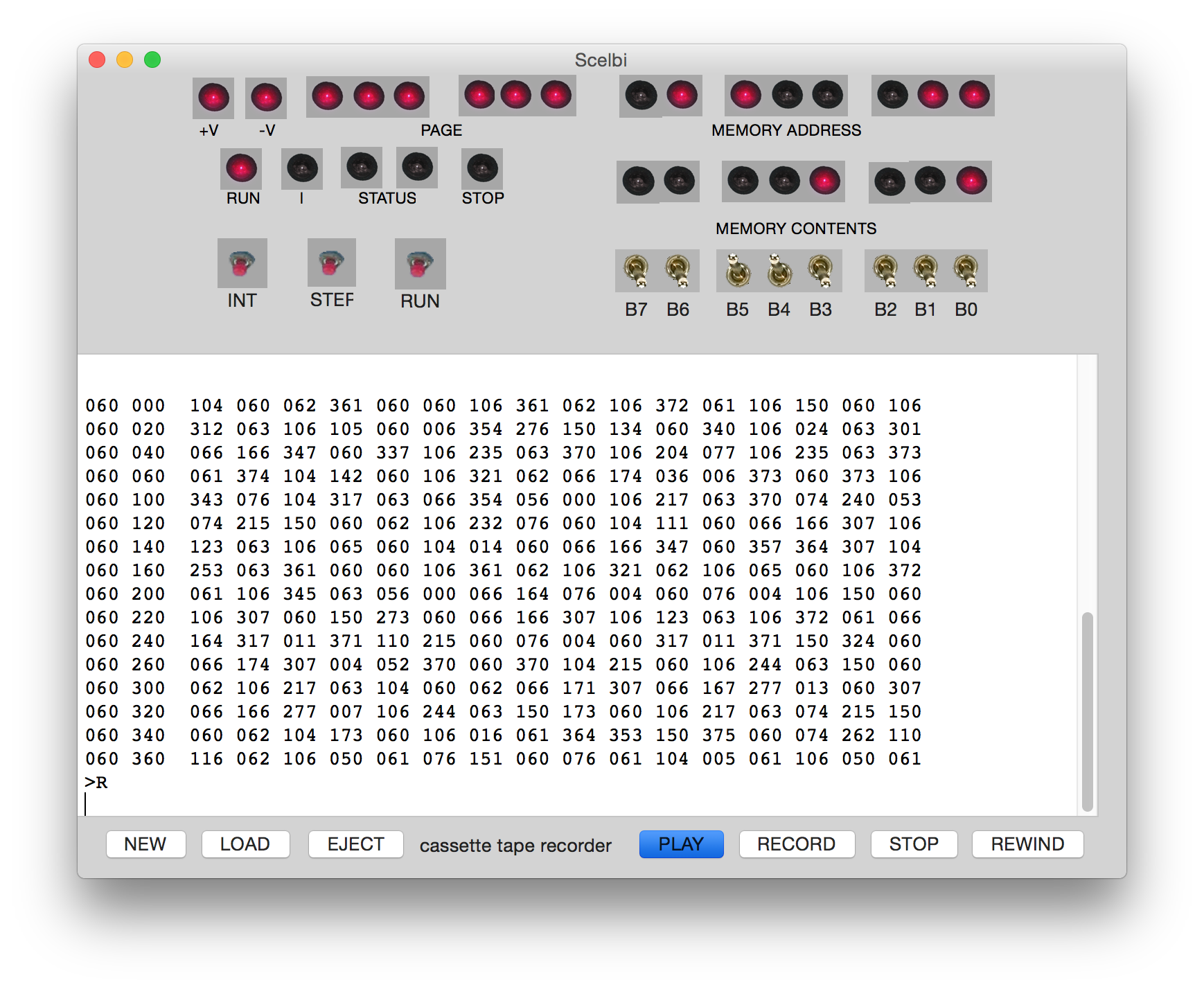
New Version of OS/X Scelbi Emulator Posted

Sunday, June 3rd, 2012

Here is a summary of some of the main changes:

  • Mark Arnold (one of the original authors of SCELBAL) has fixed some mistakes in the version of SCELBAL I was originally using. These mistakes were introduced during the reconstruction of the program.
  • I have made changes to AS8 to support the RST instruction and my interpretation of how OUT port numbering should be implemented. If you are interested in this version, drop me an email.
  • The SCELBI expects that all inputted characters have the high bit set – and starshooter and SCELBAL have been reassembled to match. The power function such as 2^3 did not work in SCELBAL prior to this change.
  • The emulator itself now accurately counts cycles based on information gleaned from the 8008 data sheet. Each cycle takes 2 clocks and instructions take from 3 to 11 cycles. The emulator executes 250,000 cycles per second, same as an actual 8008. I should do some measurements using SCELBAL, but I’ve guessed that an 8008 might execute something like 30,000 instructions per second while running a typical program.
  • This version of the emulator uses port numbers to select serial or byte I/O, so the byte I/O menu has been removed. This effectively emulates a SCELBI with both serial and parallel (BYTE I/O) ports connected.
  • My 8008/SCELBI webpage can be found at this link-
    http://www.willegal.net/scelbi/the8008andScelbi.html

    VCF EAST – May 5th and 6th – Wall, New Jersey

    Friday, March 16th, 2012

    There are going to be some great speakers this year. Make an effort to join the festivities – it’s a great time.

    VCF EAST 2012 flyer

    How do you layout a Scelbi CPU card in 14 seconds?

    Wednesday, February 29th, 2012

    Click here to see it done: Scelbi Layout in 14 Seconds

    first pass SCELBI CPU board alignment started

    Saturday, February 11th, 2012
    Scelbi layout

    Scelbi layout

    This small section looks half-decent after the first pass, but there is a lot of tedious tweaking to follow. The rest of the board, isn’t even close to this standard.

    The CPU board has been a lot of work. The next SCELBI board I’m going to layout will probably be one of the easiest, which is the front panel board.

    Scelbi front panel board

    Scelbi front panel board