Visiting Arlington National Cemetery, August, 1964
November 22nd, 2013Hear Forrest Mimms III talk about what it was like to found MITS
November 21st, 2013I ran across this most excellent podcast the other day. I think you must listen to it, if you are interested in the early days of personal computers or electronics.
If you don’t know, MITS was the company that developed and sold the Altair. Forrest wrote the original documentation for the Altair.
http://www.theamphour.com/171-an-interview-with-forrest-mims-snell-solisequious-scientist/
I only have one book by Forrest, it’s “Engineer’s Mini-notebook: Op Amp IC Circuits”. It’s where I learned about using opamps and though published years ago, it is still relevant.
By the way, the SCELBI, the MARK-8 and possibly some other machines came out before the Altair, so he doesn’t have his facts perfectly right. Certainly the Altair made a huge impact on the hobby, but it wasn’t the first.
SCELBI TTY interface revisited.
November 7th, 2013I finally found time to revisit the SCELBI TTY card. The last time I tried, I had issues getting it to work with my Apple II serial card. To start with, I have been focussed on getting the SCELBI TTY receive interface, running.
Teletypes and the SCELBI TTY card use a current loop interface, which is a technology that I’ve long been aware of, but have had no practical experience with. Instead of using a signal level, current loop uses a current to indicate 1s or 0s. This current can be sourced from either side, but the transmitter will pass on a current of around 20 milliamps to indicate a 0 and a zero to a few milliamps to indicate a 1. The reciever’s circuit in digital equipment will typically convert the current to a voltage level for later processing by a circuit that will deserialize the incoming bit stream.
Here is a crop of the SCELBI TTY schematic showing the RX circuit.
The circuit is pretty simple. At the top is a 5 volt supply, that is current limited by resistor R7 going to the edge connector, pin M. This can be sent to the transmitter as the current source, or can be ignored, if the transmitter has it’s own current source. One of the challenges of using current loop technology is determining which end point sources the current. The SCELBI TTY reciever can support either sourcing the current or not. If the transmitter supports it’s own current source, there must be a ground return path between the SCELBI TTY card and the transmitter.
In the middle, coming in from the edge connector, pin L, is in the input current source. Capacitor C3 acts as a low pass filter, to prevent switching due to incoming noise. I don’t have TTY experience, but I’m assuming that TTYs were very noisy and adding this filter improved reliability. Transistor Q2 acts as a current to level converter. Low levels of incoming current will leave the transistor turned off, allowing +5 voltage source to pull the inputs of NAND gate Z1 high through resistor R1. Higher levels of incoming current will switch on Q2, causing the inputs to Z1 to go low.
During my previous attempt at transmitting from an Apple II serial card to the SCELBI TTY card, I was unable to receive any data. This is despite trying several connection methods.
This time around, I first built a LTspice model of the circuit, including both the Apple II Serial card transmitter and the SCELBI TTY reciever in order to determine theoretical behavior of the circuit. Here is the final schematic that I ended up with.
Since I couldn’t find a model of a 7400 NAND gate used as the output of the TTY card, I modelled it with discrete components. The connections between the boards are simple.
Next I setup a 1000 KHz square wave input into the serial card in order simulate the 2400 baud serial signal that I was trying to send from the Apple II to the SCELBI.
The result shows exactly why I was having trouble.
Once I ran this simulation, it became imediately obvious why I was having trouble. The TTY’s input low pass filter is filtering out the 1000 KHz signal. I confirmed this simulated result with a scope on the actual hardware.
Changing the input signal to a simulation 100 baud (50 Hz) square wave results in the following simulation.
Clearly, if I had run my original test at 110 baud, I would have had better results. I confirmed this, by changing the baud rate on the serial card to 110 and monitoring the output of the TTY card with scope.
Simulation shows that replacing the .1uF capacitor C3 with a .001uF capacitor should enable the circuit to work at 2400 baud, at the cost of much lower noise immunity. I have yet to test this simulated result on actual hardware, but I am pretty confident that it will work.
Next up: I need to check out having SCELBI TTY transmit data to the Apple II serial card. Hopefully that will go a lot smoother than the TTY receive tests.
Mimeo PCBs now available
November 7th, 2013I now have the latest batch of Mimeo PCBs in stock – same price as before – $150 plus shipping.
Send an email to:mike@willegal.net if you need more details about ordering.
More SCELBI Power Supply Information
November 4th, 2013I just made contact with a SCELBI employee, who added some details about the power supplies that SCELI made. The power supply design that I’m talking about, is the one seen in the CHM’s online catalog.
http://www.computerhistory.org/collections/catalog/X714.86A
This is one of no more than 20 that were made. The same design was used for both the 8H and the 8B. The design incorporated 2 standard Power-One linear supplies. A 5 volt version and a 12 volt version. The 12 volt version was modified by SCELBI to produce 9 volts.
The enclosure was lettered with rub on lettering, which was then clear coated with lacquer.
A reproduction white 6502 … and comments on reproductions and fakes…
October 30th, 2013The immediate reason for this post, is that an Apple 1 reproduction now sports a plastic 6502 that has been converted to look like a white ceramic 6502. Details of this conversion can be found on the retro-restore yahoo group. I plan on converting one of my own, as I’m not that excited about the price of real ones. Also be aware that many of the white ceramic 6502s that have recently come to market were pulled from interesting vintage gear, like Kim-1s or arcade games, a practice I have mixed feelings about.
I’ve heard from several people over the years about the risk of reproduction parts and systems being sold as the real thing. As the popularity of the vintage computer hobby and value of the rare vintage systems increases, it is inevitable that new kinds of reproductions will appear.
My position on reproduction components and systems is that they will allow people who couldn’t otherwise afford to operate the real thing to get a better understanding of this vintage technology and have some fun. The closer the reproductions are to the real thing, the more accurate the experience will be and the more we will learn about the original systems and the history of computing. Usage of reproductions instead of originals also saves wear and tear on original systems.
A number people get great enjoyment from making a reproduction that both operates and appears as authentic as possible. This is similar to the enjoyment that skilled craftsman in other hobbies get from their efforts to make life size and scale reproductions of everything from stone tools to railroad empires. We should enjoy our hobby and marvell at the skill some of our friends, who go the extra mile to make their creations as accurate as they can.
One of the favorite things that I have heard during a VCF event, was when one visitor commented that he never thought he would ever get to operate an Apple 1. Of course he was operating a Mimeo, but to that visitor, it didn’t matter that it was a reproduction. So reproductions can give enjoyment not only to hobbyist, but to visitors to our hobby.
The best thing that can be done to defend ourselves from fakes, is to be made aware of the possibilities and educate ourselves as much as possible. This is one reason why I created the Apple 1 Registry. In this respect, I think the registry has been a success, as, since the registy’s creation, I am unaware of anyone trying to pass off a fake Apple 1 as real. However, be aware that some time ago, there was an attempt on eBay to pass off an Obtronix Apple 1 clone as the real thing, so I will not be surprised when it happens again.
A beautiful Apple 1 (and more) up for Auction
October 29th, 2013This Apple 1 motherboard is in fantastic condition for a 37 year old computer and includes most of the original add ons that you would want, including an original box and documentation. It is listed in my registry as “Framed #4″.
http://www.breker.com/ReadMore/
There are also a few other gems for sale, including a twiggy Macintosh, a Lisa 1, a SOL 20 and an Altair. I have a catalog of the auction scheduled for November 16th and it is filled with many other interesting vintage toys, scientific instraments and more.
I had the pleasure of meeting with the Brecker’s for a couple of hours back in August while they were on a business trip to the United States. It was very interesting to talk to them and I really wish them further success with their technology auctions.
By the way, I need to update the registry. People have continued to fix up their Apple 1s, so I’ve got a more up to date image of one unit that received some serious love over the last few months. I also need to add couple of new Apple 1s. I forgot to add the one in the history San Jose museum during last update and another one came to my attention immediately after the last update. Finally, I figured that units that are discussed in either Tom Owad’s book “Back to the Garage”, or Bob Luther’s “The First Apple”, should have that called out in the registry listing.
Next batch of Mimeos are on order
October 26th, 2013They are do to arrive around the first week of November.
People in History with Narcissistic Behavior that Acheived Great Things
October 25th, 2013I finally read Isaacson’s book on Steve Jobs and got to thinking about his narcissistic behavior. Though living around this sort of person is extremely difficult, he achieved great things. The question I have, was his narcissistic behavior part of what made him so successful or was this behavior something he had to overcome to achieve success?
Here are some other examples of narcissistic people that achieved great things.
Greek King Alexander the Great
Roman Emperor Caesar Augustus
French Emperor Napoleon Bonaparte
United States General Stonewall Jackson
United States Entrepreneur Henry Ford
United States General George Patton
United States Entrepreneur Steve Jobs
I’m omitting people that had narcissistic behavior that caused great harm to society, that will be another list.
Can you think of others?
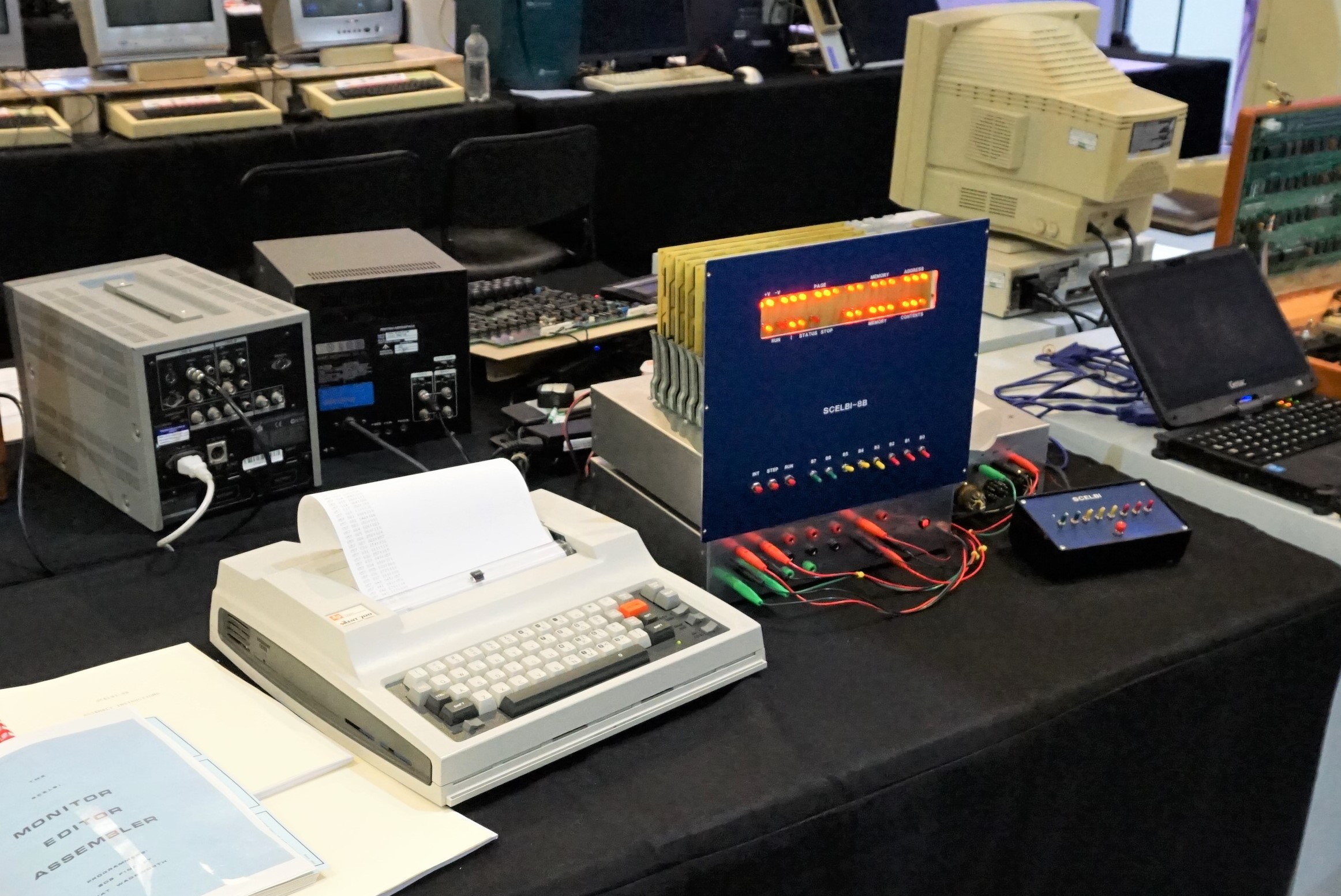
SCELBI 8H is now capable of running BASIC!
October 18th, 2013Thanks to Mark Arnold, who stripped down SCELBAL to the barest fundamental elements, I now have BASIC running on a 4K SCELBI 8H for the first time, ever. Mark, who created SCELBAL back in the mid 70’s calls his new stripped down version of BASIC, “tiny SCELBAL”. He removed all non-essential features, including support for floating point math in order to make it fit into 4K. There are only about 350 bytes for program space left in a 4K SCELBI 8H, but that is enough for some very simple games. I have ported a version of HILO from Ahl’s “BASIC COMPUTER GAMES” book, and made it fit. I’ll be making a video, posting source and object files very soon. I’ll also post the source of HILO and describe some space saving tricks.
Mark says SCELBI considered doing this back in the 70’s, but determined the result would be too limited to be useful for most practical purposes.